कोशिश गोल्ड - मुक्त
How to find a speck in space
BBC Sky at Night Magazine
|October 2025
New Horizons proves stellar parallax can locate a probe in the vastness, using the light of just two stars
-
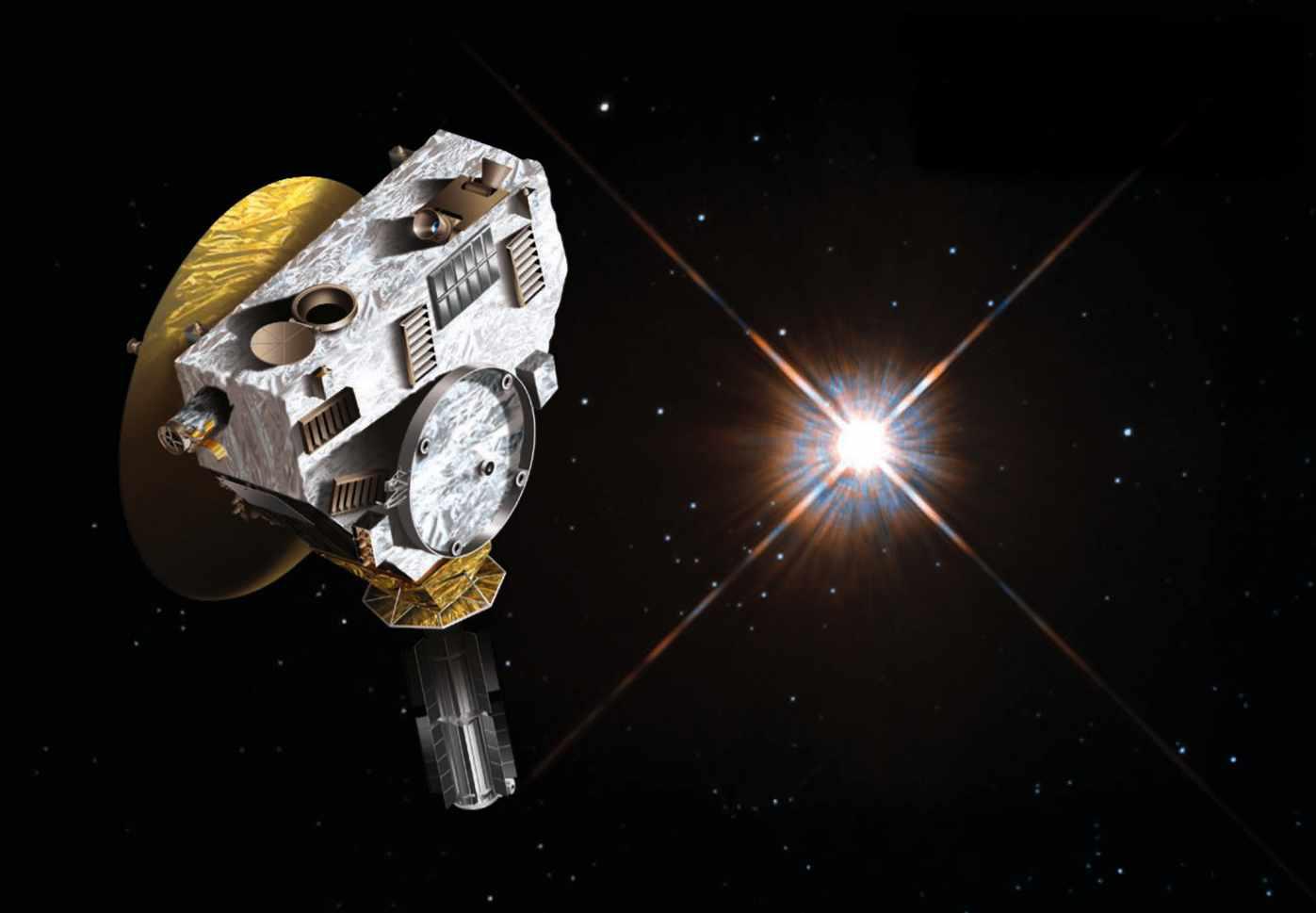
New Horizons was the first mission sent to explore Pluto, conducting a fly-by in July 2015. It was then redirected for a close pass of a much smaller Kuiper Belt object, Arrokoth, in January 2019. Today, it's over 61 AU away - almost twice as distant as Pluto - and racing from the Sun at around 50,000km/h (31,000mph), meaning that it covers the equivalent of the Earth-Sun distance every four months.
It's the fifth robotic spacecraft that we humans have launched on an escape trajectory that will ultimately leave the Solar System altogether and enter interstellar space. Indeed, the craft is already so remote that nearby stars appear to shift in position when viewed from the spacecraft, compared to how we see them from Earth. This displacement in the apparent position of objects seen from two vantage points is known as parallax. You can create this effect for yourself with a simple experiment: hold a finger at arm's length and alternate closing each eye. The finger appears to jump back and forth against the more distant background, because each eye sees it from a slightly different angle.
Tod Lauer, at the NSF National Optical-Infrared Astronomy Research Laboratory in Tucson, Arizona, led a team of 53 coauthors from 46 institutions to demonstrate stellar parallax between New Horizons and Earth. They did this by coordinating the probe to photograph two nearby stars with images taken simultaneously from ground-based observatories.

यह कहानी BBC Sky at Night Magazine के October 2025 संस्करण से ली गई है।
हजारों चुनिंदा प्रीमियम कहानियों और 10,000 से अधिक पत्रिकाओं और समाचार पत्रों तक पहुंचने के लिए मैगज़्टर गोल्ड की सदस्यता लें।
क्या आप पहले से ही ग्राहक हैं? साइन इन करें
BBC Sky at Night Magazine से और कहानियाँ

BBC Sky at Night Magazine
Crush: Close Encounters with Gravity
Gravity is something that we're all innately familiar with. It keeps our feet on the ground, fights against a rocket trying to leave Earth and governs the movement of the planets and stars.

1 mins
April 2026
BBC Sky at Night Magazine
Exploring the Universe
There's no shortage of children's books about astronomy.
2 mins
April 2026
BBC Sky at Night Magazine
Make your Milky Way images pop
Simple, free processing techniques using FastStone Image Viewer
3 mins
April 2026

BBC Sky at Night Magazine
Nightfaring: In Search of the Disappearing Darkness
This book is a manifesto for dark skies, written as a travel memoir.
1 mins
April 2026
BBC Sky at Night Magazine
Flying saucers- The making of a modern myth
Our obsession with UFOs goes back further than you might think. Robert Pateman traces how early science fiction, dubious sightings and an alien-mad media led to the 1950s saucer fever
9 mins
April 2026
BBC Sky at Night Magazine
STAR OF THE MONTH
Alphecca, the brightest jewel in the Crown
1 min
April 2026

BBC Sky at Night Magazine
How to use a planisphere
Navigate the sky with the original stargazer's tool. No batteries, apps or Wi-Fi required!
3 mins
April 2026
BBC Sky at Night Magazine
Why rockets don't launch straight up
For a rocket to get its payload into space, it has to follow a curved path. But what would happen if it didn't?
2 mins
April 2026
BBC Sky at Night Magazine
Q&A WITH A DARK MATTER SPECIALIST
Dark matter makes up 27 per cent of all matter in the Universe. So why is it so hard to find? Meet one of the people making a map that leads us to it
3 mins
April 2026

BBC Sky at Night Magazine
Why I want to put a hotel on the Moon
Bored of the beach? Sick of city breaks? Step this way. Space entrepreneur Skyler Chan explains how he'll build a holiday destination on the Moon by 2030
2 mins
April 2026
Listen
Translate
Change font size