Versuchen GOLD - Frei
Hearing the cosmos
BBC Sky at Night Magazine
|January 2026
Space isn't silent. What happens when we listen to the Universe as well as look? Paul Fisher Cockburn explores how sonification - turning data into sound unlocks new ways for us to understand the cosmos.
-
Movie posters for the classic 1979 horror film Alien warned us: "In space no one can hear you scream." And while it's true that sound can't travel through a vacuum, it doesn't follow that the Universe is quiet - or that we can't learn a lot by keeping our ears open. In fact, listening in to the mysteries of the cosmos gives us new insights that our eyes can't reveal. That's why in October 2025, scientists from around the world, and across several different disciplines, met at a workshop hosted by New York's research-focused Flatiron Institute. Titled 'Sonification for Research: Techniques, Efficacy, and Applications (SoniTEA)', its aim was to push forward the practice of sonification - using sound to represent data, especially as a research tool.
One of the workshop's organisers was Michael Petersen, currently a Stephen Hawking Fellow based at the University of Edinburgh. "We're just so used to interpreting things with our eyes - graphs, figures and images - that we've kind of developed a habit of not doing it with our ears," he says. As he points out, though, listening for information is something we have been doing, in certain situations, for more than A century. One early example of sonification technology is the Geiger-Müller counter. Who isn't familiar with the eerie clicks used to represent the dangerous ionising radiation it's detecting?
Petersen is understandably enthusiastic about the potential of sonification, but accepts not everyone has the same goal. “For the most part, people aren't looking to replace visuals with sound,” he explains. “You do want sonification to be a complete data representation without sight, because that ticks the accessibility boxes - that's very important. But I think you should be approaching it in an augmented way, not as a pure replacement.”

Diese Geschichte stammt aus der January 2026-Ausgabe von BBC Sky at Night Magazine.
Abonnieren Sie Magzter GOLD, um auf Tausende kuratierter Premium-Geschichten und über 9.000 Zeitschriften und Zeitungen zuzugreifen.
Sie sind bereits Abonnent? Anmelden
WEITERE GESCHICHTEN VON BBC Sky at Night Magazine
BBC Sky at Night Magazine
The Giant Leap: Why Space is the Next Frontier in the Evolution of Life
“Earth is the cradle of humanity, but one cannot live in the cradle forever,” wrote Konstantin Tsiolkovsky in 1911.

1 mins
February 2026
BBC Sky at Night Magazine
Tele Vue Nagler Type-7 series eyepieces
These premium optics were inspired by Apollo - and deliver a giant leap to your views
4 mins
February 2026
BBC Sky at Night Magazine
Once Upon a Time in Space
While the Space Race of the Cold War years was ultimately a geopolitical contest between the USA and the Soviet Union, the rivalry sparked rapid innovation and inspired multiple generations to look skyward.
1 mins
February 2026
BBC Sky at Night Magazine
The Multiverse: When One Universe Isn't Enough
The concept of a 'multiverse' – the idea that our Universe may be just one of many – is widespread in science fiction and a common thread of online discussions.
1 mins
February 2026
BBC Sky at Night Magazine
Q&A WITH A GAMMA RAY SPECIALIST
In 2025, astronomers detected a blast from space that lasted seven hours. Now they're uncovering the strange processes behind the exceptional outburst
3 mins
February 2026
BBC Sky at Night Magazine
Astronomy Photographer of the Year
The world-leading astrophotography competition returns. Could your image take the top prize of £10,000?
2 mins
February 2026
BBC Sky at Night Magazine
MOONWATCH
February's top lunar feature to observe
2 mins
February 2026
BBC Sky at Night Magazine
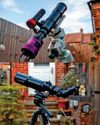
NOVAStar Scarlet A62Q 62mm f/8.4 quadruplet achromatic refractor
Well-built and capable, this beginner scope punches well above its bargain price
4 mins
February 2026
BBC Sky at Night Magazine
STAR OF THE MONTH
Rasalas, Leo the Lion's metal-rich crown
1 min
February 2026
BBC Sky at Night Magazine
Comet 24P/Schaumasse
Having reached perihelion on 8 January, comet 24P/ Schaumasse is now fading. Starting the month at a small-telescope-friendly mag. +10.5, it dims throughout February to below 12th magnitude.
1 min
February 2026
Listen
Translate
Change font size