
Mit Magzter GOLD unbegrenztes Potenzial nutzen
Erhalten Sie unbegrenzten Zugriff auf über 9.000 Zeitschriften, Zeitungen und Premium-Artikel für nur
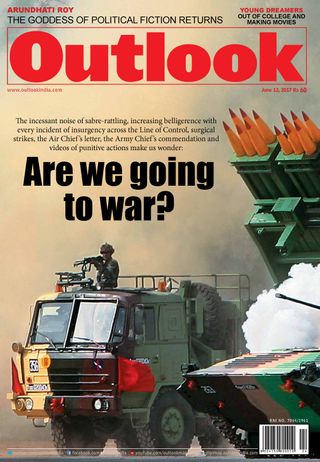
Are We Going To War?
Outlook
|June 12, 2017
The Indian Army is more than a match for its Pakistani counterpart, but tardy modernisation means it has little punching power. Plus, there dangles the threat of a nuclear response.

The last point made in the controversial interview given by Indian Army (IA) chief General Bipin Rawat was his belief that ‘limited war’ with Pakistan was not likely. In this point at least, the general is not beating the drums of war, though the same cannot be said of some of his colleagues like Air Force chief B.S. Dhanoa, who directed the IAF to be ready for a short-duration war with Pakistan last month. The key and simple lesson of the many wars of history is that it is easy to start them, but very hard to figure out how they will end. Ask the Germans in 1939, the Japanese in 1941, or, for that matter, the Pakistanis in 1965. When it comes to war, there are simply too many independent variables at play.
It is important to reflect on this, considering the rising temperatures in Jammu & Kashmir, where the Indian Army’s corporate belief is that it is involved in a proxy war with Pakistan. The Army may be sanguine that war with Pakistan is not around the corner, but the same cannot be said of the social media or the jehadi anchors who, in the absence of a coherent government policy, influence policy in an unconscionable manner.
On paper, the Indian military vastly outnumbers its Pakistani counterpart both quantitatively and qualitatively. India’s army is 12 lakh strong, compared to Pakistan’s 6,50,000. The IA has 4,000 tanks, including 1,600 T 90s, while the Pakistan Army (PA) has some 650 MBTs and 1,000 second-line tanks. The difference is even more marked in the case of the Air Forces and the Navies.

Diese Geschichte stammt aus der June 12, 2017-Ausgabe von Outlook.
Abonnieren Sie Magzter GOLD, um auf Tausende kuratierter Premium-Geschichten und über 9.000 Zeitschriften und Zeitungen zuzugreifen.
Sie sind bereits Abonnent? Anmelden
WEITERE GESCHICHTEN VON Outlook

Outlook
The Big Blind Spot
Caste boundaries still shape social relations in Tamil Nadu-a state long rooted in self-respect politics

8 mins
December 11, 2025

Outlook
Jat Yamla Pagla Deewana
Dharmendra's tenderness revealed itself without any threats to his masculinity. He adapted himself throughout his 65-year-long career as both a product and creature of the times he lived through
5 mins
December 11, 2025

Outlook
Fairytale of a Fallow Land
Hope Bihar can once again be that impossibly noisy village in Phanishwar Nath Renu's Parti Parikatha-divided, yes, but still capable of insisting that rights are not favours and development is more than a slogan shouted from a stage
14 mins
December 11, 2025

Outlook
The Lesser Daughters of the Goddess
The Dravidian movement waged an ideological war against the devadasi system. As former devadasis lead a new wave of resistance, the practice is quietly sustained by caste, poverty, superstition and inherited ritual
2 mins
December 11, 2025

Outlook
The Meaning of Mariadhai
After a hundred years, what has happened to the idea of self-respect in contemporary Tamil society?
5 mins
December 11, 2025

Outlook
When the State is the Killer
The war on drugs continues to be a war on the poor
5 mins
December 11, 2025

Outlook
We Are Intellectuals
A senior law officer argued in the Supreme Court that \"intellectuals\" could be more dangerous than \"ground-level terrorists\"
5 mins
December 11, 2025

Outlook
An Equal Stage
The Dravidian Movement used novels, plays, films and even politics to spread its ideology
12 mins
December 11, 2025
Outlook
The Dignity in Self-Respect
How Periyar and the Self-Respect Movement took shape in Tamil Nadu and why the state has done better than the rest of the country on many social, civil and public parameters
5 mins
December 11, 2025

Outlook
When Sukumaar Met Elakkiya
Self-respect marriage remains a force of socio-political change even a century later
7 mins
December 11, 2025
Translate
Change font size