कोशिश गोल्ड - मुक्त
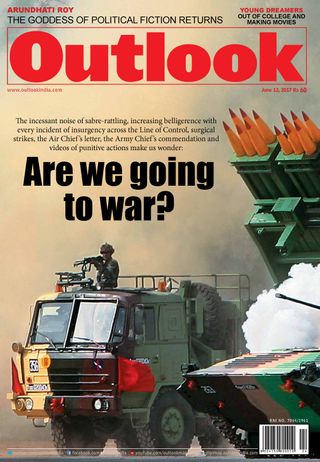
Are We Going To War?
Outlook
|June 12, 2017
The Indian Army is more than a match for its Pakistani counterpart, but tardy modernisation means it has little punching power. Plus, there dangles the threat of a nuclear response.

The last point made in the controversial interview given by Indian Army (IA) chief General Bipin Rawat was his belief that ‘limited war’ with Pakistan was not likely. In this point at least, the general is not beating the drums of war, though the same cannot be said of some of his colleagues like Air Force chief B.S. Dhanoa, who directed the IAF to be ready for a short-duration war with Pakistan last month. The key and simple lesson of the many wars of history is that it is easy to start them, but very hard to figure out how they will end. Ask the Germans in 1939, the Japanese in 1941, or, for that matter, the Pakistanis in 1965. When it comes to war, there are simply too many independent variables at play.
It is important to reflect on this, considering the rising temperatures in Jammu & Kashmir, where the Indian Army’s corporate belief is that it is involved in a proxy war with Pakistan. The Army may be sanguine that war with Pakistan is not around the corner, but the same cannot be said of the social media or the jehadi anchors who, in the absence of a coherent government policy, influence policy in an unconscionable manner.
On paper, the Indian military vastly outnumbers its Pakistani counterpart both quantitatively and qualitatively. India’s army is 12 lakh strong, compared to Pakistan’s 6,50,000. The IA has 4,000 tanks, including 1,600 T 90s, while the Pakistan Army (PA) has some 650 MBTs and 1,000 second-line tanks. The difference is even more marked in the case of the Air Forces and the Navies.

यह कहानी Outlook के June 12, 2017 संस्करण से ली गई है।
हजारों चुनिंदा प्रीमियम कहानियों और 10,000 से अधिक पत्रिकाओं और समाचार पत्रों तक पहुंचने के लिए मैगज़्टर गोल्ड की सदस्यता लें।
क्या आप पहले से ही ग्राहक हैं? साइन इन करें
Outlook से और कहानियाँ

Outlook
'Why GDP Growth Doesn't Always Translate Into Votes'
The recent election results have once again shown that economic growth alone does not guarantee electoral victory.

3 mins
June 06, 2026

Outlook
Lights, Camera, Othering
The establishment of Israel has been accompanied by a national cinema devoted to negating and erasing the Palestinian Other
5 mins
June 06, 2026

Outlook
Goodbye to All That
Booker-winning British author Julian Barnes' Departure(s) is a unique hybrid work: playful, philosophical, whimsical
4 mins
June 06, 2026

Outlook
Collapse of Trust
As the NEET-UG 2026 paper leak forced the cancellation of India’s biggest medical entrance exam, more than 22 lakh aspirants find themselves trapped in uncertainty
11 mins
June 06, 2026

Outlook
NO LONGER A TWELFTH MAN
Bihar cricket, which has languished in the shadows for long, is all set to improve its strike rate, thanks to Vaibhav Sooryavanshi, the new Bihari kid on the block
5 mins
June 06, 2026

Outlook
BLAZE OF GLORY
The challenges of being a celebrity cricketer at a young age can be tough to handle
5 mins
June 06, 2026

Outlook
THE SWASHBUCKLERS
A new generation of fearless stars is emerging and finding its feet at the very top of an extremely competitive cricketing environment
5 mins
June 06, 2026

Outlook
THE TEEN TORNAD
At the age of 15, Vaibhav Sooryavanshi is already a cricketing legend
10 mins
June 06, 2026

Outlook
A Journey to Remember
The prerecorded message crackled over the din in the compartment: ‘Welcome to the Shatabdi Express.
4 mins
June 06, 2026

Outlook
Crossing Borders
Ruth Martin is the translator of German-Iranian author Shida Bazyar’s novel The Nights are Quiet in Tehran (originally written in German), which has been shortlisted for the 2026 International Booker Prize.
4 mins
June 06, 2026
Translate
Change font size