Versuchen GOLD - Frei
All At Sea
New Zealand Listener
|November 17 - 23 2018
Rising seas will overwhelm many of our coastal regions unless we move fast. Whether to protect or retreat from low-lying areas – either option carries considerable economic, social and environmental costs and it’s a debate communities cannot tackle in isolation.

We are good at sensing danger. Some dangers anyway. Faced with a guy with a knife or an animal with big teeth, says climate change commentator Jeff Goodell, we humans have evolved to defend ourselves, “but we are not wired to prepare for the barely perceptible threats that gradually accelerate over time”.
Such as sea-level rise, writes Goodell, in his prosaically titled The Water Will Come: Rising Seas, Sinking Cities, and the Remaking of the Civilized World. With the rising tide already gnawing at coastal regions around the globe, by the end of this century, hundreds of millions of people will be forced to retreat inland, “but that is the part no one wants to talk about.”
Goodell, a contributing editor at Rolling Stone magazine, is the author of several critically acclaimed books on climate change and energy issues and was in New Zealand earlier this year. He gives the example of the small settlement of Broad Channel in New York. Families have lived there since the 1920s. They swim, they fish, they have a great view of lower Manhattan. Come hell or high water, the residents are not going to leave their homes. But high water it will be. Low-lying Broad Channel was one of the most heavily damaged areas of the city when Hurricane Sandy hit in 2012 and is swamped regularly by tidal flooding and storm surges that will only get worse.
“But they love where they live and the whole notion of getting up and going somewhere else is very hard,” says Goodell from his home in upstate New York. “Even people who understand climate change still think sea-level rise is a slow, gradual thing and they can build a seawall that will be fine for X number of years and this is a remedy for the problem.” It’s not.
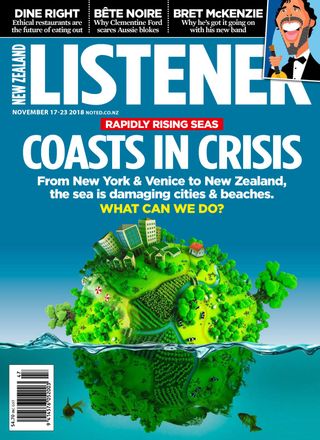

Diese Geschichte stammt aus der November 17 - 23 2018-Ausgabe von New Zealand Listener.
Abonnieren Sie Magzter GOLD, um auf Tausende kuratierter Premium-Geschichten und über 9.000 Zeitschriften und Zeitungen zuzugreifen.
Sie sind bereits Abonnent? Anmelden
WEITERE GESCHICHTEN VON New Zealand Listener
New Zealand Listener
Hum dinger
The year's NZ music books have a high-volume encore.

2 mins
December 20-26, 2025
New Zealand Listener
Slap the slop this summer
2025 was the year Al slop oozed into every corner of the internet. I'm taking the summer to go cold turkey.
2 mins
December 20-26, 2025
New Zealand Listener
Shelling out
Eggshells are a great source of calcium, but think again if you're contemplating adding them to your diet.
2 mins
December 20-26, 2025

New Zealand Listener
Heavyweight division
Mark Broatch checks out the year's best coffee table books.
3 mins
December 20-26, 2025

New Zealand Listener
As bad as it gets
Veteran filmmaker wide of the mark in dated political comedy drama.
1 mins
December 20-26, 2025

New Zealand Listener
Inspect a gadget
The 10 best tech upgrades of 2025.
4 mins
December 20-26, 2025

New Zealand Listener
To absent friends
A search of Listener issues from ages past reveals the lack of classy wines was long lamented.
2 mins
December 20-26, 2025

New Zealand Listener
That thinking feeling
Far from being emotionally driven, gut feelings can help us to make the best decisions, says a US expert on entrepreneurialism.
9 mins
December 20-26, 2025
New Zealand Listener
Diamonds in the rough
In a year in which our usual sources of sporting pride stumbled, some unlikely heroes sparkled.
7 mins
December 20-26, 2025

New Zealand Listener
Thai up
Rocker Jimmy Barnes and wife Jane deliver seasonal recipes with an accent on Southeast Asia.
4 mins
December 20-26, 2025
Translate
Change font size