
Mit Magzter GOLD unbegrenztes Potenzial nutzen
Erhalten Sie unbegrenzten Zugriff auf über 9.000 Zeitschriften, Zeitungen und Premium-Artikel für nur
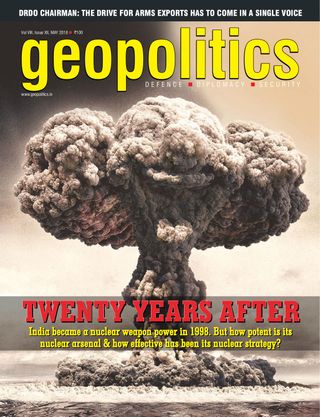
Revisiting India's Nuclear Doctrine
Geopolitics
|May 2018
In its manifesto for 2014 general elections, the Bharatiya Janata Party (BJP) has promised to review India’s nuclear doctrine. But does India really have a proper nuclear doctrine in strict sense of the term? Not really. Therefore, it is time to have one

Answering a question at a bookrelease function on November 10, 2016, the then Defence Minister Manohar Parrikar counter-questioned why the country’s policy of “No First Use” (NFU) of its nuclear weapons should not change. Many analysts overreacted by saying that India had changed its nuclear doctrine.
The problem with these reactions was that those were based on a halftruth. Parrikar was asking a question, not answering. The other half of the truth was that in the same counterquestion, Parrikar had made it absolutely clear that what he was saying was his personal opinion and that it was not the viewpoint of the government of India. He had reiterated that India’s nuclear policy remained unchanged under the Modi government.
Global arrangements or regimes are based on the declared policies of the governments of the member-states, not on the individual pronouncements of ministers and ruling party members. In fact, in its manifesto of the 2014 general elections, the Bharatiya Janata Party (BJP) had promised to review India’s nuclear doctrine. But has it prevented countries like Australia, Canada and now Japan entering nuclear pacts with the Modigovernment?
However, in my considered view there are enough reasons why the Modi government should go for a formal review of the country’s NFU policy. Let me explain why. In the strict sense of the term, India does not have a proper nuclear doctrine. It is, perhaps, a part of our strategic culture to keep things and policies as ambiguous as possible, leaving them to many and different interpretations.

Diese Geschichte stammt aus der May 2018-Ausgabe von Geopolitics.
Abonnieren Sie Magzter GOLD, um auf Tausende kuratierter Premium-Geschichten und über 9.000 Zeitschriften und Zeitungen zuzugreifen.
Sie sind bereits Abonnent? Anmelden
WEITERE GESCHICHTEN VON Geopolitics

Geopolitics
JOINTNESS TO REDEFINE MARITIME AIR POWER
The buzzword in New Delhi is multidomain warfare, which involves a high level of jointness between the three services. As mentioned in the last issue of Geopolitics (November 2025), jointness takes time and requires a large investment by the government in weapons systems, sensors, and training. But sensible and easy steps can be taken, especially in the maritime sphere, to integrate the Coast Guard, Air Force, and Navy into a potent force to safeguard the Arabian Sea and the Bay of Bengal, argues AMIT GUPTA

8 mins
December 2025

Geopolitics
THERMAL IMAGING AND BALLISTIC PROTECTION DRIVE SOLDIER MODERNISATION
Contemporary defence modernisation prioritises integrated soldier systems blending advanced thermal imaging with lightweight multi-hit ballistic protection, meeting demands for superior low-visibility awareness and survivability against evolving threats. India's indigenous manufacturing push aligns with Atmanirbhar Bharat, enhancing national security. A special report
5 mins
December 2025
Geopolitics
INDIA'S NEW HIGH-ALTITUDE PIVOT NEAR THE CHINA BORDER
Just kilometres from the LAC, India has activated one of the world's highest military airfields, a dramatic shift in Ladakh's strategic landscape. The Mudh-Nyoma airbase, now fully operational, signals faster mobility, sharper surveillance and a renewed posture along a frontier where infrastructure has become the new currency of power.
2 mins
December 2025
Geopolitics
THE MARITIME MAKEOVER
JOSEPH P CHACKO analyses the transforming role of the Indian Navy as an indigenous force multiplier, a modern blue-water fleet, and a crucial instrument in shaping India's emergence as an integral Indo-Pacific power
17 mins
December 2025

Geopolitics
GUARDING THE RIM
India's post-26/11 coastal security system boasts radars, patrol boats and new laws - yet beneath the optics lie old weaknesses. Training gaps, stranded infrastructure, jurisdictional clutter and climate stress continue to erode readiness.VISHAL DUGGAL reports
9 mins
December 2025

Geopolitics
SAGAR DEFENCE INAUGURATES PUNE FACILITY
Defence Engineering Pvt. Ltd has inaugurated its new plant in Pune, India. The plant will manufacture Uncrewed Surface Vehicles (USVs), marking a major step forward in the partnership with Liquid Robotics, a Boeing company, that was announced earlier this year to co-develop and co-produce advanced maritime systems.
2 mins
December 2025

Geopolitics
COCHIN SHIPYARD: THE COUNTRY'S SOLE AIRCRAFT CARRIER BUILDER
India is getting ready to add another aircraft carrier that will be nuclear-powered to its fleet, joining INS Vikramaditya and INS Vikrant. SUBHANGI PALVE takes a look at the only shipyard in the country to have built one.
7 mins
December 2025

Geopolitics
ICEYE'S BLUEPRINT FOR THE NEXT FRONTIER
ICEYE's fusion of miniaturised satellites, AI, and agile manufacturing transforms geospatial power, enabling nations to swiftly understand, decide, and act for strategic foresight, disaster preparedness, and security through real-time Earth Observation. A Special Report
4 mins
December 2025

Geopolitics
A report that calls for action
The Parliamentary Standing Committee on External Affairs has concluded that India’s current Indian Ocean strategy is fragmented, under-resourced, and insufficiently coordinated to meet accelerating geopolitical, security, and environmental challenges, especially China's expanding presence.
3 mins
December 2025

Geopolitics
SHOW STOPPER
The 19th edition of the Dubai Airshow recorded deals worth a historic USD 202 billion, but was marred by the unfortunate fatal crash of an IAF Tejas fighter jet. ATUL CHANDRA reports
10 mins
December 2025
Translate
Change font size