Versuchen GOLD - Frei
How Sharp Is Your Hearing?
Woman & Home
|August 2017
We expect our eyes to change with age but hearing is often ignored. Victoria Lambert asks Professor Chris Raine, a Consultant ENT surgeon at Bradford Royal Infirmary, for advice
-

Whether it’s for listening to Adele, traffic noise, birdsong – or just a friend’s voice, we’d all be lost without our hearing. Yet, as we age, it can be harder to catch sounds. And once we reach midlife, hearing problems are increasingly likely; 40% of over fifties have some level of presbycusis, or age-related hearing loss.
Yet most of us shy away from hearing tests. Deafness has long carried a stigma thanks to fears of being treated differently. Old-style hearing aids – large and unsightly – have a lot to answer for, but so do comedy programmes, which equate deafness with being grumpy or less intelligent.
Meanwhile, there are plenty of new ways to protect our hearing, and if necessary, support or enhance it, from cochlear implants to tiny digital hearing aids. On the horizon, research is being conducted to discover how to regrow the hairs in the middle ear where damage to hearing occurs.
What causes hearing loss?
High frequencies are typically affected first – think of “cocktail party deafness” when you struggle to follow conversations where there’s background noise. Most commonly loss of hearing is due to age-related damage affecting the tiny inner ear hair cells within part of the ear called the cochlea, or the hearing nerve (or both), and is called sensorineural hearing loss. Less common infections such as measles, mumps, rubella and meningitis can be to blame, or a traumatic event such as a car accident or a blow to the head.
Certain drugs such as types of chemotherapy and antibiotics called aminoglycosides are also known to damage the hair cells. Researchers at Washington State University in the US have developed a drug called Dihexa, which may be able to prevent the hair cell loss caused by aminoglycoside treatment and all toxic medications.
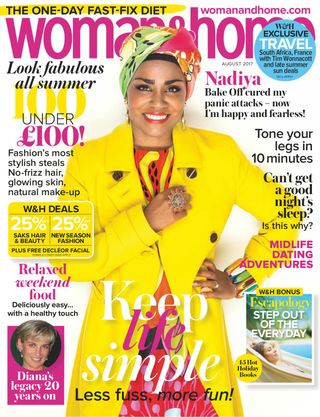

Diese Geschichte stammt aus der August 2017-Ausgabe von Woman & Home.
Abonnieren Sie Magzter GOLD, um auf Tausende kuratierter Premium-Geschichten und über 9.000 Zeitschriften und Zeitungen zuzugreifen.
Sie sind bereits Abonnent? Anmelden
WEITERE GESCHICHTEN VON Woman & Home
Woman & Home UK
BEING GRATEFUL FOR THE NOW
Living for the moment can make a big difference.

2 mins
February 2026

Woman & Home UK
IT'S NEVER TOO LATE TO...
Stuck in a rut when it comes to your health? Here's how to make a positive shift
3 mins
February 2026

Woman & Home UK
In conversation with JANE FALLON
The contemporary fiction writer talks to Zoe West
3 mins
February 2026
Woman & Home UK
Your HEALTH
Got a medical problem or need health advice? Ask GP Dr Amir Khan
4 mins
February 2026

Woman & Home UK
EVERYONE'S TALKING ABOUT The Winter Olympics and Paralympics
This February, the Olympic Winter Games Milano Cortina 2026 will take over northern Italy, as athletes from around the world go for gold.
1 mins
February 2026

Woman & Home UK
Dream stays
Sleep retreats are gaining popularity, says Alicia Miller. So if your night-times aren't what they used to be, here's her pick of the best restorative breaks
4 mins
February 2026
Woman & Home UK
Is fresh ALWAYS BEST?
You may be surprised to learn that frozen food - and even tinned - can be just as healthy
3 mins
February 2026

Woman & Home UK
Minding our MANORS
If a three-bed semi keeps you busy, imagine what it's like to live in a stately home or maintain a vast garden
6 mins
February 2026
Woman & Home UK
How to bounce back from REDUNDANCY
Advice on navigating the emotional and practical impact
5 mins
February 2026

Woman & Home UK
Kindness THE GIFT everyone can gwe give
Looking to reduce life's stresses? Discover the power of doing good
2 mins
February 2026
Translate
Change font size