
استمتع بـUnlimited مع Magzter GOLD
احصل على وصول غير محدود إلى أكثر من 9000 مجلة وصحيفة وقصة مميزة مقابل
يحاول ذهب - حر
WHY SOVEREIGN DEBT RISING IN DEVELOPING WORLD?
July 01, 2025
|Down To Earth
Biased sovereign credit ratings and steep interest rates are at work
-
THE ANSWER to this question is often traced to the oil price rise of the 1970s, which resulted in a financial squeeze in oil-importing developing countries. Arab oil wealth was deposited in Western bank vaults. These “petrodollars” provided much of the cash lent to borrowers in the developing world. This was also advantegeous to the Western economies. “Recycling” oil money to the developing world meant that they could keep buying Western exports, despite bigger oil bills, and thus help keep numerous factories in Europe and North America open, staving off a descent into recession. During the 1970s, private commercial banks in the West began to overtake official lenders. At the height of their lending in 1982, banks were lending $63 billion a year to the developing world, nearly twice the amount lent by official government sources. The economies of several borrowing countries grew rapidly during the 1970s. But the 1980s saw a recession in industrialised countries. Economic activities slowed down and interest rates on bank loan went up. Developing countries which could not pay their earlier loans now had to take more and more loans just to pay interest on the loan they had taken. An example of this vicious debt trap is Brazil; between 1972 and 1988, the nation paid $176 billion as interest on a debt of $124 billion to industrialised countries.
Cut to the 2020s. The situation has not changed much in the past 40-odd years.
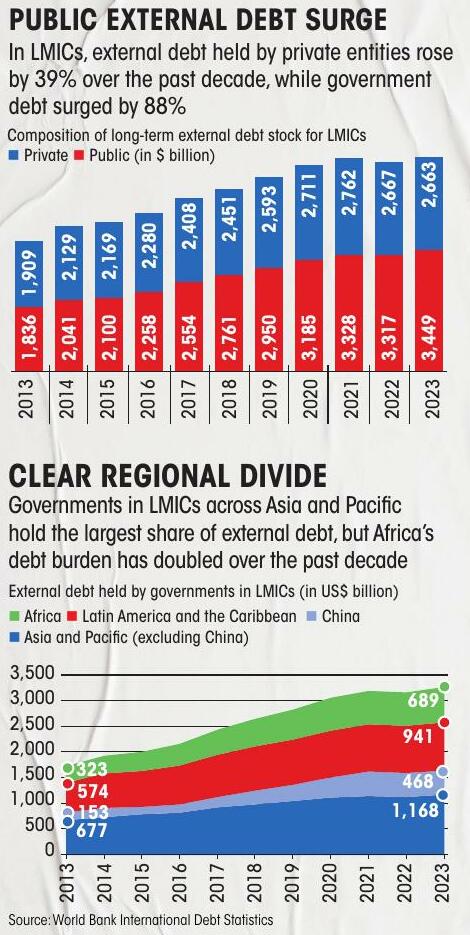 HIGH COST OF BORROWING

هذه القصة من طبعة July 01, 2025 من Down To Earth.
اشترك في Magzter GOLD للوصول إلى آلاف القصص المتميزة المنسقة، وأكثر من 9000 مجلة وصحيفة.
هل أنت مشترك بالفعل؟ تسجيل الدخول
المزيد من القصص من Down To Earth

Down To Earth
THINK TWICE BEFORE FELLING SAL TREES
Many trees considered to be affected by sal borer in the 1990s are still alive today

1 mins
February 16, 2026

Down To Earth
EDGE OF SURVIVAL
Caste divides deny marginalised communities land, resources and essential aid, leaving them more vulnerable to climate disasters
6 mins
February 16, 2026

Down To Earth
A WISH LIST?
Union Budget for 2026-27 conveys the impression of a roll-call of intentions and ambitious proposals, with little detail on their formulation
6 mins
February 16, 2026
Down To Earth
Break down the gender wall
THE RULING National Democratic Alliance (NDA) government has been heavily invested in the goal to make India a developed economy by 2047.
2 mins
February 16, 2026

Down To Earth
MENSTRUAL HEALTH, NOW A FUNDAMENTAL RIGHT
In a landmark judgement, the Supreme Court has recognised menstrual health and hygiene as a fundamental right under Article 21 of the Constitution of India, which guarantees the right to life and dignity.
8 mins
February 16, 2026

Down To Earth
Of devolution and new disasters
The 16th Finance Commission pushes for changes in view of new fiscal and climatic conditions
11 mins
February 16, 2026
Down To Earth
Rising risks of plastics
NEGATIVE IMPACTS on human health due to emissions linked to the plastic lifecycle could double by 2040, according to a study published in The Lancet Planetary Health in January.
1 min
February 16, 2026

Down To Earth
GAP BETWEEN EPIDEMICS NARROWING
A watershed-based and landscape-level approach is needed to address forest degradation
2 mins
February 16, 2026

Down To Earth
WAITING TO STRIKE
Sal heartwood borer is considered the biggest threat to forestry in India, especially to the sal tree, where it lives and breeds.
11 mins
February 16, 2026

Down To Earth
A SPRING DELIGHT
Mustard flowers are not meant only for the eyes. Invite them to your plate once in a while
3 mins
February 16, 2026
Listen
Translate
Change font size