Prøve GULL - Gratis
WHY SOVEREIGN DEBT RISING IN DEVELOPING WORLD?
Down To Earth
|July 01, 2025
Biased sovereign credit ratings and steep interest rates are at work
-
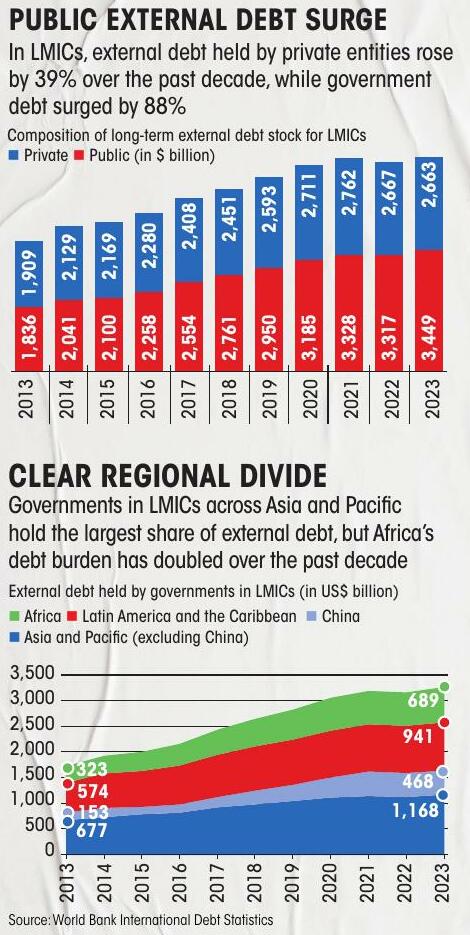
THE ANSWER to this question is often traced to the oil price rise of the 1970s, which resulted in a financial squeeze in oil-importing developing countries. Arab oil wealth was deposited in Western bank vaults. These “petrodollars” provided much of the cash lent to borrowers in the developing world. This was also advantegeous to the Western economies. “Recycling” oil money to the developing world meant that they could keep buying Western exports, despite bigger oil bills, and thus help keep numerous factories in Europe and North America open, staving off a descent into recession. During the 1970s, private commercial banks in the West began to overtake official lenders. At the height of their lending in 1982, banks were lending $63 billion a year to the developing world, nearly twice the amount lent by official government sources. The economies of several borrowing countries grew rapidly during the 1970s. But the 1980s saw a recession in industrialised countries. Economic activities slowed down and interest rates on bank loan went up. Developing countries which could not pay their earlier loans now had to take more and more loans just to pay interest on the loan they had taken. An example of this vicious debt trap is Brazil; between 1972 and 1988, the nation paid $176 billion as interest on a debt of $124 billion to industrialised countries.
Cut to the 2020s. The situation has not changed much in the past 40-odd years.
 HIGH COST OF BORROWING

Denne historien er fra July 01, 2025-utgaven av Down To Earth.
Abonner på Magzter GOLD for å få tilgang til tusenvis av kuraterte premiumhistorier og over 9000 magasiner og aviser.
Allerede abonnent? Logg på
FLERE HISTORIER FRA Down To Earth
Down To Earth
Popular distrust
THE WORLD seems to be going through a period of stasis despite facing an unfathomable polycrisis.

2 mins
February 01, 2026

Down To Earth
CONSERVE OR PERISH
Periyar Tiger Reserve has rewritten Indian conservation by turning poachers into protectors and conflict into coexistence
5 mins
February 01, 2026

Down To Earth
'Rivers need to run free'
From Tibet to West Bengal, the Brahmaputra is the pulse of communities and ecosystems along its course. But what are the risks the river faces through human interventions, particularly dams, discusses journalist, author and filmmaker SANJOY HAZARIKA in his new book, River Traveller.
4 mins
February 01, 2026

Down To Earth
India is facing up to its innovation lag
There are signs now that India is acknowledging the superior strides made by China in a frontier technology like Al
4 mins
February 01, 2026

Down To Earth
Competing concerns
What are the repercussions of the EU-Mercosur pact that have made European farmers protest against the free trade agreement?
4 mins
February 01, 2026

Down To Earth
From fryer to flight
Sustainable fuel made from used cooking oil can play a pivotal role in helping India achieve its aviation emission reduction goals. Measures to collect this oil must be revamped
4 mins
February 01, 2026

Down To Earth
ACCESS OPEN
An amendment to India's nodal forest conservation law opens up forests across India to commercial exploitation by the paper industry
6 mins
February 01, 2026
Down To Earth
DRINK FROM TAP CAN BE A REALITY
As cities across India struggle to supply safe piped water, Odisha offers a success story
2 mins
February 01, 2026

Down To Earth
GREAT DRYING
The Earth is hotter than at any point in the past 100,000 years, with 2023-25 becoming the warmest three-year period on record and also breaching the 1.5°C threshold for the first time. One fallout is dwindling freshwater.
22 mins
February 01, 2026

Down To Earth
Green redemption
Restoration of grasslands of Kerala's Pampadum Shola National Park, once dominated by invasive Australian wattles, see a return of streams and native species
1 mins
February 01, 2026
Listen
Translate
Change font size