
Magzter GOLD ile Sınırsız Olun
Sadece 9.000'den fazla dergi, gazete ve Premium hikayeye sınırsız erişim elde edin
Denemek ALTIN - Özgür
VOYAGE TO NOWHERE
Scientific American
|October 2025
An expensive and ambitious plan for interstellar travel has quietly disappeared
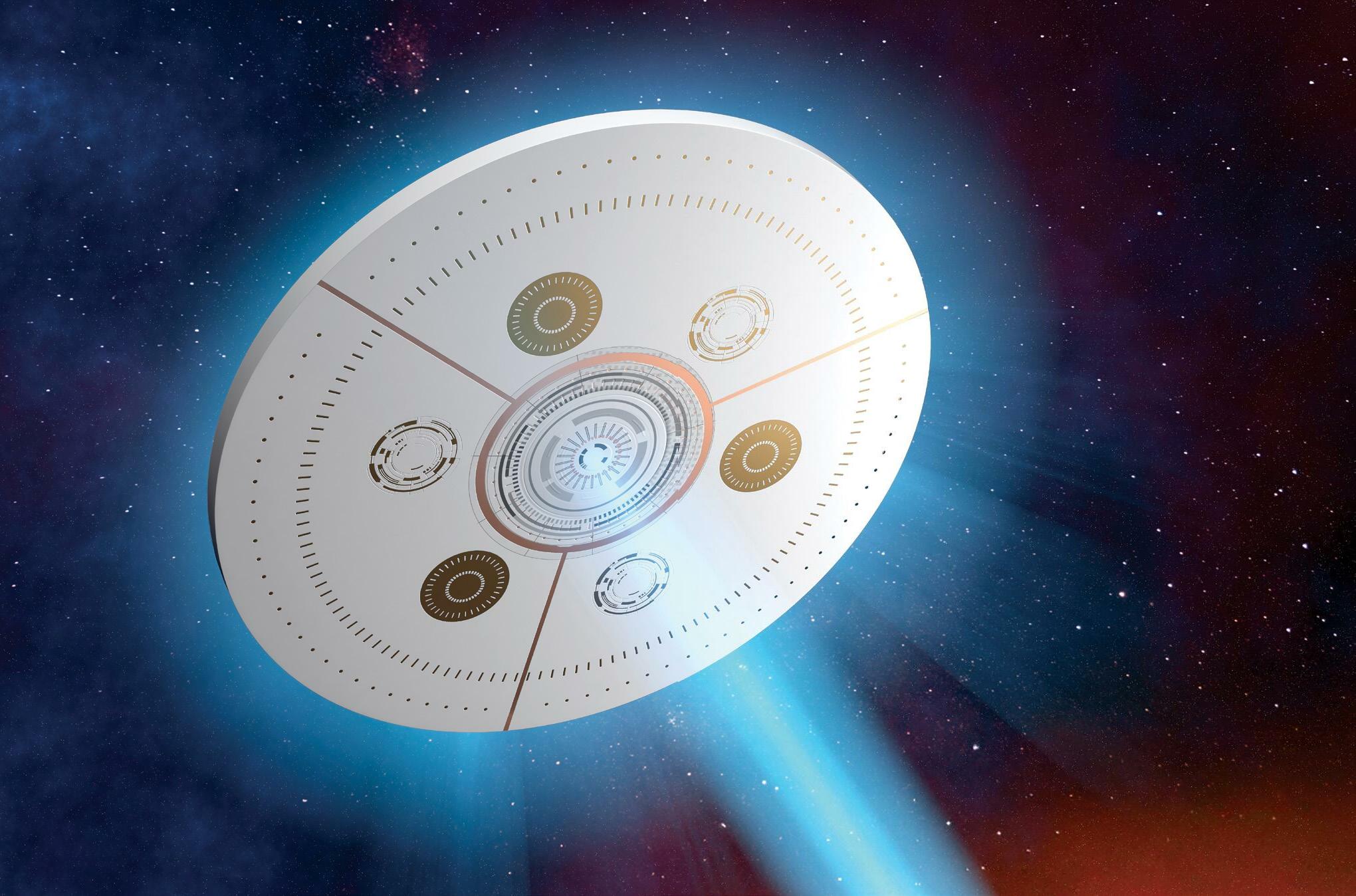
IN 2016 BILLIONAIRE YURI MILNER HOSTED a press conference at One World Observatory, the atrium topping the slick skyscraper at the center of the rebuilt World Trade Center complex.
Milner had grown rich investing in tech start-ups, and now he wanted to spend some of that money on sending a spaceship to the stars.
He called the plan Breakthrough Starshot: a project that would eventually take human technology to another solar system. The idea was that high-powered lasers would propel tiny probes to 20 percent of the speed of light, impelling them with enough inertia to launch them toward the nearest star system, Alpha Centauri, within 20 years. Milner and his Breakthrough Initiatives, a group of space science research projects related to life in the universe, were pledging $100 million toward a proof of concept. At the event, Milner was joined by, among others, Mae Jemison, a former astronaut and head of 100 Year Starship, an interstellar research program funded by the Defense Advanced Research Projects Agency; Pete Worden, former director of NASA's Ames Research Center; and Stephen Hawking, world-famous physicist.
Zachary Manchester, currently an associate professor of robotics at Carnegie Mellon University, signed on for the project's early stages. He remembers it seeming incredible that he, then a wide-eyed 20-something, was at the top of a metropolis, hanging out with people he considered legends—people such as Freeman Dyson, a physicist best known for positing that advanced civilizations could eventually cloak their stars in megastructures that siphoned their power. Dyson was one of several scientific luminaries who were joining the project, including Nobel Prize winner Saul Perlmutter and Martin Rees, then the U.K.'s Astronomer Royal.
In short, the Starshot launch event was flashy. A video preview narrated by actor Seth MacFarlane was also flashy. The text that went along with the announcement? Flashy.

Bu hikaye Scientific American dergisinin October 2025 baskısından alınmıştır.
Binlerce özenle seçilmiş premium hikayeye ve 9.000'den fazla dergi ve gazeteye erişmek için Magzter GOLD'a abone olun.
Zaten abone misiniz? Oturum aç
Scientific American'den DAHA FAZLA HİKAYE

Scientific American
The Quiet Math Problem That Runs the Planet
How Diffie-Hellman key exchange secures everything from your text messages to government secrets

7 mins
May 2026

Scientific American
The Fog of Science
Did an adversary just invent a world-changing weapon, or are they making it up? DARPA is building an AI to instantly call their bluff
4 mins
May 2026
Scientific American
The Hubble Space Telescope Is Still Awesome
Hubble is going strong despite its decades in space and next-generation successors
4 mins
May 2026

Scientific American
Meet America's Native Bees
Scientists estimate there are about 4,000 species of native bees in the U.S.
5 mins
May 2026

Scientific American
The Chemistry of Desire
Inside the secretive laboratories where scientists build novel molecules to make luxury fragrance feel like pure emotion
5 mins
May 2026

Scientific American
Scanning the Stone
As ore gets harder to find, the mining industry is turning to subatomic-particle sensors to push deep underground
8 mins
May 2026

Scientific American
YOUR HEART IN FLAMES
Inflammation may be the true cause of cardiovascular diseaseand there's a drug to treat it
13 mins
May 2026

Scientific American
Ancient Lexicon
Stone Age art may reveal a 40,000-year-old precursor to writing
2 mins
May 2026

Scientific American
Thermal Breakthrough
A new super heat conductor challenges fundamental physics
2 mins
May 2026
Scientific American
How to Vacation in Space
Planned orbital hotels promise luxury, but can they deliver?
4 mins
May 2026
Listen
Translate
Change font size