Versuchen GOLD - Frei
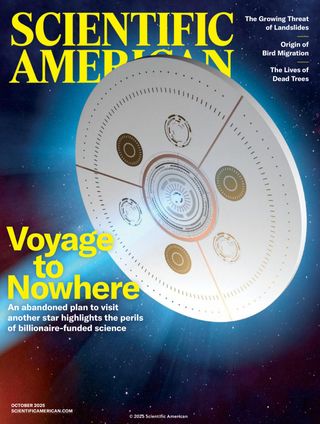
VOYAGE TO NOWHERE
Scientific American
|October 2025
An expensive and ambitious plan for interstellar travel has quietly disappeared
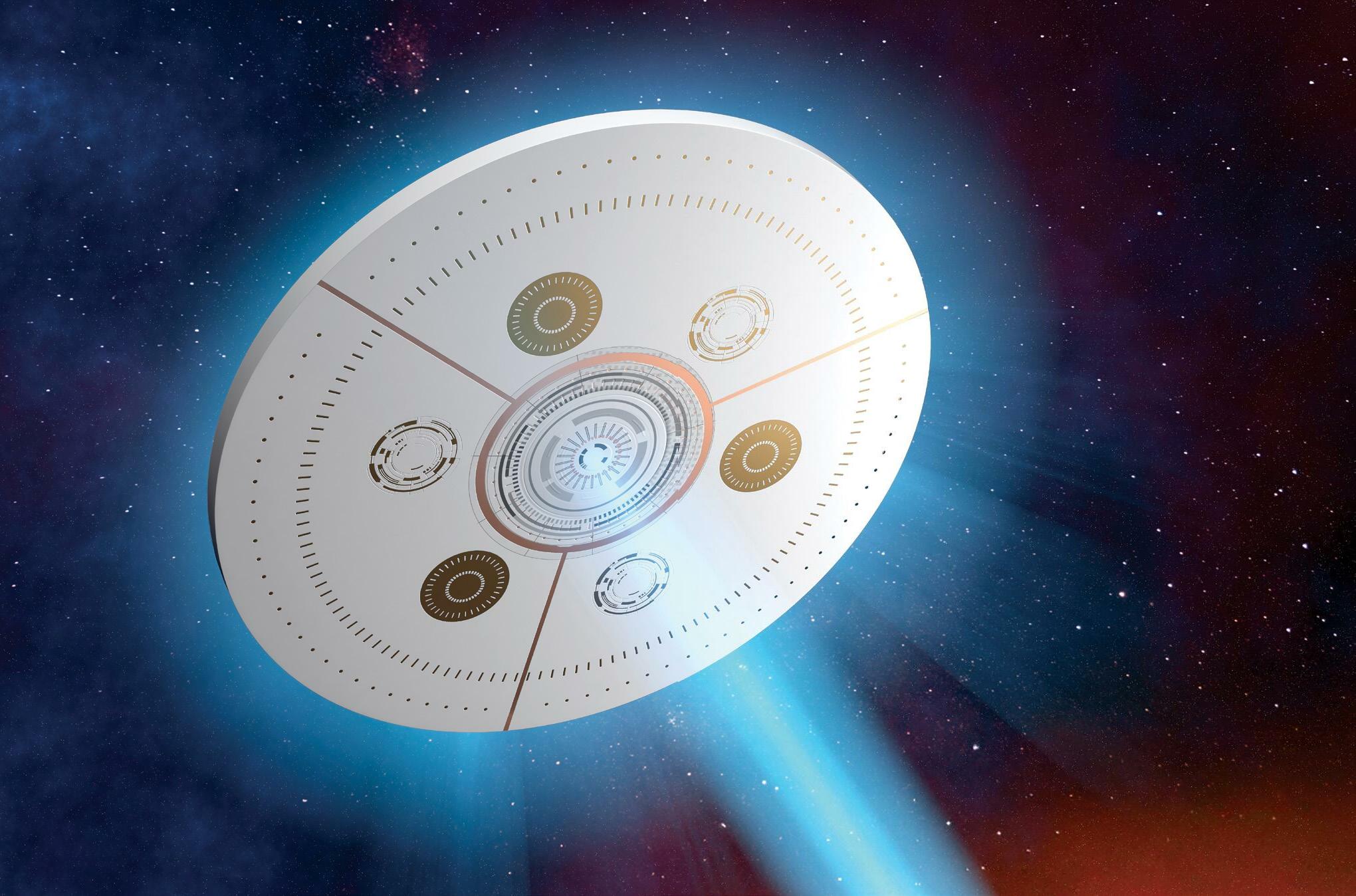
IN 2016 BILLIONAIRE YURI MILNER HOSTED a press conference at One World Observatory, the atrium topping the slick skyscraper at the center of the rebuilt World Trade Center complex.
Milner had grown rich investing in tech start-ups, and now he wanted to spend some of that money on sending a spaceship to the stars.
He called the plan Breakthrough Starshot: a project that would eventually take human technology to another solar system. The idea was that high-powered lasers would propel tiny probes to 20 percent of the speed of light, impelling them with enough inertia to launch them toward the nearest star system, Alpha Centauri, within 20 years. Milner and his Breakthrough Initiatives, a group of space science research projects related to life in the universe, were pledging $100 million toward a proof of concept. At the event, Milner was joined by, among others, Mae Jemison, a former astronaut and head of 100 Year Starship, an interstellar research program funded by the Defense Advanced Research Projects Agency; Pete Worden, former director of NASA's Ames Research Center; and Stephen Hawking, world-famous physicist.
Zachary Manchester, currently an associate professor of robotics at Carnegie Mellon University, signed on for the project's early stages. He remembers it seeming incredible that he, then a wide-eyed 20-something, was at the top of a metropolis, hanging out with people he considered legends—people such as Freeman Dyson, a physicist best known for positing that advanced civilizations could eventually cloak their stars in megastructures that siphoned their power. Dyson was one of several scientific luminaries who were joining the project, including Nobel Prize winner Saul Perlmutter and Martin Rees, then the U.K.'s Astronomer Royal.
In short, the Starshot launch event was flashy. A video preview narrated by actor Seth MacFarlane was also flashy. The text that went along with the announcement? Flashy.

Diese Geschichte stammt aus der October 2025-Ausgabe von Scientific American.
Abonnieren Sie Magzter GOLD, um auf Tausende kuratierter Premium-Geschichten und über 9.000 Zeitschriften und Zeitungen zuzugreifen.
Sie sind bereits Abonnent? Anmelden
WEITERE GESCHICHTEN VON Scientific American

Scientific American
Earthquake Life
Yellowstone quakes spark bursts of microbial growth underground

2 mins
March 2026

Scientific American
Sailing the Sun
By designing vertical panels that move in a gale, two Swedish inventors are unlocking a solar future for the windswept north
9 mins
March 2026

Scientific American
Covered in Bees
Ancient bees burrowed deep into discarded mammal jawbones
2 mins
March 2026
Scientific American
Fire Starters
Ancient humans were making fire 350,000 years earlier than thought
3 mins
March 2026

Scientific American
Relativity Revealed
Physicists have observed a bizarre prediction of special relativity for the first time
8 mins
March 2026

Scientific American
Everything You Wanted to Know about Polyamory (but Were Afraid to Ask
The practice is not a faddish excuse to sleep around, research shows. And it has deep roots in American culture
14 mins
March 2026

Scientific American
Let the Rivers Run
An investigation into the rights of nature
4 mins
March 2026

Scientific American
Hidden Proof
\"Effective zero knowledge\" beats long-standing cryptographic impossibilities
2 mins
March 2026

Scientific American
The Universe's Weirdest Optical Illusions
Sometimes the farther away an object is, the bigger it seems to be
4 mins
March 2026

Scientific American
Living in the COPILOT SOCIETY
The promise and peril of artificial intelligence everywhere
2 mins
March 2026
Listen
Translate
Change font size