
Magzter GOLD ile Sınırsız Olun
Sadece 9.000'den fazla dergi, gazete ve Premium hikayeye sınırsız erişim elde edin
Denemek ALTIN - Özgür
Disaster zone
Down To Earth
|September 01, 2025
With an extreme weather event on almost every day this year, the Himalayas show the cost of ignoring science and warnings
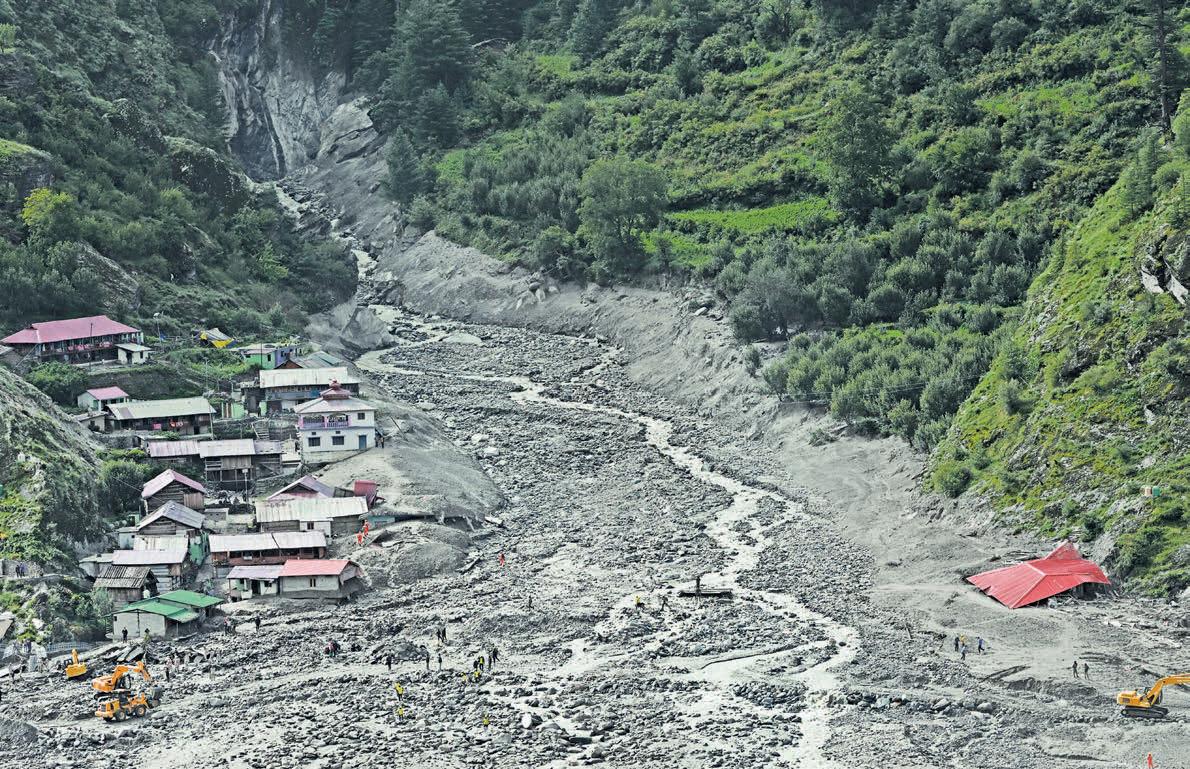
ON AUGUST 22, as the magazine went to press, Chamoli in Uttarakhand joined the growing list of Himalayan regions battered by extreme weather this monsoon. It was, in fact, the fourth major disaster in just over a month, after Mandi in Himachal Pradesh, Dharali in Uttarakhand and Kishtwar in Jammu and Kashmir. These are not just episodes of heavy rain. They show how altered rainfall, geology and rampant construction are turning landslides and floods into killers.
In 2021, the Himalayas have been in crisis almost every single day. Between January and August 18, the 13 Himalayan states and Union Territories recorded at least one disaster daily, killing 632 people, according to government data analysed by Down To Earth (DTE). The pattern is only getting worse. In 2018, disasters struck on 53 per cent of the days in the entire year, with 1,058 deaths. In 2019, the numbers rose to 58 per cent and 837 deaths. In 2020, they climbed to 60 per cent, killing 870 people.
This year, not only did the Southwest Monsoon arrive a week early, it was punctuated by an unusually high number of western disturbances, extra-tropical storms that normally affect India in winter and spring. Between June 1 and August 20, India recorded 14 western disturbances, according to India Meteorological Department (IMD) data analysed by DTE. Five occurred in June, five in July and four in August (up to August 20). At least four were strong and persistent, lasting five to seven days. India typically sees four to six western disturbances between December and March and their summer frequency is usually low because the subtropical westerly jet shifts north.

Bu hikaye Down To Earth dergisinin September 01, 2025 baskısından alınmıştır.
Binlerce özenle seçilmiş premium hikayeye ve 9.000'den fazla dergi ve gazeteye erişmek için Magzter GOLD'a abone olun.
Zaten abone misiniz? Oturum aç
Down To Earth'den DAHA FAZLA HİKAYE

Down To Earth
THINK TWICE BEFORE FELLING SAL TREES
Many trees considered to be affected by sal borer in the 1990s are still alive today

1 mins
February 16, 2026

Down To Earth
EDGE OF SURVIVAL
Caste divides deny marginalised communities land, resources and essential aid, leaving them more vulnerable to climate disasters
6 mins
February 16, 2026

Down To Earth
A WISH LIST?
Union Budget for 2026-27 conveys the impression of a roll-call of intentions and ambitious proposals, with little detail on their formulation
6 mins
February 16, 2026
Down To Earth
Break down the gender wall
THE RULING National Democratic Alliance (NDA) government has been heavily invested in the goal to make India a developed economy by 2047.
2 mins
February 16, 2026

Down To Earth
MENSTRUAL HEALTH, NOW A FUNDAMENTAL RIGHT
In a landmark judgement, the Supreme Court has recognised menstrual health and hygiene as a fundamental right under Article 21 of the Constitution of India, which guarantees the right to life and dignity.
8 mins
February 16, 2026

Down To Earth
Of devolution and new disasters
The 16th Finance Commission pushes for changes in view of new fiscal and climatic conditions
11 mins
February 16, 2026
Down To Earth
Rising risks of plastics
NEGATIVE IMPACTS on human health due to emissions linked to the plastic lifecycle could double by 2040, according to a study published in The Lancet Planetary Health in January.
1 min
February 16, 2026

Down To Earth
GAP BETWEEN EPIDEMICS NARROWING
A watershed-based and landscape-level approach is needed to address forest degradation
2 mins
February 16, 2026
Down To Earth
WAITING TO STRIKE
Sal heartwood borer is considered the biggest threat to forestry in India, especially to the sal tree, where it lives and breeds.
11 mins
February 16, 2026

Down To Earth
A SPRING DELIGHT
Mustard flowers are not meant only for the eyes. Invite them to your plate once in a while
3 mins
February 16, 2026
Listen
Translate
Change font size