Poging GOUD - Vrij
Disaster zone
Down To Earth
|September 01, 2025
With an extreme weather event on almost every day this year, the Himalayas show the cost of ignoring science and warnings
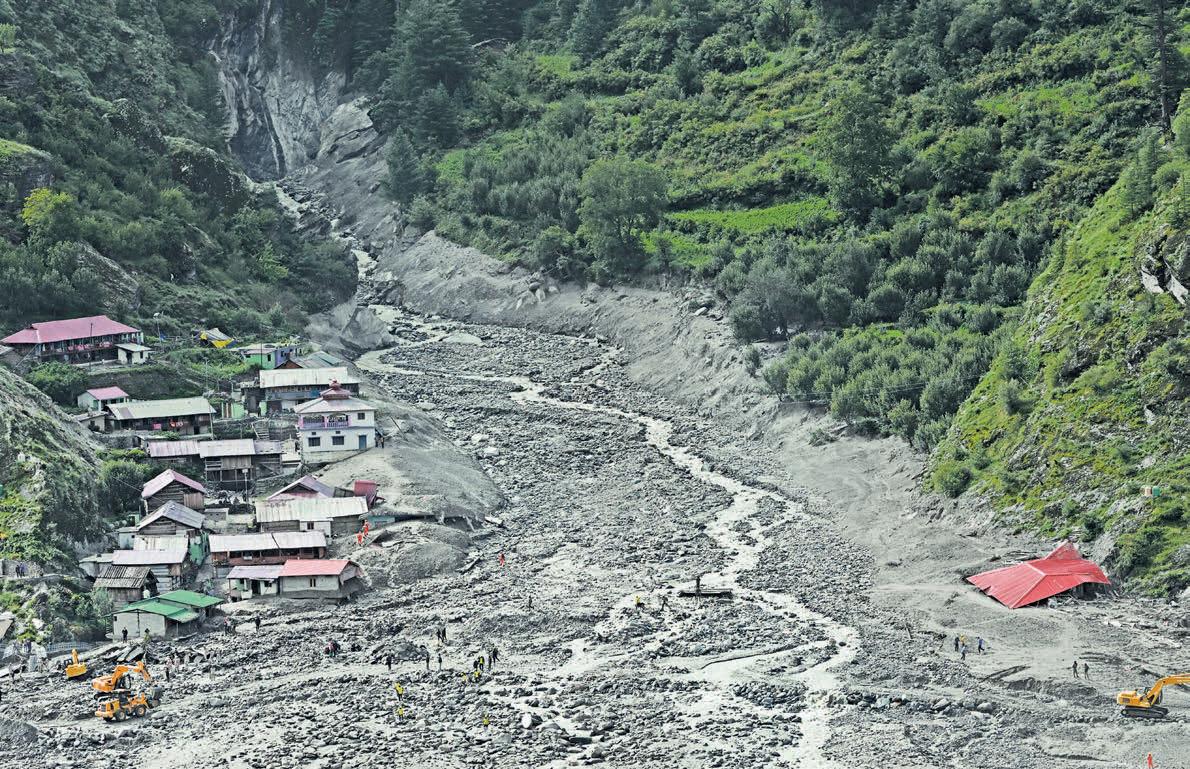
ON AUGUST 22, as the magazine went to press, Chamoli in Uttarakhand joined the growing list of Himalayan regions battered by extreme weather this monsoon. It was, in fact, the fourth major disaster in just over a month, after Mandi in Himachal Pradesh, Dharali in Uttarakhand and Kishtwar in Jammu and Kashmir. These are not just episodes of heavy rain. They show how altered rainfall, geology and rampant construction are turning landslides and floods into killers.
In 2021, the Himalayas have been in crisis almost every single day. Between January and August 18, the 13 Himalayan states and Union Territories recorded at least one disaster daily, killing 632 people, according to government data analysed by Down To Earth (DTE). The pattern is only getting worse. In 2018, disasters struck on 53 per cent of the days in the entire year, with 1,058 deaths. In 2019, the numbers rose to 58 per cent and 837 deaths. In 2020, they climbed to 60 per cent, killing 870 people.
This year, not only did the Southwest Monsoon arrive a week early, it was punctuated by an unusually high number of western disturbances, extra-tropical storms that normally affect India in winter and spring. Between June 1 and August 20, India recorded 14 western disturbances, according to India Meteorological Department (IMD) data analysed by DTE. Five occurred in June, five in July and four in August (up to August 20). At least four were strong and persistent, lasting five to seven days. India typically sees four to six western disturbances between December and March and their summer frequency is usually low because the subtropical westerly jet shifts north.

Dit verhaal komt uit de September 01, 2025-editie van Down To Earth.
Abonneer u op Magzter GOLD voor toegang tot duizenden zorgvuldig samengestelde premiumverhalen en meer dan 9000 tijdschriften en kranten.
Bent u al abonnee? Aanmelden
MEER VERHALEN VAN Down To Earth

Down To Earth
THE GREAT PIVOT
China's moves to transition to clean energy offer critical lessons to India

4 mins
March 01, 2026

Down To Earth
COAL V CORRIDOR
A proposal to mine coal along a corridor that links two tiger reserves in central India is a step away from getting final clearance. The move could affect movement and genetic diversity of tiger populations in the region
8 mins
March 01, 2026

Down To Earth
India's challenging AI predicament
Hobbled by lack of innovation and AI skills in its crucial technology sector, India is focusing on a ruinous plan to host data centres
4 mins
March 01, 2026
Down To Earth
China to implement zero tariffs across Africa
CHINA ON February 14 announced that it will implement zero tariffs for imports from all the 53 African nations it has diplomatic relations with, starting from May 1.
1 min
March 01, 2026
Down To Earth
Poverty, sans the threshold
MEASUREMENT OF poverty is a fundamental exercise, needed to direct development programmes.
2 mins
March 01, 2026

Down To Earth
A bridge across forever
For two decades, a Chhattisgarh village remains stuck in a loop of building temporary river crossings to access markets and sell forest produce
4 mins
March 01, 2026
Down To Earth
Liveable cities need a new model
CRY FOR my Delhi. This is my city—my family records many generations who have lived here.
3 mins
March 01, 2026

Down To Earth
Real impacts of the changing seasons
This refers to the article \"1,500 days, and an alarm for new climate\" (1-15 December, 2025).
1 mins
March 01, 2026

Down To Earth
‘It’s a systematic effort by US to dismantle climate policy’
The US, the world's largest historical emitter of greenhouse gases, has overturned its “endangerment finding”, the legal foundation for regulating emissions under the Clean Air Act since 2009.
4 mins
March 01, 2026
Down To Earth
Amazon turned carbon source in 2023 drought
EXTREME DROUGHT and a prolonged heatwave in 2023 pushed parts of the Amazon rainforest from acting as a carbon sink to becoming a carbon source for three months, according to a February 13 study published in the journal AGU Advances of the American Geophysical Union.
1 min
March 01, 2026
Listen
Translate
Change font size