Denemek ALTIN - Özgür
'It's a robot war' Fighting back while Moscow is raining death from the sky
The Guardian
|August 14, 2025
Nataliya Petrovna pointed to a crater on the edge of a football field. Around it lay bits of twisted metal. From nearby came loud banging as residents fixed plywood to their damaged five-storey apartment block. "The last few days have been terrible," she said. "We could hear the drones buzzing over us. The one that exploded near the school opposite was a Russian Shahed. Maybe some kind of new type."

Petrovna lives in the eastern garrison city of Kramatorsk, in Donetsk province, about 15 miles from the frontline. That puts it just beyond the range of Russian first-person view (FPV) drones, at least for now. But it is easily reachable by other kinds of enemy objects. They include air-dropped glide bombs, Grad rockets and unmanned kamikaze drones - now cruising the skies in overwhelming numbers.
Since Donald Trump returned to the White House in January, the Kremlin has dramatically escalated its bombardment of Ukrainian cities, including Kramatorsk. In his meeting tomorrow with the US president in Alaska, Vladimir Putin is likely to demand that Ukraine hands Kramatorsk over to Moscow, together with other Ukrainian-controlled territory. He claims four Ukrainian regions as well as Crimea. Ukraine's president, Volodymyr Zelenskyy, has vowed not to give up land, saying the constitution forbids it.
Amid anxiety that the US will pressure Kyiv into an unjust peace deal, Russian troops have been pushing forward, trying to create facts on the ground. Earlier this week they reportedly broke through Ukrainian lines, advancing past the town of Dobropillya, north of the besieged city of Pokrovsk.
At the same time, Russia has launched a record number of aerial attacks. Over one week, from 4 to 10 August, the Russian military dropped more than 1,000 bombs and launched nearly 1,400 kamikaze drones against Ukraine. The current record is 728 drones and 13 missiles sent in a single night in July, most directed at the western city of Lutsk. By autumn, German experts predict Moscow could send 2,000 drones a day.
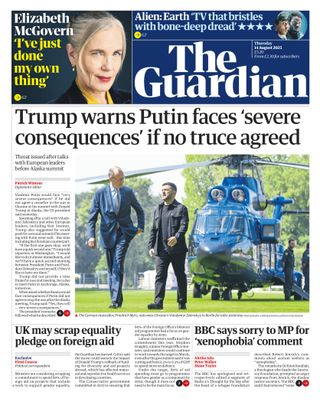

Bu hikaye The Guardian dergisinin August 14, 2025 baskısından alınmıştır.
Binlerce özenle seçilmiş premium hikayeye ve 9.000'den fazla dergi ve gazeteye erişmek için Magzter GOLD'a abone olun.
Zaten abone misiniz? Oturum aç
The Guardian'den DAHA FAZLA HİKAYE
The Guardian
'It builds up' Virus piles pressure on stretched hospital staff
Amir Hassan, an emergency medicine consultant and divisional medical director at Epsom and St Helier university hospitals trust, describes life in a hospital coping with an increase in flu cases.

2 mins
December 12, 2025
The Guardian
Zelenskyy's doubts over 'free zone' in Ukraine
The US wants Ukraine to withdraw its troops from the Donbas, with Washington then creating a “free economic zone” in the parts of the region Kyiv currently controls, Volodymyr Zelenskyy has said.
3 mins
December 12, 2025

The Guardian
UK facing worst winter flu crisis within a fortnight as cases surge
The NHS is bracing itself for its worst ever winter crisis descending in the next fortnight because of a worsening \"flu-nami\" that has left hospitals, GP surgeries and ambulances services under intense strain.
4 mins
December 12, 2025

The Guardian
Witness tells of Ukrainian journalist's final days in remote Russian prison
Details of the last days in captivity of the Ukrainian journalist Viktoriia Roshchyna, who died last year, have emerged with the witness account of a soldier who was with her when she was transported to a prison deep inside Russia.
4 mins
December 12, 2025

The Guardian
MPs round on US for 'rightwing tropes' with echoes of 1930s
The US is engaging in “extreme rightwing tropes” with echoes of the 1930s and threatening “chilling” interference in European democracies, British MPs warned government ministers yesterday.
3 mins
December 12, 2025

The Guardian
School head responds to claims of Farage abuse
Dulwich college’s headteacher has responded to allegations of teenage racism by Nigel Farage by saying he recognised the “seriousness of the behaviours described in the media”.
3 mins
December 12, 2025

The Guardian
Perilous journey: Laureate fled by sea, like many before her
Thousands of Venezuelan migrants have braved the seas off Falc6n state in recent years, fleeing their shattered homeland towards the Caribbean islands of Aruba and Curacao in rickety wooden boats called yolas. Many lost their lives in the attempt.
3 mins
December 12, 2025
The Guardian
'Monumental betrayal'
Angry fans accuse Fifa over 'extortionate' World Cup tickets
2 mins
December 12, 2025

The Guardian
Theatre review Sondheim's glorious Grimm mashup is brilliantly drawn
Can Stephen Sondheim and James Lapine’s eternally imaginative Grimm brothers mashup ever disappoint, when its book is so clever and it is driven by the most gorgeous (if tricky) music?
2 mins
December 12, 2025

The Guardian
Machado Opposition leader says US seizure of ship was 'necessary'
Venezuela’s best-known opposition leader, the Nobel peace prize winner Maria Corina Machado, said she supported the US seizure of an oil tanker off Venezuela’s coast, calling it a “very necessary step” to confront Nicolas Maduro’s “criminal” regime.
4 mins
December 12, 2025
Listen
Translate
Change font size