試す 金 - 無料
'It's a robot war' Fighting back while Moscow is raining death from the sky
The Guardian
|August 14, 2025
Nataliya Petrovna pointed to a crater on the edge of a football field. Around it lay bits of twisted metal. From nearby came loud banging as residents fixed plywood to their damaged five-storey apartment block. "The last few days have been terrible," she said. "We could hear the drones buzzing over us. The one that exploded near the school opposite was a Russian Shahed. Maybe some kind of new type."

Petrovna lives in the eastern garrison city of Kramatorsk, in Donetsk province, about 15 miles from the frontline. That puts it just beyond the range of Russian first-person view (FPV) drones, at least for now. But it is easily reachable by other kinds of enemy objects. They include air-dropped glide bombs, Grad rockets and unmanned kamikaze drones - now cruising the skies in overwhelming numbers.
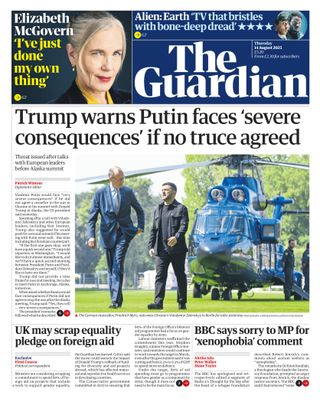
Since Donald Trump returned to the White House in January, the Kremlin has dramatically escalated its bombardment of Ukrainian cities, including Kramatorsk. In his meeting tomorrow with the US president in Alaska, Vladimir Putin is likely to demand that Ukraine hands Kramatorsk over to Moscow, together with other Ukrainian-controlled territory. He claims four Ukrainian regions as well as Crimea. Ukraine's president, Volodymyr Zelenskyy, has vowed not to give up land, saying the constitution forbids it.
Amid anxiety that the US will pressure Kyiv into an unjust peace deal, Russian troops have been pushing forward, trying to create facts on the ground. Earlier this week they reportedly broke through Ukrainian lines, advancing past the town of Dobropillya, north of the besieged city of Pokrovsk.
At the same time, Russia has launched a record number of aerial attacks. Over one week, from 4 to 10 August, the Russian military dropped more than 1,000 bombs and launched nearly 1,400 kamikaze drones against Ukraine. The current record is 728 drones and 13 missiles sent in a single night in July, most directed at the western city of Lutsk. By autumn, German experts predict Moscow could send 2,000 drones a day.

このストーリーは、The Guardian の August 14, 2025 版からのものです。
Magzter GOLD を購読すると、厳選された何千ものプレミアム記事や、10,000 以上の雑誌や新聞にアクセスできます。
すでに購読者ですか? サインイン
The Guardian からのその他のストーリー
The Guardian
The UK’s pharma deal was essential - but GSK’'s boss was correct about US dominance
That’s gratitude, eh?

3 mins
December 12, 2025
The Guardian
New C of E archbishop accused over handling of 2019 abuse complaint
The Church of England is reviewing a complaint against the incoming archbishop of Canterbury over her handling of an abuse allegation.
2 mins
December 12, 2025

The Guardian
Fans packing darts’ theatre of dreams relish expansion
Arguably the championship distorts the wider sport but the hordes in fancy dress cannot get enough of it
3 mins
December 12, 2025
The Guardian
Ashes to Ashes
Barmy Army's pride and parps show no sign of easing despite Bazball's implosion
4 mins
December 12, 2025
The Guardian
Border clash Fleeing Thais sceptical of Trump's peace drive
Rangsan Angda and many of his neighbours in border areas of Thailand had already packed their bags, fearing that a ceasefire with neighbouring Cambodia would soon collapse.
2 mins
December 12, 2025
The Guardian
WSL to review TV slots after concern over viewership
The league takes stock on whether this was shrewd
2 mins
December 12, 2025
The Guardian
Police seek four men after 'high-value' museum exhibits stolen
More than 600 artefacts from Bristol Museum’s British empire and Commonwealth collection have been stolen in a “high-value burglary”, according to police.
2 mins
December 12, 2025

The Guardian
Net zero by 2050 What will it cost to hit the target and will it be a price worth paying?
Britain’s official energy system operator has attempted to work out what achieving net zero carbon emissions will cost, with its figures showing surging spending in the coming years.
4 mins
December 12, 2025
The Guardian
Border clash
Fleeing Thais sceptical of Trump's peace drive
2 mins
December 12, 2025
The Guardian
Changes to polar bear DNA could help them adapt to global heating, scientists discover
Changes in polar bear DNA that could help the animals adapt to warmer climates have been detected by researchers in what is thought to be the first time a statistically significant link has been found between rising temperatures and changing DNA in a wild mammal species.
2 mins
December 12, 2025
Listen
Translate
Change font size