
Magzter GOLD ile Sınırsız Olun
Sadece 9.000'den fazla dergi, gazete ve Premium hikayeye sınırsız erişim elde edin
The next view into the cosmos
Time
|March 24, 2025
The giant, 40-ft. space telescope resting in the airtight, climate-controlled clean room at NASA’s Goddard Space Flight Center in Greenbelt, Md., wants nothing to do with the microscopic dust particles clinging to your clothing.
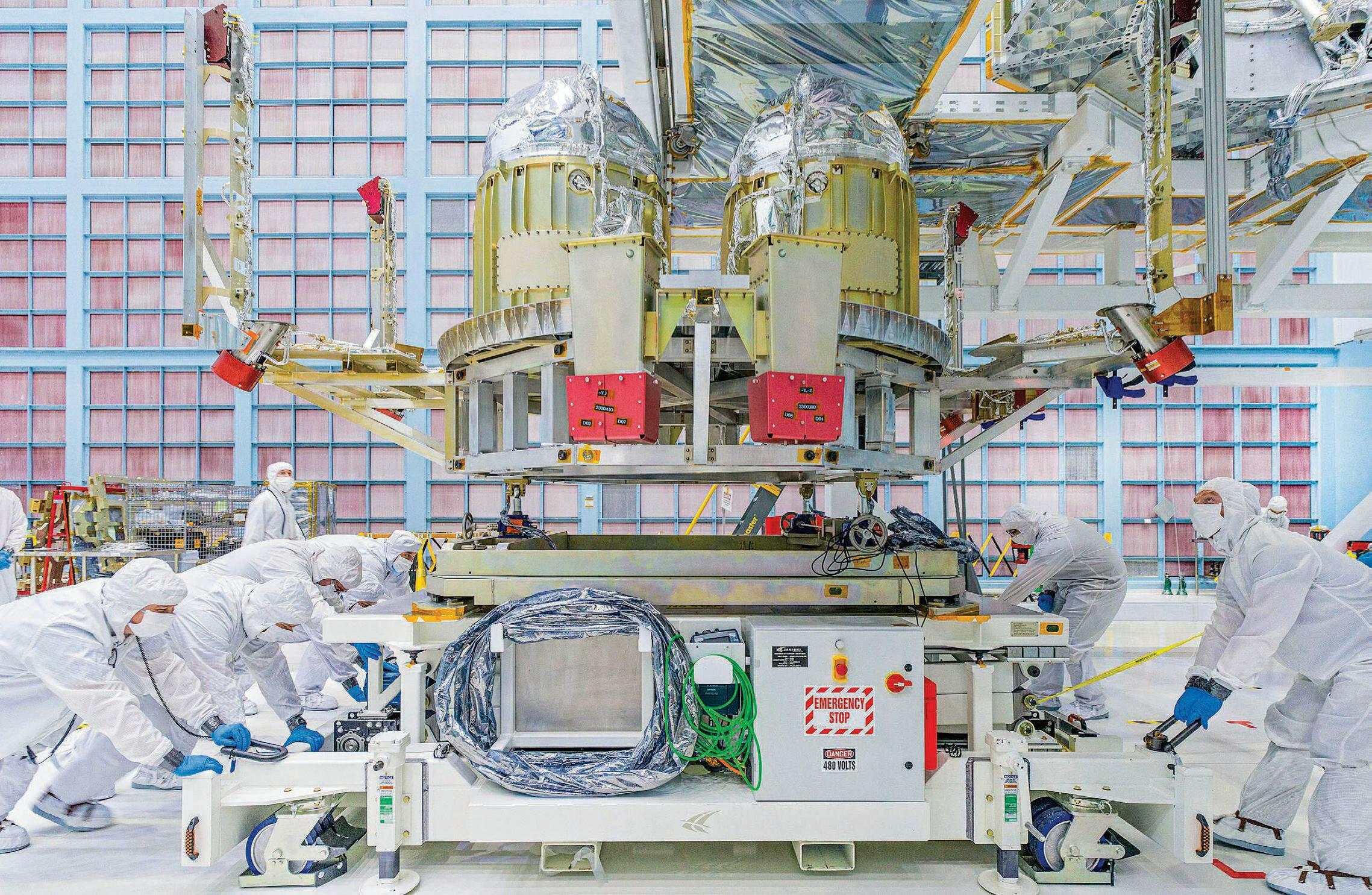
So before you enter the room, you stand in a chamber that blows high-powered, compressed air at you from head to toe, sweeping you clean. Next you dress up in surgical scrubs—booties, head covering, mask, blouse, and pants—and pass through a series of doors that take you into successively more sterile anterooms. Only then, when your dust can pose no danger to the delicate machine in the center of the room, can you join the Nancy Grace Roman Space Telescope on the factory floor. There, technicians are busy completing its assembly in preparation for its launch in May 2027 to a spot in space close to 1 million miles from Earth. From there it may transform our understanding of the cosmos.
“The vast discovery power of this telescope is going to expand our window of knowledge by orders of magnitude,” says Jamie Dunn, the Roman telescope’s project manager. “You’re going to have a tremendous amount of data available to tens of thousands of scientists. It’s just mind-boggling.”
“We [will be able to] move quickly and map out very large areas of the sky,” adds Josh Schlieder, the $4 billion telescope’s wide-field-instrument scientist. “We [will] detect hundreds of millions of galaxies to very high accuracy with very deep imaging.”
The telescope will be able to look at a patch of sky 100 times larger than both the Hubble Space Telescope and the James Webb Space Telescope can. It will be able to peer up to 13.2 billion light-years away, collecting images of the 13.8 billion-year-old universe when it was just 600 million years old. The 18 detectors in its wide-field infrared imaging camera are equipped with 16 million pixels each, providing exquisite image resolution. And its 5.6-ft. (1.7 m) high-gain antenna will be able to send a fire hose of pictures and data back to Earth at unprecedented speed. What’s more, all of this data will be open source—available to the world.

Bu hikaye Time dergisinin March 24, 2025 baskısından alınmıştır.
Binlerce özenle seçilmiş premium hikayeye ve 9.000'den fazla dergi ve gazeteye erişmek için Magzter GOLD'a abone olun.
Zaten abone misiniz? Oturum aç
Time'den DAHA FAZLA HİKAYE

Time
TRUMP
LAST YEAR'S PERSON OF THE YEAR SPENT 2025 TESTING THE LIMITS OF HIS OFFICE

5 mins
December 29, 2025

Time
BEST OF CULTURE 2023
The art that entertained, moved, and inspired us this year
3 mins
December 29, 2025
Time
NEAL MOHAN
THE YOUTUBE CEO HAS LED THE PLATFORM INTO A NEW ERA OF TV AND VIDEO DOMINATION
16 mins
December 29, 2025

Time
LEONARDO DICAPRIO
MOVIE BY MOVIE, THE ACTOR HAS CRAFTED A HOLLYWOOD CAREER THAT'S BUILT TO LAST— EVEN IN AN INDUSTRY DEFINED BY CHANGE
14 mins
December 29, 2025

Time
A'JA WILSON
HER FOURTH MVP AWARD. HER THIRD WNBA TITLE. IT WAS A VERY GOOD YEAR.
21 mins
December 29, 2025
Time
HOW THE U.S. CAN LEAD
Artificial intelligence is reshaping the world.
2 mins
December 29, 2025
Time
State of the art
AS TIME’S CREATIVE DIRECTOR, I’VE been privileged to work with some of the world’s best artists and photographers in creating thousands of images for our cover.
1 mins
December 29, 2025

Time
The fractured agenda
BY THE TIME NEGOTIATORS FROM AROUND THE WORLD gathered in the Amazonian city of Belém in November to discuss the future of climate action, the world had already experienced an alarming year: near-record global temperatures, unprecedented heat waves across continents, and extreme flooding that scientists say would have been virtually impossible without human-driven warming.
2 mins
December 29, 2025

Time
PERSON OF THE YEAR
SINCE 1801, AMERICAN LEADERS HAVE GATHERED in Washington, D.C., to attend the Inauguration of a new President.
4 mins
December 29, 2025
Time
AI'S NEXT FRONTIER IS HERE
In 1950, when computing was little more than automated arithmetic and simple logic, Alan Turing asked a question that reverberates today: Can machines think? It took remarkable imagination to see what he saw—intelligence might someday be built rather than born.
1 mins
December 29, 2025
Listen
Translate
Change font size