
Ga onbeperkt met Magzter GOLD
Krijg onbeperkte toegang tot meer dan 9000 tijdschriften, kranten en Premium-verhalen voor slechts
Poging GOUD - Vrij
The next view into the cosmos
Time
|March 24, 2025
The giant, 40-ft. space telescope resting in the airtight, climate-controlled clean room at NASA’s Goddard Space Flight Center in Greenbelt, Md., wants nothing to do with the microscopic dust particles clinging to your clothing.
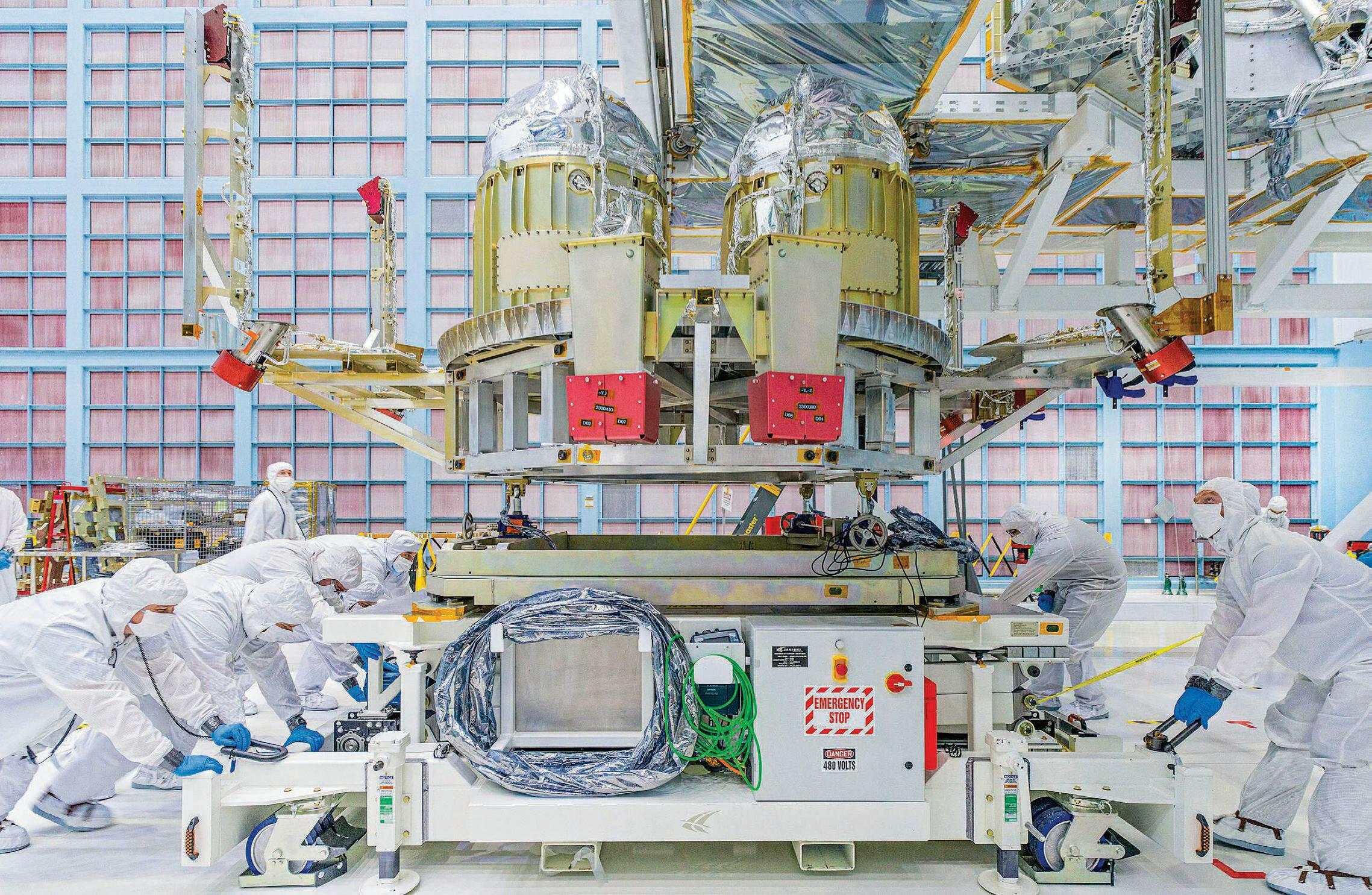
So before you enter the room, you stand in a chamber that blows high-powered, compressed air at you from head to toe, sweeping you clean. Next you dress up in surgical scrubs—booties, head covering, mask, blouse, and pants—and pass through a series of doors that take you into successively more sterile anterooms. Only then, when your dust can pose no danger to the delicate machine in the center of the room, can you join the Nancy Grace Roman Space Telescope on the factory floor. There, technicians are busy completing its assembly in preparation for its launch in May 2027 to a spot in space close to 1 million miles from Earth. From there it may transform our understanding of the cosmos.
“The vast discovery power of this telescope is going to expand our window of knowledge by orders of magnitude,” says Jamie Dunn, the Roman telescope’s project manager. “You’re going to have a tremendous amount of data available to tens of thousands of scientists. It’s just mind-boggling.”
“We [will be able to] move quickly and map out very large areas of the sky,” adds Josh Schlieder, the $4 billion telescope’s wide-field-instrument scientist. “We [will] detect hundreds of millions of galaxies to very high accuracy with very deep imaging.”
The telescope will be able to look at a patch of sky 100 times larger than both the Hubble Space Telescope and the James Webb Space Telescope can. It will be able to peer up to 13.2 billion light-years away, collecting images of the 13.8 billion-year-old universe when it was just 600 million years old. The 18 detectors in its wide-field infrared imaging camera are equipped with 16 million pixels each, providing exquisite image resolution. And its 5.6-ft. (1.7 m) high-gain antenna will be able to send a fire hose of pictures and data back to Earth at unprecedented speed. What’s more, all of this data will be open source—available to the world.


Dit verhaal komt uit de March 24, 2025-editie van Time.
Abonneer u op Magzter GOLD voor toegang tot duizenden zorgvuldig samengestelde premiumverhalen en meer dan 9000 tijdschriften en kranten.
Bent u al abonnee? Aanmelden
MEER VERHALEN VAN Time

Time
T100 ARTISTS
Luke Combs Claire Danes • Benicio Del Toro Jonathan Groff • Jennie • Dakota Johnson Coco Jones • Tayari Jones Noah Kahan Ranbir Kapoor Freida McFadden Anderson .Paak Keke Palmer Jafar Panahi Rhea Seehorn Noah Wyle .

1 min
April 27, 2026

Time
CO2 Leadership Report
IN SOME WAYS, THE ANNUAL summit of the Sustainable Markets Initiative was notable merely for continuing on.
2 mins
April 06, 2026

Time
The Most Disruptive Company in The World
ANTHROPIC WAS POISED TO TRANSFORM THE FUTURE OF WORK. NOW IT'S IN A FIGHT OVER THE FUTURE OF WAR
22 mins
April 06, 2026

Time
A soul-deep friendship, lost in a shallow murder mystery
A COMPETITION TO DETERMINE TV’S MOST generic domestic thriller would have dozens of compelling entrants, but if I had to pick a winner, it would be Imperfect Women.
2 mins
April 06, 2026

Time
How do you respond to parents who think football is too dangerous for their kids?
I wouldn't blame them. But I will also say that fear is a choice. There are a lot of great things that you learn through sports. I wouldn't allow the fear of something negative happening stop me from achieving all of the character-building and life lessons that come with sports.
3 mins
April 06, 2026

Time
Zelensky's drone diplomacy
It was just over a year ago that President Donald Trump told Volodymyr Zelensky that he didn’t “have the cards right now.”
2 mins
April 06, 2026

Time
THE SCIENCE OF SKEPTICISM
Scientists once thought illness was caused by “miasmas,” foul vapors that drifted through the air.
3 mins
April 06, 2026

Time
FINDING THE HEARTBEAT
Michelle Pfeiffer is the emotional core of two layered and wildly different new TV shows
6 mins
April 06, 2026
Time
Housing bill
By an overwhelming bipartisan vote of 89-10, the Senate passed a sweeping piece of legislation on March 12 that seeks to bolster the U.S. housing supply and lower costs for homebuyers.
1 min
April 06, 2026

Time
Health Matters
THERE ARE MORE THAN 170 RHINO-viruses known to science.
3 mins
April 06, 2026
Listen
Translate
Change font size