Denemek ALTIN - Özgür
THE BEACON OF DEMOCRACY GOES DARK
The Atlantic
|November 2025
For nearly 250 years, America promoted freedom and equality abroad, even when it failed to live up to those ideals itself. Not anymore.
"We hold these truths to be self-evident, that all men are created equal." Within weeks of their publication in July 1776, those words spread around the world. In August, a London newspaper reprinted the Declaration of Independence in full. Edinburgh followed. Soon after that, it appeared in Madrid, Leiden, Vienna, and Copenhagen.
Before long, others drew on the text in more substantial ways. Thomas Jefferson himself helped draft the Declaration of the Rights of Man and of the Citizen, issued by French revolutionaries in 1789. The Haitian Declaration of Independence, of 1804, drew on both the American and French precedents, calling for the construction of an “empire of liberty in the country which has given us birth.” In subsequent decades, declarations of independence were issued by Greece, Liberia (the author had been born in Virginia), and a host of new Latin American nations. In 1918, Thomáš Masaryk, the first president of Czechoslovakia, signed a Declaration of Common Aims of the Independent Mid-European Nations at Independence Hall, in Philadelphia, using the Founders’ inkwell.
On that occasion, a replica of the Liberty Bell was rung, not because any American president or official had asked for it to ring but because Masaryk had been inspired by the story of the American founding. He evoked the Declaration not because of any pressure applied by U.S. foreign policy, but because of Jefferson’s words and what they signify. Since 1776, Americans have promoted democracy just by existing. Human rights and the rule of law are in our founding documents. The dream of separation from a colonial empire is built into them too. Our aspirations have always inspired others, even when we did not live up to them ourselves.
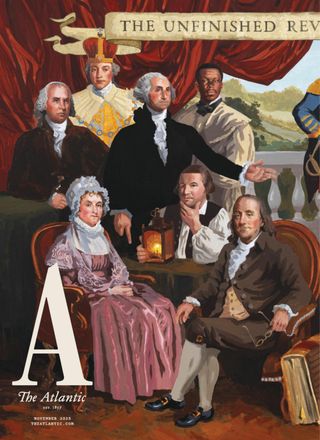

Bu hikaye The Atlantic dergisinin November 2025 baskısından alınmıştır.
Binlerce özenle seçilmiş premium hikayeye ve 9.000'den fazla dergi ve gazeteye erişmek için Magzter GOLD'a abone olun.
Zaten abone misiniz? Oturum aç
The Atlantic'den DAHA FAZLA HİKAYE
The Atlantic
You Had to Be There
An emerging field of history asks if we can ever really understand how our forebears experienced love, anger, fear, and sorrow.

23 mins
January 2026

The Atlantic
By the Horns
The week before the biggest bullfight of her career, in Cádiz, Spain, this past July, 24-year-old Miriam Cabas posted a carefully produced video on Instagram.
1 mins
January 2026

The Atlantic
The New German War Machine
After World War II, Germany embraced pacifism as a form of atonement. Now the country is arming itself again.
18 mins
January 2026
The Atlantic
The Eloquence
The prime minister was watching a disaster movie when we found him.
4 mins
January 2026

The Atlantic
What's for Dinner, Mom?
The women who want to change the way America eats
12 mins
January 2026

The Atlantic
How Terror Works
A 1947 German novel explores the sometimes corrosive, sometimes energizing nature of fear.
8 mins
January 2026

The Atlantic
Yesterday's Idea of a Modern Man
Sam Shepard, a self-made cowboy, was also a poet of masculine angst.
7 mins
January 2026

The Atlantic
ACCOMMODATION NATION
America's colleges have an extra-time-on-tests problem.
11 mins
January 2026

The Atlantic
Respect the Drummer
A new history of rock, told through its overlooked heroes
5 mins
January 2026

The Atlantic
THE MOST POWERFUL MAN IN SCIENCE
WHY IS ROBERT F. KENNEDY JR. SO CONVINCED HE'S RIGHT?
42 mins
January 2026
Listen
Translate
Change font size