Denemek ALTIN - Özgür
What Happened to Philosophy?
Philosophy Now
|October/November 2023
Alexander Jeuk says overspecialization, academic debate focusing, and simplistic argument structures, are prominent missteps in modern philosophy.

It is likely that most current academic philosophers would agree that there is not remotely a philosopher alive today who matches up to some of the classic philosophers. The last truly great analytic philosopher might have been Wittgenstein; the last great continental philosopher Heidegger. The former died in the 1950s, while the latter passed away in 1976. Probably there are more philosophers working today than ever before, and certainly some of them are very good and interesting, but are any of them great? Will some thinkers working today eventually come to be recognised by future generations as having been great? Nobody seems to have much confidence in this.
Of course, 'greatness' is an unclear term. Yet, it doesn't seem controversial to say that 'greatness' is a laudible attribute of particularly insightful, creative, revolutionary, or impactful philosophy - usually with a breadth that transcends the narrow specialization of modern academic disciplines with their categories and subcategories.
It is not merely a that little philosophy today is done even with the aspiration to be great. There should be an imperative to strive for such greatness, just because this greatness means particularly insightful, creative, revolutionary, or impactful philosophy that is, all the things that are desirable in philosophy. This applies in particular to those fields that influence the wider life of society, such as ethics, and social, economic, or political philosophy. If these fields can potentially contribute to the betterment of the human condition, then those toiling within them are under a moral obligation to strive to produce great work. Yet, while authors such as Marx or Keynes had a powerful impact on society (in many respects due to the intellectual quality of their work), contemporary research in such 'normative' fields has little influence on anybody except other academic philosophers.
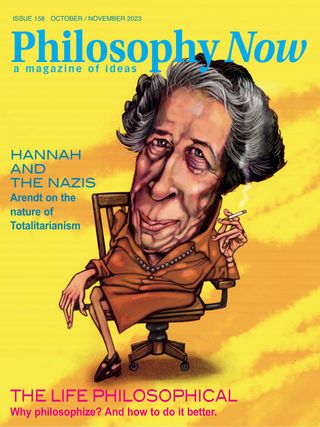

Bu hikaye Philosophy Now dergisinin October/November 2023 baskısından alınmıştır.
Binlerce özenle seçilmiş premium hikayeye ve 9.000'den fazla dergi ve gazeteye erişmek için Magzter GOLD'a abone olun.
Zaten abone misiniz? Oturum aç
Philosophy Now'den DAHA FAZLA HİKAYE

Philosophy Now
Bilbo Theorizes About Wellbeing
Eric Comerford overhears Bilbo and Gandalf discussing happiness.

9 mins
December 2025 / January 2026

Philosophy Now
What Women?
Marcia Yudkin remembers almost choking at Cornell
11 mins
December 2025 / January 2026
Philosophy Now
Islamic Philosophers On Tyranny
Amir Ali Maleki looks at tyranny from an Islamic perspective.
4 mins
December 2025 / January 2026

Philosophy Now
Peter Singer
The controversial Australian philosopher defends the right to choose to die on utilitarian grounds
5 mins
December 2025 / January 2026

Philosophy Now
Another Conversation with Martin Heidegger?
Raymond Tallis talks about communication problems.
7 mins
December 2025 / January 2026

Philosophy Now
Letters
When inspiration strikes, don't bottle it up. Email me at rick.lewis@philosophynow.org Keep them short and keep them coming!
17 mins
December 2025 / January 2026
Philosophy Now
The Philosophy of William Blake
Mark Vernon looks at the imaginative thinking of an imaginative artist.
9 mins
December 2025 / January 2026

Philosophy Now
Philosophical Haiku
Peering through life’s lens God in nature is deduced: The joy of being.
1 mins
December 2025 / January 2026

Philosophy Now
Philosophy Shorts
More songs about Buildings and Food' was the title of a 1978 album by the rock band Talking Heads. It was about all the things rock stars normally don't sing about. Pop songs are usually about variations on the theme of love; tracks like Rose Royce's 1976 hit 'Car Wash' are the exception. Philosophers, likewise, tend to have a narrow focus on epistemology, metaphysics and trifles like the meaning of life. But occasionally great minds stray from their turf and write about other matters, for example buildings (Martin Heidegger), food (Hobbes), tomato juice (Robert Nozick), and the weather (Lucretius and Aristotle). This series of Shorts is about these unfamiliar themes; about the things philosophers also write about.
2 mins
December 2025 / January 2026

Philosophy Now
Hedonic Treadmills in the Vale of Tears
Michael Gracey looks at how philosophers have pursued happiness.
8 mins
December 2025 / January 2026
Translate
Change font size