Denemek ALTIN - Özgür
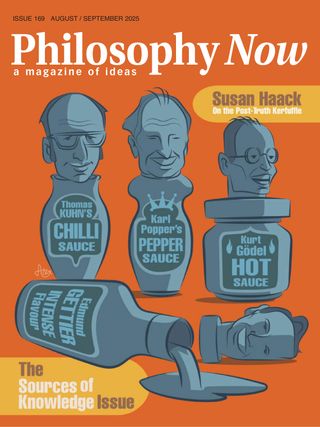
Popper, Science & Democracy
Philosophy Now
|August/September 2025
Brian King follows Popper's idea of the evolution of knowledge, life and society.
-

In an age in which both science and pseudoscience are more prominent than ever, it is useful to have a way to distinguish between them. The Austrian-British philosopher of science Sir Karl Popper (1902-94) gave us just that, in his 1934 book The Logic of Scientific Discovery. He called it falsification. A truly scientific theory, he said, consists of statements that can be rigorously tested against the evidence and potentially found to be false. Popper claimed that falsifiability is the key feature differentiating science from all other ways of thinking.
Ever since Aristotle in ancient times and Francis Bacon four hundred years ago, inductive logic was thought of as the method by which scientists discovered laws of nature. The sight of one white swan after another leads us to the theory that 'all swans are white' - in effect, a generalisation. However, as David Hume (1711-76) noted, the problem is that the generalisation does not logically follow. The more white swans you see, the more you might think the law 'All swans are white' is true - but this is just a psychological point about the way we think, not a point about the natural world, or swans. In fact, the only legitimate derivation would be that 'all swans seen so far are white'. And to argue that the future will always be like the past because it always has been, would be a circular argument - assuming what you are trying to prove. Moreover, the observation of black swans in Australia immediately disproved the law that 'all swans are white', showing that inductive generalisations can be disproved with one counter-instance. Popper develops this point in a falsificationist direction by writing,

Bu hikaye Philosophy Now dergisinin August/September 2025 baskısından alınmıştır.
Binlerce özenle seçilmiş premium hikayeye ve 9.000'den fazla dergi ve gazeteye erişmek için Magzter GOLD'a abone olun.
Zaten abone misiniz? Oturum aç
Philosophy Now'den DAHA FAZLA HİKAYE

Philosophy Now
The Possibility- Bearing Animal
Raymond Tallis explores a twilight zone.

7 mins
February/March 2026

Philosophy Now
Amazing Times at the Pub Agora
John Douglas Mullen is a philosophical bar fly on the wall.
8 mins
February/March 2026
Philosophy Now
Friedrich Nietzsche (1844-1900)
Hilarius Bogbinder considers the all too human life of the notorious iconoclast.
11 mins
February/March 2026

Philosophy Now
Heisenberg's Philosophy of Quantum Mechanics
Kanan Purkayastha explains how Werner Heisenberg's 1925 paper turned the quantum theory of the early 1900s into the quantum mechanics of today.
10 mins
February/March 2026
Philosophy Now
Cicero & the Ideal of Virtue
Abdullah Shaikh explores Cicero's ideas about the core Roman principle of virtus.
13 mins
February/March 2026

Philosophy Now
ROPE
Les Jones has a Nietzschean take on a Hitchcock thriller.
6 mins
February/March 2026
Philosophy Now
What Have the Romans Ever Done For Us?
Salve! This issue's theme is Roman Philosophy. But as the rebels in Monty Python's Life of Brian asked, what have the Romans ever done for us? The question seems relevant here; we are philosophers, not archaeologists.
2 mins
February/March 2026

Philosophy Now
Paul Guyer
Paul Guyer is an American philosopher and a leading scholar of both Immanuel Kant and aesthetics. AmirAli Maleki interviews him about Kant's political and moral vision.
9 mins
February/March 2026
Philosophy Now
Identity in the Age of Connectivity
Sara Asran explores the dynamics of identity online.
6 mins
February/March 2026
Philosophy Now
A Very Short History of Critical Thinking
Luc de Brabandere summarises a long history through key figures of thought.
7 mins
February/March 2026
Listen
Translate
Change font size