
Magzter GOLD ile Sınırsız Olun
Sadece 9.000'den fazla dergi, gazete ve Premium hikayeye sınırsız erişim elde edin
Denemek ALTIN - Özgür
Fish exposed to Microplastics pollution since 1950s
Scientific India
|November - December 2021
Plastics is an avoidable thing for modern Pcivilization, it is impossible to picture a future without it. Plastics are ubiquitous and it is included in food packaging, automobiles, clothes, fishing gear, and medical devices. Plastics are highly used because of its features such as lightness, strength, durability, and low cost, among other alternatives. Plastics benefits are overshadowed by their drawbacks, such as their strong resistance to deterioration and the real fact that they get accumulate in nature due to poor management of waste in many parts of the world. This can be particularly noticeable on beaches and in oceans, where currents and wind carry plastic trash.

Plastics and microplastics
According to Eriksen et al. 2014 there are around 5 trillion plastic bits of all sizes floating in the oceans, which weighs about 250,000 tonnes. Growing awareness of plastic pollution of ocean has led to better plastic waste management, prohibitions were imposed by several nations on the use of microplastics in cosmetics, and in the use of disposable plastic products like shopping bags, cutlery etc. Plastics which are smaller than 5 mm are classified as Microplastics. Microplastics are usually divided into two categories according to the source namely primary and secondary. Microplastics are released into the environment either accidently or through wastewater. Pellets used in the production of bigger plastic goods, as well as microbeads used in cosmetics and industrial processes are the principal sources. Plastic fragmentation, weathering of plastic debris on shorelines, sea, and UV induced brittleness of plastics are the secondary sources of microplastics.
Microplastics in Fishes and Bivalves
Rochman and his team conducted a study on the 76 whole fish which includes 11 species purchased from Indonesian fish market and they discovered that gastrointestinal track of these species contains about 28 percentage of plastic waste. The same team has evaluated the 64 whole fish which includes 12 species purchased from California and they identified that 25 percent microplastics are available in the gut of these species.
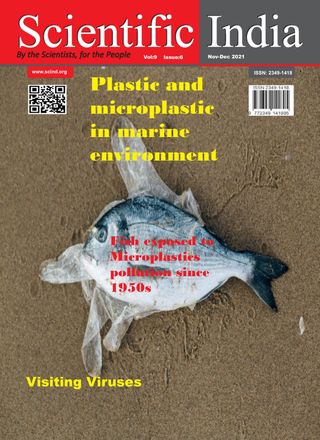

Bu hikaye Scientific India dergisinin November - December 2021 baskısından alınmıştır.
Binlerce özenle seçilmiş premium hikayeye ve 9.000'den fazla dergi ve gazeteye erişmek için Magzter GOLD'a abone olun.
Zaten abone misiniz? Oturum aç
Scientific India'den DAHA FAZLA HİKAYE

Scientific India
Astronomers discover dying stars eating their planets
Anew study from astronomers at UCL (University College London) and the University of Warwick suggests that aging stars may be destroying the giant planets orbiting closest to them.

1 mins
November-December 2025

Scientific India
The Gut-Brain Connection: How Our Second Brain May Hold the Key to Preventing Neurodegeneration
For decades, the prevailing narrative of neurodegenerative diseases like Alzheimer's and Parkinson's was centred around isolated confinement within the brain.
4 mins
November-December 2025

Scientific India
Active and Intelligent Bioplastic Packaging: Materials, Benefits, Applications, Challenges, and Future Prospects
Bioplastic-based active and intelligent packaging represents one of the most transformative innovations in modern food preservation.
2 mins
November-December 2025

Scientific India
Gut Microbes and Yoga: The Hidden Harmony for Healthy Aging and Well-Being
The human gut is home to trillions of microorganisms, including bacteria, viruses, fungi, and archaea. In fact, the number of microbial cells in your body might outnumber your human cells by about 10 to 1! About 70% of your immune system is located in your gut. Your gut microbes help train your immune system to differentiate between harmful invaders and harmless substances, thus playing a big role in preventing autoimmune diseases. Just like a rainforest, the gut microbiota is a diverse and complex ecosystem. A healthy gut has a balanced mix of different types of microbes, which can help prevent the overgrowth of harmful bacteria.
6 mins
November-December 2025

Scientific India
Market Trends and Future Prospects of Bioplastics in the Global Packaging Industry
Across retail shelves, e-commerce parcels, and ready-to-eat food containers, packaging is undergoing one of the most rapid material transitions of the 21st century.
5 mins
November-December 2025

Scientific India
From Waste to Harvest: The Power of Human Urine as an Eco-Friendly Fertilizer
As the global population continues to grow, so too does the demand for food.
4 mins
November-December 2025

Scientific India
Sugar-free sweeteners may still be harming your liver
Sweeteners such as aspartame, found in Equal packets, sucralose (Splenda), and sugar alcohols are widely promoted as healthier options than foods made with refined sugar (glucose).
2 mins
November-December 2025

Scientific India
Colon cancer is surging in younger adults and doctors are alarmed
Colorectal cancer has long been viewed as a condition that primarily affects older adults.
3 mins
November-December 2025

Scientific India
How Eating Your Vitamin C Builds Healthier Skin From Within
For decades, the skincare aisle has promised younger-looking skin from the outside in, with vitamin C serums occupying a prized place on the shelf.
1 mins
November-December 2025

Scientific India
A Simple Blood Test Could Transform Alzheimer's Diagnosis
For decades, diagnosing Alzheimer's disease has relied heavily on memory tests, clinical judgment, and a long wait for symptoms to become unmistakable. Now, a groundbreaking blood test being rolled out across the UK could dramatically change that narrative bringing earlier, more accurate diagnosis within reach of routine healthcare.
2 mins
November-December 2025
Translate
Change font size