Denemek ALTIN - Özgür
Market Trends and Future Prospects of Bioplastics in the Global Packaging Industry
Scientific India
|November-December 2025
Across retail shelves, e-commerce parcels, and ready-to-eat food containers, packaging is undergoing one of the most rapid material transitions of the 21st century.
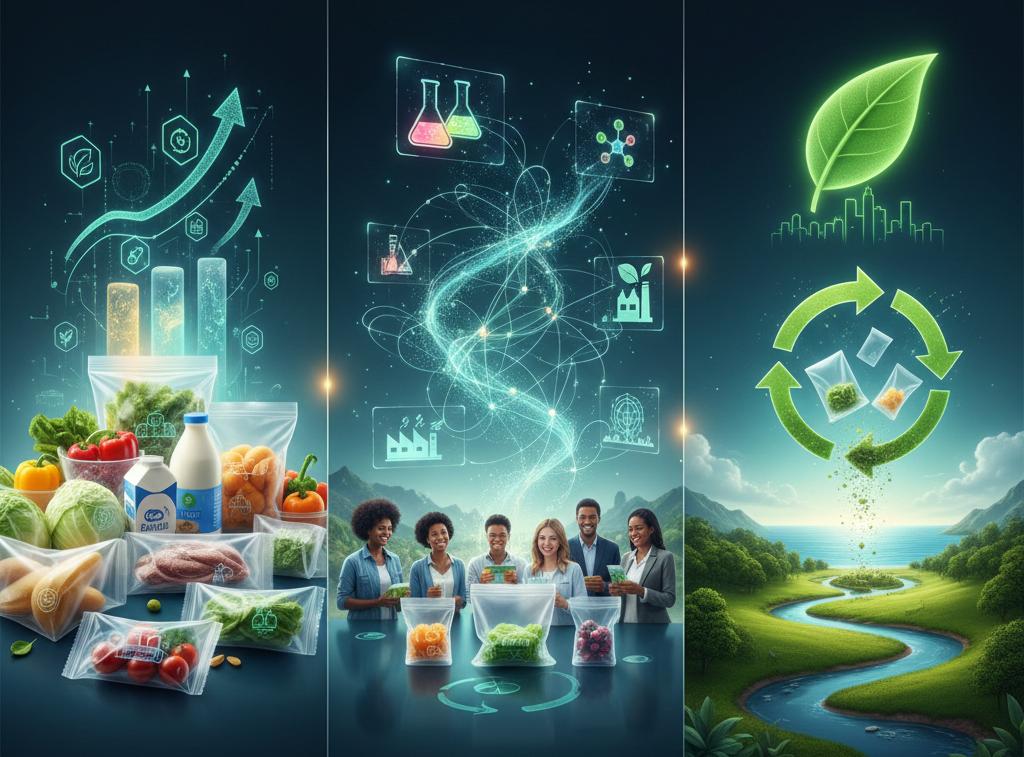
Bioplastics a diverse family of bio-based, biodegradable, and compostable polymers such as PLA, PHA, bio-PE, and starch blends—are emerging as prominent alternatives to conventional fossilbased plastics. Their rising adoption is powered by several converging forces: ambitious corporate sustainability commitments, regulatory measures targeting single-use plastics, and growing consumer preference for environmentally responsible packaging. Yet, the sector also faces significant challenges, including production costs, infrastructure gaps for waste management, and uncertainties surrounding environmental impacts. This article provides a comprehensive overview of the current market landscape, technological and regulatory drivers, commercial factors, challenges, and future prospects for bioplastics in global packaging.
Current Market Snapshot and Growth Projections
Market estimates for bioplastic packaging differ across studies, but all indicate rapid expansion. Global market size for bioplastic packaging in 2024–2025 is estimated in the mid-to-upper billion-dollar range, with strong double-digit compound annual growth rates (CAGRs) projected through 2030. Production capacity is also rising sharply. According to European Bioplastics, global bioplastics production capacity will increase from about 2.5 million tonnes in 2024 to over 5.7 million tonnes by 2029—nearly doubling within five years. New facilities producing PLA, PHA, and bio-PE are being commissioned by both traditional chemical companies and specialized biopolymer firms.
Two primary forces underpin these aggressive capacity expansions:
1. Regulatory pressure to reduce fossil-based plastic waste, and
2. Corporate and consumer demand for more sustainable packaging.
These signals reinforce each other, creating a selfsustaining cycle of demand growth and production investment.
Regulatory and Policy Drivers

Bu hikaye Scientific India dergisinin November-December 2025 baskısından alınmıştır.
Binlerce özenle seçilmiş premium hikayeye ve 9.000'den fazla dergi ve gazeteye erişmek için Magzter GOLD'a abone olun.
Zaten abone misiniz? Oturum aç
Scientific India'den DAHA FAZLA HİKAYE
Scientific India
Japanese physicists were the first to measure the most tolerant entanglement state, the W state
There are many unusual things that happen in the world of quantum physics.

3 mins
September - October 2025

Scientific India
The Fifth Force: Could It Unlock the Secret of Dark Matter?
What if the universe is powered by a force we've never seen before? For centuries, science has explained nature with four fundamental forces.
3 mins
September - October 2025

Scientific India
A flu test you can chew
As flu season nears in the northern hemisphere, scientists are exploring a surprising new way to detect infection: through taste.
1 mins
September - October 2025

Scientific India
Lab-Grown Kidney Brings Artificial Organ Dream Closer to Reality
In a major leap toward bioengineered organ replacement, scientists have successfully grown human kidney 'assembloids' in the laboratory that mimic key structural and functional features of natural kidneys.
1 min
September - October 2025

Scientific India
Your pumpkin might be hiding a toxic secret
Pumpkins, squash, zucchini, and other members of the gourd family have a surprising trait: they can take up pollutants from the soil and store them in their edible parts.
1 mins
September - October 2025

Scientific India
2025 Nobel Prize in Physics Reveals Quantum Secrets in Superconducting Circuits
The 2025 Nobel Prize in Physics has been awarded to John Clarke, Michel H. Devoret, and John M. Martinis for their pioneering experiments that brought quantum mechanics from the invisible atomic world to the macroscopic scale a system large enough to hold in your hand.
1 mins
September - October 2025
Scientific India
Genomic Evidence Redefines the Evolutionary Age of Mosquitoes
A new genetic analysis has shaken up what we thought we knew about one of humanity's most notorious pests the mosquito.
1 min
September - October 2025

Scientific India
Nobel Prize in Chemistry 2025: Building Molecular Architectures with Room to Breathe
In a scientific breakthrough that bridges molecular design with planetary-scale problems, the 2025 Nobel Prize in Chemistry has been awarded to Susumu Kitagawa, Richard Robson, and Omar Yaghi.
1 mins
September - October 2025

Scientific India
Guardians of Immunity: Nobel Prize 2025 Honors Discoveries that Keep the Immune System in Check
The 2025 Nobel Prize in Physiology or Medicine has been awarded to Mary E. Brunkow, Fred Ramsdell, and Shimon Sakaguchi for their groundbreaking discoveries in the field of peripheral immune tolerance a crucial mechanism that prevents the body's immune system from turning against itself.
1 mins
September - October 2025

Scientific India
'Is cold nuclear fusion feasible?
In early May 1989, two chemists from the University of Utah, Pons and Fleischmann, arrived in Washington, U.S.A. The aim is to present their findings to members of the US Congress.
3 mins
September - October 2025
Listen
Translate
Change font size