
Magzter GOLD ile Sınırsız Olun
Sadece 9.000'den fazla dergi, gazete ve Premium hikayeye sınırsız erişim elde edin
Denemek ALTIN - Özgür
We Let Them Die
Down To Earth
|July 16, 2019
Failure of states to provide basic nutrition and health facilities has led to the death of hundreds of children from the preventable acute encephalopathy syndrome. BANJOT KAUR from Bihar and SHAGUN KAPIL from Uttar Pradesh report

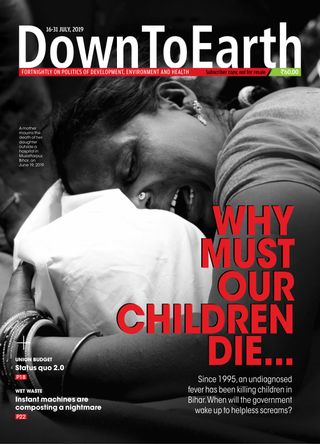
Death looms over Bihar’s Muzaffarpur district. The tragedy that robbed Ramesh Sahni of his daughter on June 15 had, by July 3, turned into a mass curse, killing 168 children in the state. The victims, mostly girls, are below 15 years, belong to socially and economically deprived sections, and live in villages without easy access to healthcare centres.
Acute encephalopathy syndrome or AES, a brain fever whose cause remains unknown (see ‘Enigmatic AES’ on p36 ), strikes in and around Muzaffarpur and has killed 1,673 children in the state since 2010, when the government started a centralised registry for it. This year, one in every five AES patientsin Bihar has died. The tragedy is even more acute in Muzaffarpur, which accounts for 65 per cent of the state’s 539 AES cases and 58 per cent of the total deaths till July 3. The disease has an unmistakable pattern: most children went to sleep at night hungry and woke up in the morning with fever and seizures. Most of them died because their nearest health centre did not even have glucose drips.
Vijay Kumar, who lost his six-year-old son on June 6, says the primary health centre nearest to his Bahadurpur village in Muzaffarpur refused to treat his ailing son because it did not have glucose. Kumar had to travel for over two hours to reach the Sri Krishna Medical College and Hospital (SKMCH) in Muzaffarpur. “My son went into coma during the travel. Four hours later, he died,” says Kumar.

Bu hikaye Down To Earth dergisinin July 16, 2019 baskısından alınmıştır.
Binlerce özenle seçilmiş premium hikayeye ve 9.000'den fazla dergi ve gazeteye erişmek için Magzter GOLD'a abone olun.
Zaten abone misiniz? Oturum aç
Down To Earth'den DAHA FAZLA HİKAYE

Down To Earth
THINK TWICE BEFORE FELLING SAL TREES
Many trees considered to be affected by sal borer in the 1990s are still alive today

1 mins
February 16, 2026

Down To Earth
EDGE OF SURVIVAL
Caste divides deny marginalised communities land, resources and essential aid, leaving them more vulnerable to climate disasters
6 mins
February 16, 2026

Down To Earth
A WISH LIST?
Union Budget for 2026-27 conveys the impression of a roll-call of intentions and ambitious proposals, with little detail on their formulation
6 mins
February 16, 2026
Down To Earth
Break down the gender wall
THE RULING National Democratic Alliance (NDA) government has been heavily invested in the goal to make India a developed economy by 2047.
2 mins
February 16, 2026

Down To Earth
MENSTRUAL HEALTH, NOW A FUNDAMENTAL RIGHT
In a landmark judgement, the Supreme Court has recognised menstrual health and hygiene as a fundamental right under Article 21 of the Constitution of India, which guarantees the right to life and dignity.
8 mins
February 16, 2026

Down To Earth
Of devolution and new disasters
The 16th Finance Commission pushes for changes in view of new fiscal and climatic conditions
11 mins
February 16, 2026
Down To Earth
Rising risks of plastics
NEGATIVE IMPACTS on human health due to emissions linked to the plastic lifecycle could double by 2040, according to a study published in The Lancet Planetary Health in January.
1 min
February 16, 2026

Down To Earth
GAP BETWEEN EPIDEMICS NARROWING
A watershed-based and landscape-level approach is needed to address forest degradation
2 mins
February 16, 2026
Down To Earth
WAITING TO STRIKE
Sal heartwood borer is considered the biggest threat to forestry in India, especially to the sal tree, where it lives and breeds.
11 mins
February 16, 2026

Down To Earth
A SPRING DELIGHT
Mustard flowers are not meant only for the eyes. Invite them to your plate once in a while
3 mins
February 16, 2026
Translate
Change font size