يحاول ذهب - حر
We Let Them Die
July 16, 2019
|Down To Earth
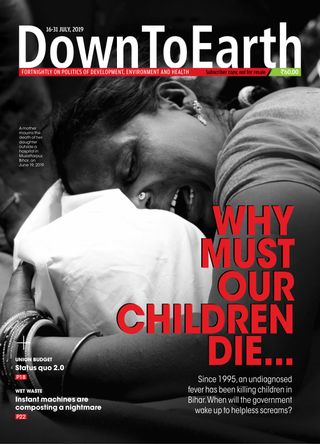
Failure of states to provide basic nutrition and health facilities has led to the death of hundreds of children from the preventable acute encephalopathy syndrome. BANJOT KAUR from Bihar and SHAGUN KAPIL from Uttar Pradesh report

Death looms over Bihar’s Muzaffarpur district. The tragedy that robbed Ramesh Sahni of his daughter on June 15 had, by July 3, turned into a mass curse, killing 168 children in the state. The victims, mostly girls, are below 15 years, belong to socially and economically deprived sections, and live in villages without easy access to healthcare centres.
Acute encephalopathy syndrome or AES, a brain fever whose cause remains unknown (see ‘Enigmatic AES’ on p36 ), strikes in and around Muzaffarpur and has killed 1,673 children in the state since 2010, when the government started a centralised registry for it. This year, one in every five AES patientsin Bihar has died. The tragedy is even more acute in Muzaffarpur, which accounts for 65 per cent of the state’s 539 AES cases and 58 per cent of the total deaths till July 3. The disease has an unmistakable pattern: most children went to sleep at night hungry and woke up in the morning with fever and seizures. Most of them died because their nearest health centre did not even have glucose drips.
Vijay Kumar, who lost his six-year-old son on June 6, says the primary health centre nearest to his Bahadurpur village in Muzaffarpur refused to treat his ailing son because it did not have glucose. Kumar had to travel for over two hours to reach the Sri Krishna Medical College and Hospital (SKMCH) in Muzaffarpur. “My son went into coma during the travel. Four hours later, he died,” says Kumar.

هذه القصة من طبعة July 16, 2019 من Down To Earth.
اشترك في Magzter GOLD للوصول إلى آلاف القصص المتميزة المنسقة، وأكثر من 9000 مجلة وصحيفة.
هل أنت مشترك بالفعل؟ تسجيل الدخول
المزيد من القصص من Down To Earth

Down To Earth
THE GREAT PIVOT
China's moves to transition to clean energy offer critical lessons to India

4 mins
March 01, 2026

Down To Earth
COAL V CORRIDOR
A proposal to mine coal along a corridor that links two tiger reserves in central India is a step away from getting final clearance. The move could affect movement and genetic diversity of tiger populations in the region
8 mins
March 01, 2026

Down To Earth
India's challenging AI predicament
Hobbled by lack of innovation and AI skills in its crucial technology sector, India is focusing on a ruinous plan to host data centres
4 mins
March 01, 2026
Down To Earth
China to implement zero tariffs across Africa
CHINA ON February 14 announced that it will implement zero tariffs for imports from all the 53 African nations it has diplomatic relations with, starting from May 1.
1 min
March 01, 2026
Down To Earth
Poverty, sans the threshold
MEASUREMENT OF poverty is a fundamental exercise, needed to direct development programmes.
2 mins
March 01, 2026

Down To Earth
A bridge across forever
For two decades, a Chhattisgarh village remains stuck in a loop of building temporary river crossings to access markets and sell forest produce
4 mins
March 01, 2026
Down To Earth
Liveable cities need a new model
CRY FOR my Delhi. This is my city—my family records many generations who have lived here.
3 mins
March 01, 2026
Down To Earth
Real impacts of the changing seasons
This refers to the article \"1,500 days, and an alarm for new climate\" (1-15 December, 2025).
1 mins
March 01, 2026

Down To Earth
‘It’s a systematic effort by US to dismantle climate policy’
The US, the world's largest historical emitter of greenhouse gases, has overturned its “endangerment finding”, the legal foundation for regulating emissions under the Clean Air Act since 2009.
4 mins
March 01, 2026
Down To Earth
Amazon turned carbon source in 2023 drought
EXTREME DROUGHT and a prolonged heatwave in 2023 pushed parts of the Amazon rainforest from acting as a carbon sink to becoming a carbon source for three months, according to a February 13 study published in the journal AGU Advances of the American Geophysical Union.
1 min
March 01, 2026
Translate
Change font size