Denemek ALTIN - Özgür
Listen... Plants Too Speak
Down To Earth
|January 01, 2019
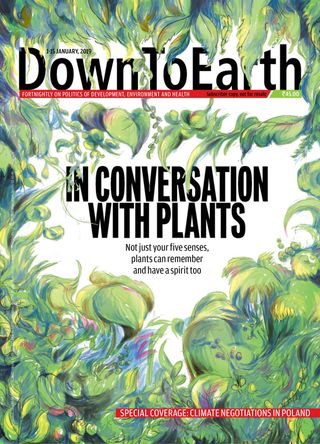
As early as in 1880, Charles Darwin demonstrated that plants could sense light, moisture, gravity, pressure and possessed several other qualities. Over the years, many scientists have proved that plants are sentient beings and move and respond to sensation. The subject is still controversial among the scientific community. Monica Gagliano is research associate professor of evolutionary ecology and former fellow of the Australian Research Council who has pioneered a brand-new research field of plant bioacoustics. In her latest book, Thus Spoke the Plant: A Remarkable Journey of Groundbreaking Scientific Discoveries and Personal Encounters with Plants, she, for the first time, has experimentally demonstrated that plants emit their own ªvoicesº and detect and respond to the sounds of their environments. In these excerpts, Gagliano writes about how the pea plant responds to acoustic vibrations to locate water
-

Oryngham means thank you for listening in the language of the plants. It is not a word, as we humans understand it, because its meaning cannot be spoken—nor can it be heard. However, we can experience it by feeling with our bodies and listening to what our ears cannot hear. When we learn to listen to plants without the need to hear them speak, a language that we have forgotten emerges; it is a language beyond words, one that does not wander or pretend or mislead. It is a language that conveys its rich and meaningful expression by bypassing the household of our mind and directly connecting one spirit to another. This language belongs to plants, and so do these stories.
IN GENERAL, organisms use various kinds of information transmitted by smells, sounds, lights, or magnetic fields in order to make good choices and avoid fatal errors. Based on this idea and as instructed by Ayahuma, I designed the experiments with the peas in the maze to test how roots choose the direction that correctly leads them to water, depending on the cues available. Particularly, could the roots of the young peas sense the acoustic vibrations generated by water moving underground or inside pipes? Could they use the sound of water alone to detect and find its source, when no actual water was available in close vicinity?
To answer this, I wrapped a sealed, soft plastic pipe through which water was constantly flowing around the base of one side of the maze, but the water itself was never directly accessible to the plants. Then I compared the choices roots made in these mazes to those they made growing in mazes where the soil was kept moist by actual water contained in the small plastic tray attached at the base of one side of the maze, hence producing a moisture gradient.

Bu hikaye Down To Earth dergisinin January 01, 2019 baskısından alınmıştır.
Binlerce özenle seçilmiş premium hikayeye ve 9.000'den fazla dergi ve gazeteye erişmek için Magzter GOLD'a abone olun.
Zaten abone misiniz? Oturum aç
Down To Earth'den DAHA FAZLA HİKAYE

Down To Earth
THINK TWICE BEFORE FELLING SAL TREES
Many trees considered to be affected by sal borer in the 1990s are still alive today

1 mins
February 16, 2026

Down To Earth
EDGE OF SURVIVAL
Caste divides deny marginalised communities land, resources and essential aid, leaving them more vulnerable to climate disasters
6 mins
February 16, 2026

Down To Earth
A WISH LIST?
Union Budget for 2026-27 conveys the impression of a roll-call of intentions and ambitious proposals, with little detail on their formulation
6 mins
February 16, 2026
Down To Earth
Break down the gender wall
THE RULING National Democratic Alliance (NDA) government has been heavily invested in the goal to make India a developed economy by 2047.
2 mins
February 16, 2026

Down To Earth
MENSTRUAL HEALTH, NOW A FUNDAMENTAL RIGHT
In a landmark judgement, the Supreme Court has recognised menstrual health and hygiene as a fundamental right under Article 21 of the Constitution of India, which guarantees the right to life and dignity.
8 mins
February 16, 2026

Down To Earth
Of devolution and new disasters
The 16th Finance Commission pushes for changes in view of new fiscal and climatic conditions
11 mins
February 16, 2026
Down To Earth
Rising risks of plastics
NEGATIVE IMPACTS on human health due to emissions linked to the plastic lifecycle could double by 2040, according to a study published in The Lancet Planetary Health in January.
1 min
February 16, 2026

Down To Earth
GAP BETWEEN EPIDEMICS NARROWING
A watershed-based and landscape-level approach is needed to address forest degradation
2 mins
February 16, 2026
Down To Earth
WAITING TO STRIKE
Sal heartwood borer is considered the biggest threat to forestry in India, especially to the sal tree, where it lives and breeds.
11 mins
February 16, 2026

Down To Earth
A SPRING DELIGHT
Mustard flowers are not meant only for the eyes. Invite them to your plate once in a while
3 mins
February 16, 2026
Translate
Change font size