يحاول ذهب - حر
Listen... Plants Too Speak
January 01, 2019
|Down To Earth
As early as in 1880, Charles Darwin demonstrated that plants could sense light, moisture, gravity, pressure and possessed several other qualities. Over the years, many scientists have proved that plants are sentient beings and move and respond to sensation. The subject is still controversial among the scientific community. Monica Gagliano is research associate professor of evolutionary ecology and former fellow of the Australian Research Council who has pioneered a brand-new research field of plant bioacoustics. In her latest book, Thus Spoke the Plant: A Remarkable Journey of Groundbreaking Scientific Discoveries and Personal Encounters with Plants, she, for the first time, has experimentally demonstrated that plants emit their own ªvoicesº and detect and respond to the sounds of their environments. In these excerpts, Gagliano writes about how the pea plant responds to acoustic vibrations to locate water
-

Oryngham means thank you for listening in the language of the plants. It is not a word, as we humans understand it, because its meaning cannot be spoken—nor can it be heard. However, we can experience it by feeling with our bodies and listening to what our ears cannot hear. When we learn to listen to plants without the need to hear them speak, a language that we have forgotten emerges; it is a language beyond words, one that does not wander or pretend or mislead. It is a language that conveys its rich and meaningful expression by bypassing the household of our mind and directly connecting one spirit to another. This language belongs to plants, and so do these stories.
IN GENERAL, organisms use various kinds of information transmitted by smells, sounds, lights, or magnetic fields in order to make good choices and avoid fatal errors. Based on this idea and as instructed by Ayahuma, I designed the experiments with the peas in the maze to test how roots choose the direction that correctly leads them to water, depending on the cues available. Particularly, could the roots of the young peas sense the acoustic vibrations generated by water moving underground or inside pipes? Could they use the sound of water alone to detect and find its source, when no actual water was available in close vicinity?
To answer this, I wrapped a sealed, soft plastic pipe through which water was constantly flowing around the base of one side of the maze, but the water itself was never directly accessible to the plants. Then I compared the choices roots made in these mazes to those they made growing in mazes where the soil was kept moist by actual water contained in the small plastic tray attached at the base of one side of the maze, hence producing a moisture gradient.
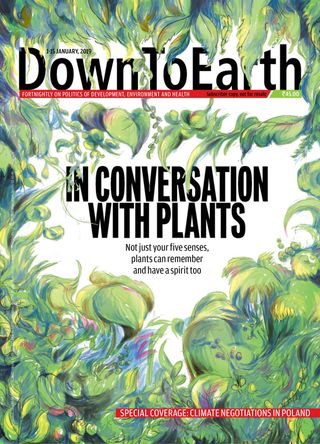

هذه القصة من طبعة January 01, 2019 من Down To Earth.
اشترك في Magzter GOLD للوصول إلى آلاف القصص المتميزة المنسقة، وأكثر من 9000 مجلة وصحيفة.
هل أنت مشترك بالفعل؟ تسجيل الدخول
المزيد من القصص من Down To Earth
Down To Earth
THE GREAT PIVOT
China's moves to transition to clean energy offer critical lessons to India

4 mins
March 01, 2026

Down To Earth
COAL V CORRIDOR
A proposal to mine coal along a corridor that links two tiger reserves in central India is a step away from getting final clearance. The move could affect movement and genetic diversity of tiger populations in the region
8 mins
March 01, 2026

Down To Earth
India's challenging AI predicament
Hobbled by lack of innovation and AI skills in its crucial technology sector, India is focusing on a ruinous plan to host data centres
4 mins
March 01, 2026
Down To Earth
China to implement zero tariffs across Africa
CHINA ON February 14 announced that it will implement zero tariffs for imports from all the 53 African nations it has diplomatic relations with, starting from May 1.
1 min
March 01, 2026
Down To Earth
Poverty, sans the threshold
MEASUREMENT OF poverty is a fundamental exercise, needed to direct development programmes.
2 mins
March 01, 2026

Down To Earth
A bridge across forever
For two decades, a Chhattisgarh village remains stuck in a loop of building temporary river crossings to access markets and sell forest produce
4 mins
March 01, 2026
Down To Earth
Liveable cities need a new model
CRY FOR my Delhi. This is my city—my family records many generations who have lived here.
3 mins
March 01, 2026
Down To Earth
Real impacts of the changing seasons
This refers to the article \"1,500 days, and an alarm for new climate\" (1-15 December, 2025).
1 mins
March 01, 2026

Down To Earth
‘It’s a systematic effort by US to dismantle climate policy’
The US, the world's largest historical emitter of greenhouse gases, has overturned its “endangerment finding”, the legal foundation for regulating emissions under the Clean Air Act since 2009.
4 mins
March 01, 2026
Down To Earth
Amazon turned carbon source in 2023 drought
EXTREME DROUGHT and a prolonged heatwave in 2023 pushed parts of the Amazon rainforest from acting as a carbon sink to becoming a carbon source for three months, according to a February 13 study published in the journal AGU Advances of the American Geophysical Union.
1 min
March 01, 2026
Translate
Change font size