
Magzter GOLD ile Sınırsız Olun
Sadece 9.000'den fazla dergi, gazete ve Premium hikayeye sınırsız erişim elde edin
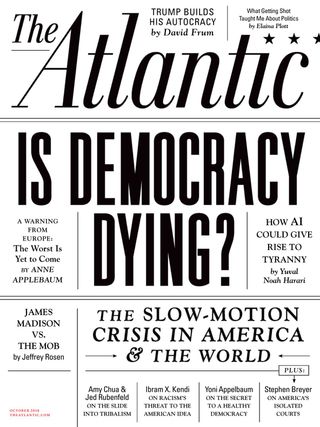
Adison Vs. The Mob
The Atlantic
|October 2018
The founders designed a government that would be insulated from the heat of popular sentiment, but they didnt anticipate the unbridled passions of the digital age.Here show the constitutional order can survive.

JAMES
MADISON
TRAVELED
to Philadelphia in 1787 with Athens on his mind. He had spent the year before the Constitutional Convention reading two trunkfuls of books on the history of failed democracies, sent to him from Paris by Thomas Jefferson. Madison was determined, in drafting the Constitution, to avoid the fate of those “ancient and modern confederacies,” which he believed had succumbed to rule by demagogues and mobs.
Madison’s reading convinced him that direct democracies—such as the assembly in Athens, where 6,000 citizens were required for a quorum—unleashed populist passions that overcame the cool, deliberative reason prized above all by Enlightenment thinkers.
“In all very numerous assemblies, of whatever characters composed, passion never fails to wrest the sceptre from reason,” he argued in The Federalist Papers, the essays he wrote (along with Alexander Hamilton and John Jay) to build support for the ratification of the Constitution. “Had every Athenian citizen been a Socrates, every Athenian assembly would still have been a mob.”
Madison and Hamilton believed that Athenian citizens had been swayed by crude and ambitious politicians who had played on their emotions. The demagogue Cleon was said to have seduced the assembly into being more hawkish toward Athens’s opponents in the Peloponnesian War, and even the reformer Solon cancelled debts and debased the currency. In Madison’s view, history seemed to be repeating itself in America. After the Revolutionary War, he had observed in Massachusetts “a rage for paper money, for abolition of debts, for an equal division of property.” That populist rage had led to Shays’s Rebellion, which pitted a band of debtors against their creditors.

Bu hikaye The Atlantic dergisinin October 2018 baskısından alınmıştır.
Binlerce özenle seçilmiş premium hikayeye ve 9.000'den fazla dergi ve gazeteye erişmek için Magzter GOLD'a abone olun.
Zaten abone misiniz? Oturum aç
The Atlantic'den DAHA FAZLA HİKAYE

The Atlantic
You Had to Be There
An emerging field of history asks if we can ever really understand how our forebears experienced love, anger, fear, and sorrow.

23 mins
January 2026

The Atlantic
By the Horns
The week before the biggest bullfight of her career, in Cádiz, Spain, this past July, 24-year-old Miriam Cabas posted a carefully produced video on Instagram.
1 mins
January 2026

The Atlantic
The New German War Machine
After World War II, Germany embraced pacifism as a form of atonement. Now the country is arming itself again.
18 mins
January 2026
The Atlantic
The Eloquence
The prime minister was watching a disaster movie when we found him.
4 mins
January 2026

The Atlantic
What's for Dinner, Mom?
The women who want to change the way America eats
12 mins
January 2026

The Atlantic
How Terror Works
A 1947 German novel explores the sometimes corrosive, sometimes energizing nature of fear.
8 mins
January 2026

The Atlantic
Yesterday's Idea of a Modern Man
Sam Shepard, a self-made cowboy, was also a poet of masculine angst.
7 mins
January 2026

The Atlantic
ACCOMMODATION NATION
America's colleges have an extra-time-on-tests problem.
11 mins
January 2026

The Atlantic
Respect the Drummer
A new history of rock, told through its overlooked heroes
5 mins
January 2026

The Atlantic
THE MOST POWERFUL MAN IN SCIENCE
WHY IS ROBERT F. KENNEDY JR. SO CONVINCED HE'S RIGHT?
42 mins
January 2026
Translate
Change font size