
Magzter GOLD ile Sınırsız Olun
Sadece 9.000'den fazla dergi, gazete ve Premium hikayeye sınırsız erişim elde edin
Denemek ALTIN - Özgür
Transcending Kant
Philosophy Now
|June / July 2022
Joshua Mozersky argues that reality itself might be accessible to us.

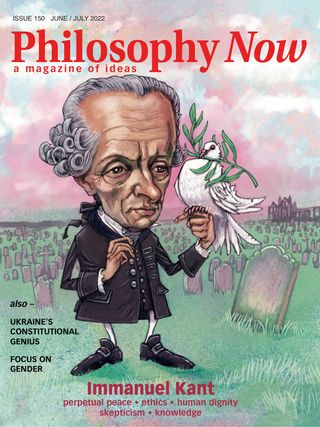
Immanuel Kant is the grandfather of social constructivism the theory that people construct reality out of a shared human experience. According to Kant, the world we experience of space, time, matter, and causation, is structured by the human mind. His point is not just that our concepts of the world are determined by our mental architecture. Rather, space, time, matter, and causation themselves are mentally structured kinds.
Kant assumes that the structure of rational thought is universal. Hence, we are not each trapped in an individual reality of our individual making, but instead share a common world of experience. Today, sociologists tend to emphasize the variety of human thought that arises from differences in culture, history, or social position. The result is a more fragmented view of human thought than Kant imagined. Where he saw everyone inhabiting a single mentally constructed reality, many today see us as occupying different realities, each dependent on contingent background features. But this does mean that Kant + contingent variability = social constructivism. Hence, he is the grandfather of social constructivism.
Kant deployed his own 'constructivism' to respond to Hume, who argued that the senses can only deliver imperfect information about the view just from your particular perspective and there is no way to push beyond personal experience to knowledge of the universal or general structure of the world. Kant points out that this only follows if we assume that gaining knowledge is a matter of the mind conforming itself to what lies outside of it, and so is separate from it. If, on the other hand, the mind is responsible for the general features of the empirical experience of the world, then we can uncover the large-scale properties of reality from sufficiently critical reflection on the workings of the mind, and in particular, from reason itself.

Bu hikaye Philosophy Now dergisinin June / July 2022 baskısından alınmıştır.
Binlerce özenle seçilmiş premium hikayeye ve 9.000'den fazla dergi ve gazeteye erişmek için Magzter GOLD'a abone olun.
Zaten abone misiniz? Oturum aç
Philosophy Now'den DAHA FAZLA HİKAYE
Philosophy Now
Bilbo Theorizes About Wellbeing
Eric Comerford overhears Bilbo and Gandalf discussing happiness.

9 mins
December 2025 / January 2026

Philosophy Now
What Women?
Marcia Yudkin remembers almost choking at Cornell
11 mins
December 2025 / January 2026
Philosophy Now
Islamic Philosophers On Tyranny
Amir Ali Maleki looks at tyranny from an Islamic perspective.
4 mins
December 2025 / January 2026

Philosophy Now
Peter Singer
The controversial Australian philosopher defends the right to choose to die on utilitarian grounds
5 mins
December 2025 / January 2026

Philosophy Now
Another Conversation with Martin Heidegger?
Raymond Tallis talks about communication problems.
7 mins
December 2025 / January 2026

Philosophy Now
Letters
When inspiration strikes, don't bottle it up. Email me at rick.lewis@philosophynow.org Keep them short and keep them coming!
17 mins
December 2025 / January 2026
Philosophy Now
The Philosophy of William Blake
Mark Vernon looks at the imaginative thinking of an imaginative artist.
9 mins
December 2025 / January 2026

Philosophy Now
Philosophical Haiku
Peering through life’s lens God in nature is deduced: The joy of being.
1 mins
December 2025 / January 2026

Philosophy Now
Philosophy Shorts
More songs about Buildings and Food' was the title of a 1978 album by the rock band Talking Heads. It was about all the things rock stars normally don't sing about. Pop songs are usually about variations on the theme of love; tracks like Rose Royce's 1976 hit 'Car Wash' are the exception. Philosophers, likewise, tend to have a narrow focus on epistemology, metaphysics and trifles like the meaning of life. But occasionally great minds stray from their turf and write about other matters, for example buildings (Martin Heidegger), food (Hobbes), tomato juice (Robert Nozick), and the weather (Lucretius and Aristotle). This series of Shorts is about these unfamiliar themes; about the things philosophers also write about.
2 mins
December 2025 / January 2026

Philosophy Now
Hedonic Treadmills in the Vale of Tears
Michael Gracey looks at how philosophers have pursued happiness.
8 mins
December 2025 / January 2026
Translate
Change font size