Denemek ALTIN - Özgür
EAST meets WEST
Gourmet Traveller
|May 2020
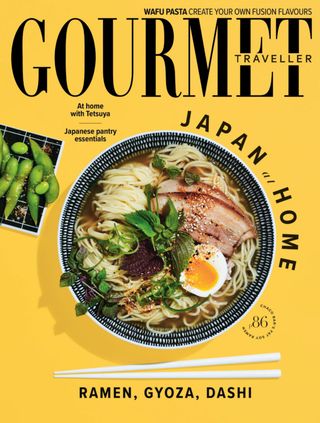
Japanese and Italian are two of the world’s most loved cuisines, so why not combine them? Enter wafu pasta.

Enter wafu pasta. “Wafu” means “Japanese-style”, so wafu pasta literally translates to Japanese-style pasta. It sees the Italian pantry staple of dried pasta shaken up with the addition of Japanese ingredients. Spaghetti might be infused with umami-rich ingredients like soy sauce and wakame, or Bolognese sauce bolstered with miso and topped with fresh shiso to create a fusion of Italian and Japanese flavours in the one bowl.
The style is said to have originated in Japan after World War II, when dried pasta became readily available and Western influences flourished. In Japan, wafu pasta is typically served at casual restaurants and is seen as a quick and affordable lunch option. One of the first known wafu pasta dishes was created by chef Shigetada Irie of the prestigious New Grand Hotel in Yokohama. Dubbed spaghetti naporitan, its ingredients comprised mushrooms, capsicum, bacon, and simply, ketchup. An ode to Italian-American cuisine, the concept of wafu has come a long way since then.

Bu hikaye Gourmet Traveller dergisinin May 2020 baskısından alınmıştır.
Binlerce özenle seçilmiş premium hikayeye ve 9.000'den fazla dergi ve gazeteye erişmek için Magzter GOLD'a abone olun.
Zaten abone misiniz? Oturum aç
Gourmet Traveller'den DAHA FAZLA HİKAYE

Gourmet Traveller
Hot in the city
There's no need to deliberate between beach and metropolis, Just do both.

4 mins
January 2026

Gourmet Traveller
Daphne
Review by MICHAEL HARDEN.
2 mins
January 2026
Gourmet Traveller
Everyday
Easy entertaining, simple weeknight dinners and suppers to share.
11 mins
January 2026
Gourmet Traveller
Viewing the world like a sailor
When you travel by sea, you never look at a destination the same way again
3 mins
January 2026

Gourmet Traveller
Postcards from Lisbon
The food in Portugal's hilly coastal capital is definitely something to write home about
4 mins
January 2026

Gourmet Traveller
Brand Americano
Melbourne's glamorous steakhouse brings its elevated style to Sydney,
2 mins
January 2026

Gourmet Traveller
Jess Coulson
This month we catch up with the co-owner of Ruffle Farm, which grows and supplies gourmet mushrooms in Sydney's inner west.
2 mins
January 2026

Gourmet Traveller
Worth your salt
Its reputation has ebbed and flowed but as IVY CARRUTH discovers, seasoning from the sea is back in fashion.
4 mins
January 2026

Gourmet Traveller
TWILIGHT ZONE
Iceland's midnight sun, geothermal wonders and rugged terrain make for a summer drive unlike any other
5 mins
January 2026

Gourmet Traveller
The new nostalgia
Overwhelmed by modern life? The simple pleasures of an old-school holiday might just be the perfect antidote
3 mins
January 2026
Translate
Change font size