
Magzter GOLD ile Sınırsız Olun
Sadece 9.000'den fazla dergi, gazete ve Premium hikayeye sınırsız erişim elde edin
AI on the Front Lines
MIT Sloan Management Review
|Summer 2022
AI progress can stall when end users resist adoption. Developers must think beyond a project's business benefits and ensure that end users' workflow concerns are addressed.

It’s 10 a.m. on a Monday, and Aman, one of the developers of a new artificial intelligence tool, is excited about the technology launching that day. Leaders of Duke University Hospital’s intensive care unit had asked Aman and his colleagues to develop an AI tool to help prevent overcrowding in their unit. Research had shown that patients coming to the hospital with a particular type of heart attack did not require hospitalization in the c and its leaders hoped that an AI tool would help emergency room clinicians identify these patients and refer them to noncritical care. This would both improve quality of care for patients and reduce unnecessary costs.
A man and his team of cardiologists, data scientists, computer scientists, and project managers had developed an AI tool that made it easy for clinicians to identify these patients. It also inserted language into the patients’ electronic medical records to explain why they did not need to be transferred to the ICU. Finally, after a year of work, the tool was ready for action.
Fast-forward three weeks. The launch of the tool had failed. One ER doctor’s comment that “we don’t need a tool to tell us how to do our job” is typical of front-line employees’ reactions to the introduction of AI decision support tools. Busy clinicians in the fast-paced ER environment objected to the extra work of inputting data into a system outside of their regular workflow — and they resented the intrusion on their domain of expertise by outsiders who they felt had little understanding of ER operations.
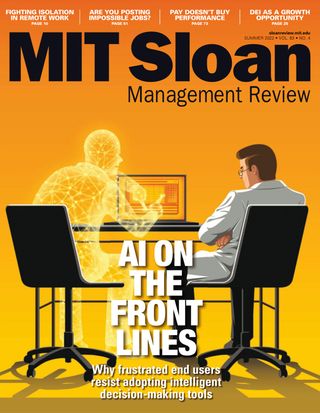

Bu hikaye MIT Sloan Management Review dergisinin Summer 2022 baskısından alınmıştır.
Binlerce özenle seçilmiş premium hikayeye ve 9.000'den fazla dergi ve gazeteye erişmek için Magzter GOLD'a abone olun.
Zaten abone misiniz? Oturum aç
MIT Sloan Management Review'den DAHA FAZLA HİKAYE

MIT Sloan Management Review
Assess What Is Certain in a Sea of Unknowns
Understanding what won't change clarifies what might — and strengthens decision-making in volatile times.

13 mins
winter 2026

MIT Sloan Management Review
Ask Sanyin: Why Is It So Hard to Pull the Plug on a Project?
We're finding it difficult to wind down projects that no longer serve our priorities.
2 mins
winter 2026

MIT Sloan Management Review
Integrate Sustainability and Innovation to Find New Opportunities
Five common innovation practices can help leaders pursue sustainability as a growth strategy.
12 mins
winter 2026

MIT Sloan Management Review
The Case for Quiet Corporate Activism
Leaders concerned that they will be penalized for championing sustainability and diversity can still sustain their commitments.
11 mins
winter 2026

MIT Sloan Management Review
The Perils of Algorithmic Pricing
Some revenue management systems based on algorithms may lead to unintended collusion and antitrust violations.
9 mins
winter 2026

MIT Sloan Management Review
Broadening Future Perspectives at the Bank of England
Leaders at the U.K’s central bank sought to broaden their thinking about future risks and opportunities. Here’s how they built longer-term horizon-scanning capabilities and what they learned along the way.
9 mins
winter 2026

MIT Sloan Management Review
How Nesting Changes Platform Strategy
Should your platform host another platform — or be hosted by one? Here's how to think through the choices.
14 mins
winter 2026
MIT Sloan Management Review
Are You an Authentic Leader or an Authentic Jerk?
Leaders who are true to their values can inspire trust and respect, but not if \"being yourself\" becomes the problem.
13 mins
winter 2026

MIT Sloan Management Review
How to Make Scenario Planning Stick
Developing future scenarios can deepen leaders’ strategic insights. Establishing scenario planning as an ongoing capability and reaping its full benefits require linking it to other processes.
16 mins
winter 2026

MIT Sloan Management Review
A Faster Way to Build Future Scenarios
This streamlined approach to scenario planning incorporates AI and helps managers navigate future uncertainties more efficiently.
13 mins
winter 2026
Translate
Change font size