Denemek ALTIN - Özgür
Identifying and controlling sweet potato viruses
Farmer's Weekly
|Farmers Weekly 8 November 2019
Sweet potatoes are an important commercial crop and contribute significantly to food security in many poorer South African households. Dr Julia Mulabisana and Dr Sunette Laurie of the Agricultural Research Council’s Vegetable and Ornamental Plants division explain how farmers can recognise and control the most serious viruses that affect this crop.
-

Sweet potato (Ipomoea batatas Lam.) is produced commercially, as well as grown by subsistence and smallscale farmers, as an important and reliable food source. Unfortunately, like several other crops, sweet potato is prone to virus infections, which are associated with substantial yield and quality loss. Recent research at the Agricultural Research Council (ARC) has shown that mixed infections of begomoviruses, such as the sweet potato leaf curl virus, and potyviruses such as the sweet potato feathery mottle virus, have a detrimental effect on sweet potato production.
Virus-infected sweet potato vines used as planting material act as sources of infection and can transmit viruses from one place to another.
More than 30 viruses occur naturally in sweet potatoes worldwide. Some of the more important ones in South Africa are described below.
Sweet potato feathery mottle virus and sweet potato virus c
Sweet potato feathery mottle virus and sweet potato virus C are transmitted by the aphid species Myzus persicae and Aphis gossypii. An aphid can acquire the virus from infected plants in less than a minute while feeding, and transmit it to a healthy plant in seconds. Leaf symptoms vary with cultivar, climatic conditions and plant age.
Sweet potato virus C was previously called the C strain of sweet potato feathery mottle virus. However, comparison of the coat protein amino acid sequences revealed that it is distinct from other strains of sweet potato feathery mottle virus.
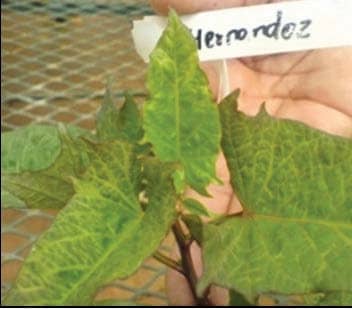
• Symptoms Leaf symptoms include a diffuse mottled effect, faint to distinct chlorotic spots, which may have purple pigmented borders, and irregular chlorotic patterns (feathering) along the main veins (


Bu hikaye Farmer's Weekly dergisinin Farmers Weekly 8 November 2019 baskısından alınmıştır.
Binlerce özenle seçilmiş premium hikayeye ve 9.000'den fazla dergi ve gazeteye erişmek için Magzter GOLD'a abone olun.
Zaten abone misiniz? Oturum aç
Farmer's Weekly'den DAHA FAZLA HİKAYE

Farmer's Weekly
How AFGRI uses technology to unlock farm finance from asset to market
As modern farming becomes more capital-intensive and digitally driven, AFGRI is reinventing agricultural finance by linking technology directly to lending decisions.

5 mins
January 16-23, 2026

Farmer's Weekly
Adele's Mohair: a living tapestry of craft, colour and rural heritage
Octavia Avesca Spandiel spoke to Adele Cutten, founder of Adele's Mohair, to explore how a small spinning experiment grew into a thriving rural craft enterprise rooted in South Africa's rich mohair heritage.
6 mins
January 16-23, 2026
Farmer's Weekly
Cannabis and marketing in South Africa
The path from cultivation to commercial success remains complicated by regulatory ambiguity. Cultivators who master compliant marketing while delivering verifiable quality will build sustainable businesses, says Thomas Walker.
2 mins
January 16-23, 2026
Farmer's Weekly
Foot-and-mouth disease project targets waste reduction and regulatory reform
A groundbreaking research collaboration between Red Meat Industry Services, the University of Pretoria, and global animal health leader Zoetis is aiming to transform South Africa's approach to foot-and-mouth disease.
3 mins
January 16-23, 2026
Farmer's Weekly
What to expect in 2026
The world faces a complex interplay of economic, geopolitical, environmental, technological, and social pressures.
3 mins
January 16-23, 2026

Farmer's Weekly
How drones are revolutionising pest and disease detection in agriculture
Drones are reshaping modern crop protection by giving farmers a powerful new vantage point: the sky. With advanced sensors, high-resolution imaging, and artificial intelligence-driven analytics, these unmanned aerial vehicles can detect early signs of disease, water stress, and pest damage long before the human eye can. Jedrie Harmse spoke to agricultural drone specialist Monique Heydenrych.
7 mins
January 16-23, 2026
Farmer's Weekly
Generic advertising in perspective
Dr Koos Coetzee explains how industry organisations and the agriculture sector actually have the ability to prudently manage the negative perceptions surrounding generic advertising campaigns.
2 mins
January 16-23, 2026

Farmer's Weekly
The modern Merino: the benchmark breed
The Merino breed has transformed dramatically over the past seven decades-from the skin-folded wool specialists of the 1950s to today's plain-bodied, fertile, well-balanced sheep prized for their dual-purpose productivity. Yet, despite its versatility, myths persist. Willie van Heerden, manager at Merino South Africa, dispels some of these myths.
2 mins
January 16-23, 2026

Farmer's Weekly
Elsenburg Agricultural Training Institute celebrates excellence
The Elsenburg Agricultural Training Institute marked a major milestone in December 2025, conferring over 200 agricultural qualifications, including bachelor's degrees and various national certificates.
2 mins
January 16-23, 2026
Farmer's Weekly
Grain SA issues guidelines as poor-quality agri inputs threaten farmers livelihoods
Grain SA has urged South African grain and oilseed farmers to act fast when seeds, fertilisers, or agrochemicals underperform, providing clear guidelines to protect crops.
2 mins
January 16-23, 2026
Translate
Change font size