Try GOLD - Free
Pytket: A Comprehensive Guide to Quantum Circuit Design
Open Source For You
|December 2024
Pytket stands out as a powerful toolkit in the realm of quantum computing, offering a suite of features that cater to both researchers and industry practitioners. Its key strengths include optimisation, platform-agnostic support, flexible quantum circuit design and hybrid algorithm support. These features make Pytket a versatile tool for various quantum computing applications, from machine learning and cryptography to optimisation problems in industrial settings.

Pytket, developed by Cambridge Quantum, is a versatile quantum circuit toolkit designed for the efficient design, manipulation, and execution of quantum circuits across multiple quantum computing platforms. Known for its contributions to quantum software and technology, Cambridge Quantum created Pytket to tackle significant challenges in quantum computing, particularly circuit optimisation, which is crucial for the effectiveness and reliability of quantum algorithms on real-world hardware.
What sets Pytket apart is its strong emphasis on optimisation. Given the limitations of current quantum hardware, including qubit quantity, quality, noise, and error rates, Pytket provides solutions for minimising gate counts and circuit depth-two critical factors that enhance algorithm performance and reduce errors. Its platform-agnostic nature allows seamless integration with various quantum backends such as IBM Q, Rigetti, and Google Cirq, enabling researchers to experiment with different hardware without the need for extensive modifications to their circuit designs. This flexibility has established Pytket as a preferred toolkit for researchers and developers seeking robust optimisation tools.
Importance of quantum circuit toolkits
Quantum circuit toolkits are essential in transitioning from theoretical quantum algorithms to practical implementations. As quantum technology matures, tools like Pytket address key issues stemming from hardware limitations. Quantum systems are prone to errors, and the coherence time of qubits is often limited, necessitating careful optimisation of quantum circuits to execute efficiently while minimising noise and computational overhead.
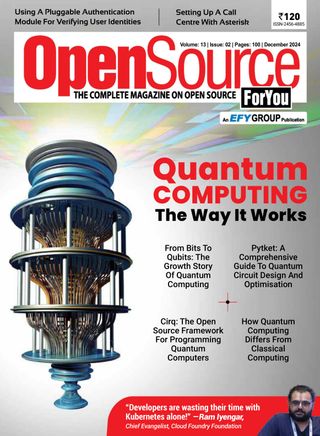

This story is from the December 2024 edition of Open Source For You.
Subscribe to Magzter GOLD to access thousands of curated premium stories, and 10,000+ magazines and newspapers.
Already a subscriber? Sign In
MORE STORIES FROM Open Source For You

Open Source For You
Apple acquires open source photonics startup invrs.io and hires its founder
Open source technology sits at the heart of Apple's latest acquisition.

1 min
April 2026
Open Source For You
OpenClaw adoption wave lifts China's tech stocks
OpenClaw, an open source autonomous AI agent, is driving a wave of investor enthusiasm in mainland China's stock markets, lifting shares of companies linked to the technology even as broader market sentiment remains subdued.
1 min
April 2026

Open Source For You
NVIDIA's NemoClaw could power Al-based warfare for India
NVIDIA has introduced NemoClaw, an open source, chip-agnostic AI platform designed to deploy agentic AI systems.
1 min
April 2026

Open Source For You
Microsoft flags fake Next.js repos are embedding staged backdoors inside build scripts
Attackers are seeding the open source ecosystem with malicious yet legitimatelooking Next.js repositories that embed staged backdoors inside build scripts and Microsoft dependencies, according to Microsoft.
1 min
April 2026

Open Source For You
NeoNephos expands its open source cloud ecosystem with new members
NeoNephos Foundation has expanded its pan-European open source cloud coalition with the addition of BWI GmbH as a Premier Member, SUSE LLC as a General Member, and Fraunhofer ISST as an Associate Member.
1 mins
April 2026

Open Source For You
Meta's Manus AI allows users to operate its agents through Telegram
The rise of OpenClaw is reshaping the AI agent market, compelling closed platforms to mirror features first popularised in the open source community. The latest example: Manus AI has introduced Telegrambased mobile control, a capability long central to OpenClaw's messaging-first approach.
1 min
April 2026

Open Source For You
China's DeepSeek has more than 75 million downloads on Hugging Face
Chinese AI lab DeepSeek is turning open source momentum into hardware leverage, with more than 75 million downloads of its models on Hugging Face helping Chinese AI releases surpass every other country on the platform.
1 min
April 2026

Open Source For You
Fractal's LLM Studio will help build domain-specific AI models
Fractal Analytics has launched LLM Studio, an enterprise platform designed to build, evaluate, and operate domain-specific language models using open source foundations, marking a shift away from closed, API-led AI approaches.
1 min
April 2026

Open Source For You
Monitoring Machine Learning in Production
Discover the concepts of drift and data skew, and explore online monitoring techniques that keep your machine learning model relevant.
5 mins
April 2026

Open Source For You
Managing Multi-Cloud Infrastructure: The Way Forward
Kubernetes and open source control planes make multi-cloud operations easier and help organisations build scalable and cloudagnostic infrastructure platforms.
7 mins
April 2026
Listen
Translate
Change font size