
Go Unlimited with Magzter GOLD
Get unlimited access to 10,000+ magazines, newspapers and Premium stories for just
Try GOLD - Free
From Virtual Machines to Docker Containers: The Evolution of Software Development
Open Source For You
|November 2024
Containerisation and Kubernetes have eased software development, making it faster and better. Let's see where these are headed, looking at trends that are making life easier for developers.

Whether we’re using a banking app or watching videos, we expect all software applications to run smoothly, no matter what device or platform we use. Technologies like virtualisation and containers, and orchestration tools such as Docker and Kubernetes have restructured how applications are built, tested, and deployed. They make it easier for developers to create and run software consistently across different environments.
In the past, software development faced a lot of challenges—compatibility issues, scaling problems, and time-consuming deployment. These old methods often led to the well-known phrase, “it works on my machine,” when software didn’t behave the same way in different environments. As applications grew more complex with many dependencies and varying setups, finding more reliable solutions became essential.
Virtualisation, introduced in the 1960s, revolutionised computing by enabling multiple operating systems to run on a single machine. In the 2000s, containerisation was a significant development, with tools like Linux containers (LXC). The concept gained widespread attention with the launch of Docker in 2013, which made containerisation easier and more accessible for developers. Docker made it easy for developers to bundle applications and their requirements into portable containers. This allowed isolated environments to be easily deployed anywhere, cutting down the overhead that came with traditional virtual machines. Building on Docker’s success, Kubernetes arrived in 2014, created by Google to meet the need for managing containers at scale. With Kubernetes, developers gained powerful tools for automating the deployment, scaling, and management of applications, making software development even more efficient.
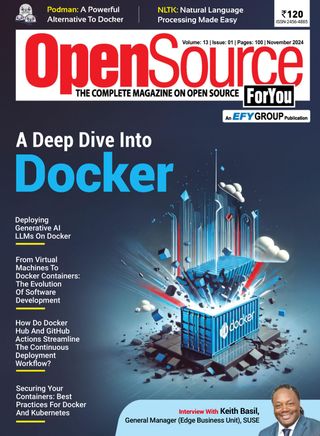

This story is from the November 2024 edition of Open Source For You.
Subscribe to Magzter GOLD to access thousands of curated premium stories, and 10,000+ magazines and newspapers.
Already a subscriber? Sign In
MORE STORIES FROM Open Source For You

Open Source For You
Apple acquires open source photonics startup invrs.io and hires its founder
Open source technology sits at the heart of Apple's latest acquisition.

1 min
April 2026
Open Source For You
OpenClaw adoption wave lifts China's tech stocks
OpenClaw, an open source autonomous AI agent, is driving a wave of investor enthusiasm in mainland China's stock markets, lifting shares of companies linked to the technology even as broader market sentiment remains subdued.
1 min
April 2026

Open Source For You
NVIDIA's NemoClaw could power Al-based warfare for India
NVIDIA has introduced NemoClaw, an open source, chip-agnostic AI platform designed to deploy agentic AI systems.
1 min
April 2026

Open Source For You
Microsoft flags fake Next.js repos are embedding staged backdoors inside build scripts
Attackers are seeding the open source ecosystem with malicious yet legitimatelooking Next.js repositories that embed staged backdoors inside build scripts and Microsoft dependencies, according to Microsoft.
1 min
April 2026

Open Source For You
NeoNephos expands its open source cloud ecosystem with new members
NeoNephos Foundation has expanded its pan-European open source cloud coalition with the addition of BWI GmbH as a Premier Member, SUSE LLC as a General Member, and Fraunhofer ISST as an Associate Member.
1 mins
April 2026

Open Source For You
Meta's Manus AI allows users to operate its agents through Telegram
The rise of OpenClaw is reshaping the AI agent market, compelling closed platforms to mirror features first popularised in the open source community. The latest example: Manus AI has introduced Telegrambased mobile control, a capability long central to OpenClaw's messaging-first approach.
1 min
April 2026

Open Source For You
China's DeepSeek has more than 75 million downloads on Hugging Face
Chinese AI lab DeepSeek is turning open source momentum into hardware leverage, with more than 75 million downloads of its models on Hugging Face helping Chinese AI releases surpass every other country on the platform.
1 min
April 2026

Open Source For You
Fractal's LLM Studio will help build domain-specific AI models
Fractal Analytics has launched LLM Studio, an enterprise platform designed to build, evaluate, and operate domain-specific language models using open source foundations, marking a shift away from closed, API-led AI approaches.
1 min
April 2026

Open Source For You
Monitoring Machine Learning in Production
Discover the concepts of drift and data skew, and explore online monitoring techniques that keep your machine learning model relevant.
5 mins
April 2026

Open Source For You
Managing Multi-Cloud Infrastructure: The Way Forward
Kubernetes and open source control planes make multi-cloud operations easier and help organisations build scalable and cloudagnostic infrastructure platforms.
7 mins
April 2026
Listen
Translate
Change font size