Try GOLD - Free
COULD A SUPERNOVA WORDS ANDREW MAY ENGULF EARTH?
How It Works UK
|Issue 190
We put some intriguing, baffling and bizarre space questions under the spotlight
-

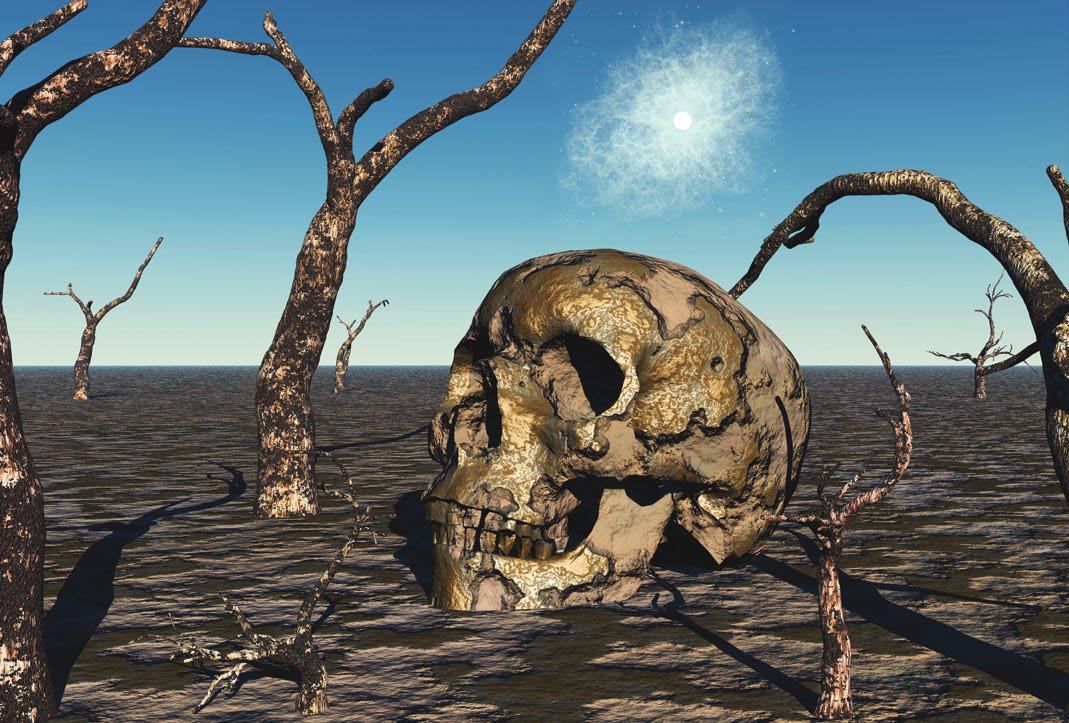
A supernova is what happens when a large enough star explodes. Such explosions are among the most dramatic of all astronomical events, and the resulting remnant can be a spectacular sight thousands of years later. Fortunately, supernovae are relatively rare, and we’re very unlikely to get caught up in one. The most disastrous thing from our perspective would be if our own Sun went supernova, but this will never happen. Only two types of star are capable of exploding in such a dramatic fashion: super-dense white dwarfs orbiting larger companion stars, which can produce Type I supernovae, or stars with at least eight times as much mass as the Sun, which end their lives as Type II supernovae. Our Sun isn’t in either of these categories.
Even so, this doesn’t mean that Earth can never be harmed by a supernova – in theory, at least. As well as producing the visible remnant, a supernova creates a burst of high-energy radiation that travels outwards at the speed of light. This radiation, particularly the highest energy gamma rays, could damage Earth’s biosphere if it came from the explosion of a nearby star. A sudden burst of gamma rays hitting the upper atmosphere could convert nitrogen and oxygen into smog-like nitrogen oxides, as well as damaging the ozone layer that protects Earth’s surface from the deadliest frquencies of ultraviolet radiation.


This story is from the Issue 190 edition of How It Works UK.
Subscribe to Magzter GOLD to access thousands of curated premium stories, and 10,000+ magazines and newspapers.
Already a subscriber? Sign In
MORE STORIES FROM How It Works UK

How It Works UK
WHY ANIMALS PLAY DEAD
These species have mastered faking their own deaths for several different reasons

1 min
Issue 214
How It Works UK
THE JAMES WEBB SPACE TELESCOPE MAPS 3D AURORAE ON URANUS
An international team of researchers has uncovered new insights into the upper atmosphere of Uranus, where ions swirling above the ice giant's clouds meet its magnetic field.
1 min
Issue 214
How It Works UK
LASERS BEAM 'ARTIFICIAL STARS' INTO CHILE'S SKIES
The European Southern Observatory has released a breathtaking photo of the Milky Way shining over Paranal Observatory in Chile as lasers create artificial 'guide stars' in the dark sky above.
1 min
Issue 214

How It Works UK
WHISKERS AT WORK
How long hairs on a cat's face fine-tune their senses
2 mins
Issue 214

How It Works UK
HOW AI IMPROVES CAR SAFETY
The vehicle technology that saves lives today - and the innovations that will soon make the roads safer for everyone
4 mins
Issue 214

How It Works UK
APOLLO 17: THE LAST CREWED MOON LANDING
It's been over 50 years since the final Apollo mission, so why haven't we put astronauts on the Moon since then?
4 mins
Issue 214
How It Works UK
WHAT IS LIMESCALE?
Why 'hard' water leaves chalky, flaky deposits wherever it settles
2 mins
Issue 214
How It Works UK
Astronauts describe the moment a crack was discovered on their spacecraft
Chinese astronauts have described what happened when they were nearly stranded in space last year after a suspected piece of space junk struck their return capsule.
2 mins
Issue 214
How It Works UK
The Vera C. Rubin Observatory found 800,000 objects of interest in a single night
The newly commissioned Vera C. Rubin Observatory has issued 800,000 astronomy alerts in just one night, a staggering number of nightly discoveries that's expected to grow nearly tenfold by the end of this year.
2 mins
Issue 214
How It Works UK
RETURN TO THE MOON
Project Artemis is accelerating its push to put humans back on Earth's orbital dancing partner before the end of the decade
5 mins
Issue 214
Listen
Translate
Change font size