
Go Unlimited with Magzter GOLD
Get unlimited access to 10,000+ magazines, newspapers and Premium stories for just
Try GOLD - Free
Defined to exclude
Down To Earth
|November 16, 2025
Kerala has declared itself free of 'extreme poverty', even as people employed in the informal sector, tribal populations and coastal communities continue to live in extremely impoverished conditions
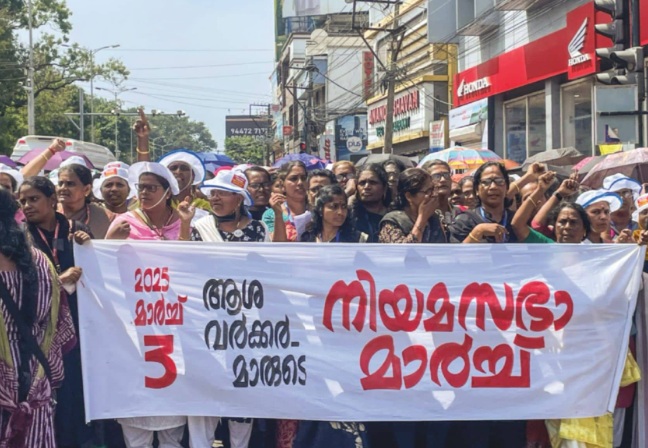
OUR WAGES are ₹420 a day. During the four-five monsoon months, we cannot work and do not get paid. But as per the government's list, we are not poor because we have jobs," says R Selvi, a 36-year-old tea estate worker in Meppadi town of Kerala's Wayanad district.
On November 1, Kerala announced that it was free of "extreme poverty", becoming India's first state to claim the status. It did so on the basis of extensive surveys to identify and rehabilitate those facing extreme poverty. Selvi, who does not have a secure source of income and lives in a 10 square metre room built by the British at the estate, was not considered extremely poor under the state's Extreme Poverty Eradication Programme (EPEP).
Under EPEP, the state government conducted extensive surveys with the help of municipal wards and non-profits and identified 64,006 households (103,099 individuals) as extremely poor. After verification, a total of 59,277 households were "rehabilitated" under micro-plans that connected them to welfare schemes, as per the EPEP dashboard.
Kerala's achievements in nearly all human development indices are noteworthy and surpass the national average. For instance, NITI Aayog's Multidimensional Poverty Index puts the state's poverty at just 0.55 per cent, compared to the national average of 15 per cent.
How did the state then leave out people like Selvi? Experts say declaration of eradicating extreme poverty has more to do with poverty definition than reality.


This story is from the November 16, 2025 edition of Down To Earth.
Subscribe to Magzter GOLD to access thousands of curated premium stories, and 10,000+ magazines and newspapers.
Already a subscriber? Sign In
MORE STORIES FROM Down To Earth

Down To Earth
The fossilised ICAR needs to be shaken up
India’s vast agricultural research network has made no breakthroughs as crop yields drop and imports soar, especially in oilseeds

4 mins
June 01, 2026
Down To Earth
Reimagine renewable expansion in the Thar
This refers to the article, \"Unwanted barter” (1-15 March, 2026).
2 mins
June 01, 2026

Down To Earth
Harvest of heritage
India's wealth of traditional seeds hold the key to its nutritional security amid a changing climate. Yet comprehensive data on these seeds remain scarce VIBHA VARSHNEY reports from KORAPUT, ODISHA and DHARWAD, KARNATAKA
7 mins
June 01, 2026

Down To Earth
TIGERS, CATTLE AND LANTANA
The story of tigers, cattle and lantana is not a feel-good conservation tale. It is a warning wrapped in ecological ingenuity
5 mins
June 01, 2026

Down To Earth
Fruitful cashews
Farmers and scientists across southern India promote the use of nutrient-rich yet underused cashew apples by developing a zero-additive juice that creates an additional source of income
2 mins
June 01, 2026
Down To Earth
No feather in the cap
NO TO a Switzerland with 10 million! (Sustainability Initiative).” On June 14, when Switzerland votes in the referendum, it will be the world’s first attempt to cap a country’s population at a specific level.
2 mins
June 01, 2026

Down To Earth
FARM-SIDE SLAY
India's agriculture sector is no longer remunerative, and there is no support from the government to make it so
3 mins
June 01, 2026

Down To Earth
RETHINKING CONSERVATION
Tiger numbers have seen a healthy rise in India over the past couple of decades. But the surge in the tiger population has been accompanied by an increase in cases of infighting, poaching and attacks on humans, which suggest that the animal is cramped for space and venturing out of reserves in search of food. Managing the species now requires a complete reimagining of the way tiger conservation is practised in India, reports HIMANSHU NITNAWARE
11 mins
June 01, 2026
Down To Earth
Ganga runs polluted
Uttarakhand's river-cleaning efforts face scrutiny as audit reveals untreated sewage discharge and incomplete infrastructure
3 mins
June 01, 2026
Down To Earth
The new environmentalism
EACH YEAR, when the UN-designated World Environment Day is observed on June 5, it is a moment to reflect on where we stand and where we must head.
3 mins
June 01, 2026
Listen
Translate
Change font size