Try GOLD - Free
THE BIGGEST BREAKTHROUGHS OF THE CENTURY
BBC Science Focus
|January 2025
We're a quarter of the way into the new century. To mark this milestone, we asked the UK's top minds to highlight some of the game-changing scientific breakthroughs shaping our world since the year 2000
-

TISSUE ENGINEERING
Sir Mark Miodownik
Professor of Materials & Society, UCL Author of It's a Gas: The Magnificent and Elusive Elements that Expand Our World
Going to the dentist and having a synthetic resin filling is fine, but it's not as good as a real tooth.
But what if we could grow real teeth in the lab from a person's own stem cells and implant them back into their mouth? This sounds like science fiction, but tissue engineering is a breakthrough technology that's already being used to grow human tissue, through *scaffold technology'. Scaffolds are porous materials that support stem cells as they divide and grow into new tissues. Artificial ears, trachea (windpipes) and bone have been grown this way and successfully implanted into human patients. Because the implanted tissues are grown from a patient's own cells, there are no problems with immune rejection.
Artificial kidneys, knee cartilage and even hearts are also being grown this way, although these are still confined to lab experiments. No one can yet put a limit on this new technology, but the successful regrowing of teeth is on the horizon.
...BUT ALSO SELF-REPAIRING MATERIALS
A modern smartphone contains half the elements in the periodic table and yet only has a lifespan of two to three years, on average. To save the massive amounts of energy we're wasting on continually producing (and even recycling) phones and everything else that fills our lives, we need to find a new way of making products that last longer..

This story is from the January 2025 edition of BBC Science Focus.
Subscribe to Magzter GOLD to access thousands of curated premium stories, and 10,000+ magazines and newspapers.
Already a subscriber? Sign In
MORE STORIES FROM BBC Science Focus
BBC Science Focus
HEALTH: Eating oats could lower your cholesterol in just two days
The health benefits of a two-day porridge diet lasted for weeks afterwards

1 mins
April 2026
BBC Science Focus
Most people are too sure they can identify fake human faces
Even 'super recognisers' struggle with the challenge. Can you do better?
1 min
April 2026

BBC Science Focus
WHAT'S THE WORST THING YOU CAN DO FOR THE PLANET ONLINE?
Human beings can barely move a muscle without some kind of deleterious effect on the environment around us.
2 mins
April 2026
BBC Science Focus
A bug in the system
The complex arrangement of equipment you see here is part of a particle accelerator.
1 min
April 2026
BBC Science Focus
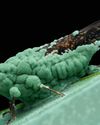
Snug as a bug in a rug
At first glance, you might feel envious of this little leafhopper, swaddled beneath the folds of what appears to be a luxurious fur blanket.
1 min
April 2026

BBC Science Focus
WHY DO WE ROOT FOR THE VILLAIN IN MOVIES?
Whether it's Darth Vader or Cruella de Vil, we all have a favourite movie villain.
1 mins
April 2026
BBC Science Focus
A TURN TO DISPERSE
Why a fart walk after dinner does more than release your gas
3 mins
April 2026

BBC Science Focus
Hatching a nebula
Welcome to the Egg Nebula, an enigmatic structure formed by ejected stardust in the Cygnus constellation around 1,000 light-years from Earth.
1 min
April 2026

BBC Science Focus
7 TIMES AI GOT IT SPECTACULARLY WRONG
For the past four years, AI has been reshaping how we work and live. But its failures are proving just as transformative as its triumphs
8 mins
April 2026
BBC Science Focus
CHARLES ADCOCK, VIA EMAIL: COULD DARK MATTER BE ALL AROUND PLANET EARTH BUT UNDETECTABLE?
Astronomers have gathered overwhelming evidence that 80 per cent of all matter in the Universe is invisible.
1 min
April 2026
Listen
Translate
Change font size