Try GOLD - Free
Color Grading with Lightroom Classic
Smart Photography
|April 2025
The term 'color grading' can be interpreted in many ways.
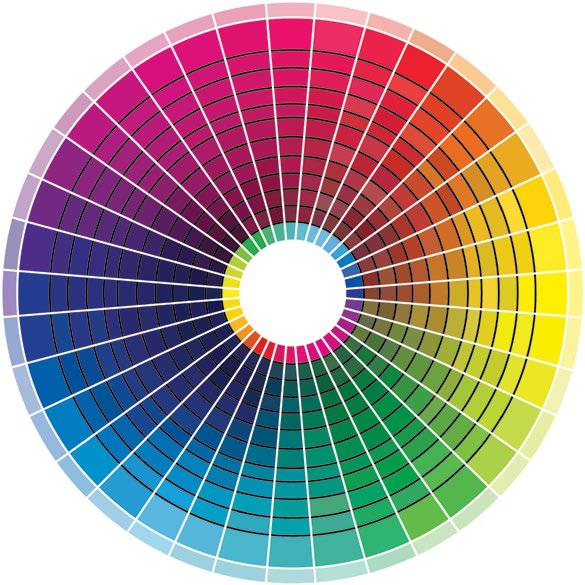
Picture 1: The color wheel.
For our article, let us define it as the process of adjusting and enhancing the colors in an image to achieve a desired look or mood. It usually involves adjusting the hue, saturation, and luminance parts of the image based on, in our case, tonal (that is, brightness) values.
To make things clearer, we will differentiate it from color corrections. These are meant for altering the colors to match that of the original. This operation is often done to remove any color biases that might have risen out of the wrong white balance settings.
Split toning was a technique that harks back to the film era. It involves applying a specific color (confusingly called “toning”) to the highlights or shadows.
(To avoid any ambiguity, we will use the word 'tone' only with reference to brightness and not color). Usually, the two different colors are applied for the highlight and shadows and are usually picked up from the colors that are on the opposite sides of the color wheel (Picture 1). This was called 'split-toning.' As an example, warmer colors (like yellow or orange) are applied to the highlights, and cooler ones (like blue) are applied to the shadows. By controlling the application and blending of these, a variety of effects can be created. Originally, this was a technique used for monochromatic images, but now it is commonly used in color photography. Also, note that this is different from coloring or tinting the entire picture in a single color like sepia or cyan. One interesting application is the use of color grading to get the effect of 'cross processing' that film aficionados might recall.

This story is from the April 2025 edition of Smart Photography.
Subscribe to Magzter GOLD to access thousands of curated premium stories, and 10,000+ magazines and newspapers.
Already a subscriber? Sign In
MORE STORIES FROM Smart Photography

Smart Photography
Great Performance, Affordable Price!
The second lens launched with the joint efforts of Samyang and Schneider Kreuznach is the 24mm to 60mm F 2.8 standard zoom for the Sony E mount.

2 mins
April 2026

Smart Photography
Smart Photography AWARDS 2026
Yet another year has passed and it is now time to highlight the best products launched in the past year.
1 min
April 2026

Smart Photography
A Stepping Stone for Serious Cinematography
The ZR is the culmination of Nikon's much-publicised partnership with RED Digital Cinema, two giants in their respective fields.
8 mins
April 2026

Smart Photography
When Printing Becomes a Choice
As photography becomes increasingly digital, printing is no longer automatic. It is intentional. This month's issue explores the technologies, materials, and market shifts shaping the future of photographic print.
1 mins
April 2026

Smart Photography
Shreenath Veer Mhaskoba Festival
Every year in rural Maharashtra, thousands of devotees gather to celebrate Shreenath Veer Mhaskoba, a revered folk deity worshipped by farming and pastoral communities.
1 min
April 2026

Smart Photography
MagSafe storage expansion
When we got the Mag-Vault for review we were hoping for a clever on-the-go solution for the iPhone, but after a week of testing it mostly sits in the drawer.
1 min
April 2026

Smart Photography
Crop or Use a TC?
All wildlife photographers are perennially short of one thing and that is, reach.
10 mins
April 2026

Smart Photography
Lens Extraordinaire
The newly designed wide-angle prime lens from the house of Nikon is a S-Line (Performance) full frame lens with a superfast f/1.2 aperture.
3 mins
April 2026

Smart Photography
CP Plus attracts record crowds
CP Plus 2026 was held in February and attracted a record 23000 visitors in the first two days.
1 min
April 2026

Smart Photography
Printing Photographs: From Silver Halide to Substrates of the Future
For decades, photographic printing has evolved quietly, often overshadowed by cameras, sensors, and screens. Yet behind every meaningful print lies a complex interplay of technology, chemistry, substrates, and market forces.
10 mins
April 2026
Listen
Translate
Change font size