
Go Unlimited with Magzter GOLD
Get unlimited access to 10,000+ magazines, newspapers and Premium stories for just
Try GOLD - Free
What Youth Day won't tell you
Mail & Guardian
|M&G 12 June 2026
Fifty years after the Soweto Uprising, Tiisetso Mashifane wa Noni’s Rise ‘76 strips away the ceremony of Youth Day to confront what actually happened to those children on June 16th 1976
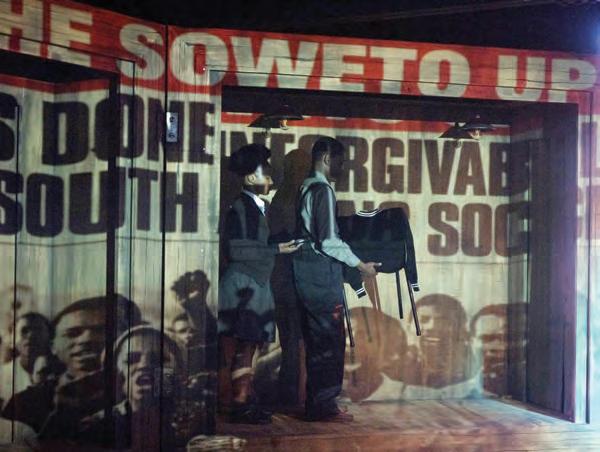
“Memory is a romantic thing.” These words are repeated at various points of Rise ‘76: The Story of June 16th, now running at the Market Theatre’s Mannie Manim space and they carry a different weight each time.
Playwright and director Tiisetso Mashifane wa Noni lifted the phrase from a written testimony by the late Sibongile Khumalo, who had prefaced her own account of June 16th 1976 by warning her interviewer: “Memory is a romantic thing. So please stop me if I start romanticising anything.”
It was just one of many details that Mashifane wa Noni collected during two and a half months of research — university archives, TRC testimony videos, autopsy records, first-hand interviews with survivors — and tucked away in what she calls her “little bank,” unsure at the time of exactly how it would be used but certain that it meant something.
That instinct for the telling detail is everywhere in this production. “I have picked up what I think are only a couple of crumbs,” she told me when I sat down with her after seeing the play on Sunday, its opening day at the Market Theatre.
“But the crumbs do give us an idea of the various flavours of that terrible day.”
Mashifane wa Noni’s great instinct as a dramatist is to resist the gravitational pull of the monumental. She was writing about an event that most South Africans encountered first through a photograph, Hector Pieterson’s body carried through the street and that has since been processed and repackaged, annually, into something called Youth Day.
Her response was to go smaller and more specific, to find the boy inside the icon. It was in a TRC video, she told me, that she first noticed something small and arresting: a woman walking out of her home to give testimony about her dead son had beautiful pink flowers growing outside her front door. That image, grief existing in the same frame as ordinary beauty, found its way into the play.


This story is from the M&G 12 June 2026 edition of Mail & Guardian.
Subscribe to Magzter GOLD to access thousands of curated premium stories, and 10,000+ magazines and newspapers.
Already a subscriber? Sign In
MORE STORIES FROM Mail & Guardian

Mail & Guardian
The unfinished business of freedom
Fifty years after Soweto, children in this country can still be denied access to school because of an unfinished bridge, inadequate or poorly built classrooms and public funds diverted into corrupt hands

6 mins
M&G 12 June 2026

Mail & Guardian
be silent
Her journey into theatre began far from the professional stages of Newtown.
4 mins
M&G 12 June 2026
Mail & Guardian
The Rockefellers, the Vanderbilts and the hidden power of life cover
Life insurance is often misunderstood, seen as a middle-class product to replace income after death. But for the wealthy, life cover isn’t about death. It's about design.
3 mins
M&G 12 June 2026

Mail & Guardian
We call them youth; they were children
Every June we return to the children of 1976.
4 mins
M&G 12 June 2026
Mail & Guardian
Living Forward: Ensuring continuity when it matters most
Planning for the future is often framed around growth, building wealth, expanding businesses, and securing financial independence. Far less attention is given to what happens next: how that wealth is preserved, structured and ultimately transferred.
4 mins
M&G 12 June 2026
Mail & Guardian
A generation pushed against the wall
The onus was on young people to ensure a bright future for themselves or forever become hewers of wood and fetchers of water
3 mins
M&G 12 June 2026

Mail & Guardian
What the Soweto Uprising still demands of us
Historian Noor Nieftagodien warns that annual celebrations have replaced genuine reckoning with the causes, character and unfinished consequences of June 16th
6 mins
M&G 12 June 2026

Mail & Guardian
The Arc betrayed
The 1975 and 1976 generation’s grandchildren are educated, mobile, fluent and comfortable. They are also alienated, anxious and disconnected from the history that made their comfort possible
8 mins
M&G 12 June 2026
Mail & Guardian
This isn't what Hector died for
Five decades after the watershed 1976 youth uprisings, the country is still pondering ways of repaying the huge debt of gratitude it owes the brave learners who took on the might of apartheid — unarmed but unafraid.
2 mins
M&G 12 June 2026

Mail & Guardian
Meaning of June 16 lost
Fifty years later and 32 years since liberation, we have a situation that can be described only as a betrayal of our youngsters
2 mins
M&G 12 June 2026
Listen
Translate
Change font size