Try GOLD - Free
Sense of an Ending
The Atlantic
|February 2026
Julian Barnes says goodbye to the novel

“Yes—oh, dear, yes—the novel tells a story,” E. M. Forster wrote. “I wish that it was not so.” Julian Barnes has confessed that as a young man reading Aspects of the Novel, he found this sentiment “feeble” and responded impatiently, “If you aren’t up to telling a story, why write a novel?” Barnes, who turned 80 in January, now sings a different tune, and anyway, Forster’s wish was long ago granted. The literary novel of today is quite free from conventional storytelling, and ironically (irony is one of his specialties), Barnes got busy loosening the bonds early in his career. He’s still at it: His brief new novel, Departure(s), offers only a sketchy storyline, mixed with memoir and thoughts on memory. An extended farewell, an author’s valedictory flourish, the whole package is a culmination of sorts, shimmering with his silky, erudite prose; beneath the suave surface is an earnest investigation into the mysterious ways of the human heart.
The scant plot in Departure(s)—a “true story” the narrator swore he wouldn’t tell—tracks the two-part romance of Stephen and Jean, friends of his at university who fell in love, broke up when they graduated, then connected again in late middle age after Stephen asked Julian to reach out to Jean. Like many of Barnes’s 14 previous novels—including his most famous, Flaubert’s Parrot (1984), and the Man Booker Prize winner, The Sense of an Ending (2011)—Departure(s) tells a love story filtered through the consciousness of a ruminative, standoffish man preoccupied with something other than the love at stake.
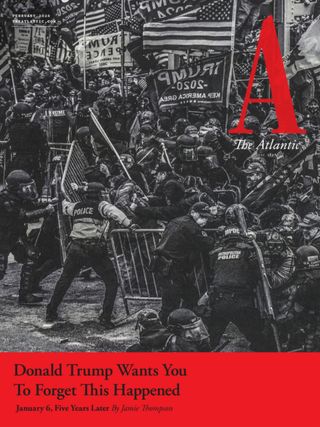

This story is from the February 2026 edition of The Atlantic.
Subscribe to Magzter GOLD to access thousands of curated premium stories, and 10,000+ magazines and newspapers.
Already a subscriber? Sign In
MORE STORIES FROM The Atlantic

The Atlantic
The First 18 Months
A Cabinet meeting with my son, who is exactly as old as the current administration

2 mins
July 2026
The Atlantic
What Dogs See
To understand a painting, look for the canine.
10 mins
July 2026

The Atlantic
Boy George
Finally, an action movie about Washington’s French and Indian War years.
5 mins
July 2026

The Atlantic
Disneyland With No People
When I was 17, I worked at Fantasyland’s magic shop as a magician demonstrating Svengali decks, cups and balls, and the Incredible (their word) Shrinking Die.
4 mins
July 2026

The Atlantic
THE REBELLIOUS ORIGINS OF AMERICAN SPORTS
FROM THE BEGINNING, PATRIOTISM AND PLAY HAVE BEEN INEXTRICABLY LINKED.
12 mins
July 2026

The Atlantic
Queen of the Skies
The Boeing 747, the world’s first jumbo jet, has started its final descent.
18 mins
July 2026
The Atlantic
HOW TO TELL THE AMERICAN STORY
Finding a common history that’s both unsparing and unifying has proved all but impossible in recent years. It shouldn’t be.
17 mins
July 2026

The Atlantic
Nathaniel Hawthorne’s American Horror Story
The author wrote a tale that challenged the nation’s founding myths. Then it disappeared.
13 mins
July 2026

The Atlantic
The Surprising, Liberating History of Marriage
To find a future for the institution, Stephanie Coontz turns to its wildly varying past.
11 mins
July 2026
The Atlantic
USE IT OR LOSE IT
Freedom of speech, and of the press, can be guaranteed only if Americans exercise their rights.
8 mins
July 2026
Listen
Translate
Change font size