Try GOLD - Free
India Braces for Disasters in Himalayas, Coasts
TerraGreen
|January 2026
Scientists Urge for Adaptation and Climate-resilient Planning
-
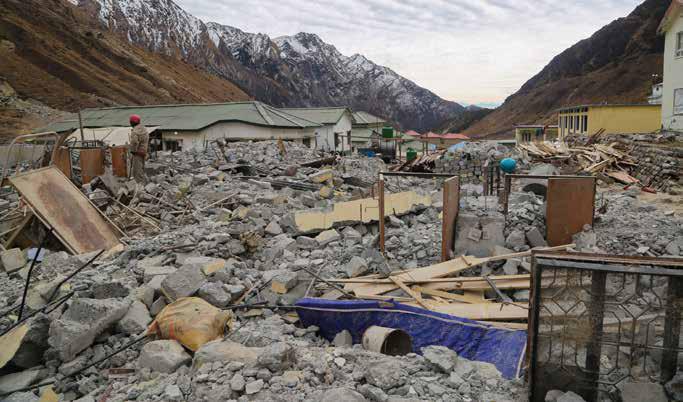
In this article, Athar Parvaiz highlights that India's revised seismic zonation has placed 61 per cent of the country, including the entire Himalayan arc, in moderate to very high earthquake risk, prompting scientists to call for urgent adaptation. The new BIS map, based on probabilistic hazard assessment, upgrades the Himalayas to the highest-risk Zone VI, compounding climate-driven threats such as floods, landslides and permafrost thaw affecting over 50 million people. Experts warn that infrastructure, dams and cities such as Delhi and Chandigarh require stricter building codes, retrofitting and audits. Simultaneously, intensifying, rain-heavy cyclones along India's coasts highlight the growing need for climate-resilient planning, preparedness, and adaptation.
Reacting to the radical upgradation of India's seismic zonation which has placed the country's 61 per cent landmass in moderate to high-risk category and the entire Himalayan arc in the highest-risk or Zone VI, scientists say that the upgrade (in November 2025) calls for reevaluation of infrastructure in high-risk zones, especially in the Himalayas where the overlay of climate stress and the upgraded tectonic hazard assessment deepen the vulnerability of around 52 million people living in Himalayan states.
The Himalayan communities, already under threat from climate-driven floods and slope failures, will now have to also reckon with major seismic risk. A surge in disasters has been witnessed in recent months and years in the Himalayas,1 including a 2025 debris-flow in Uttarakhand that was traced to moraines and thawing permafrost rather than a cloudburst.
In 2022, disasters struck on 63 per cent of the days in the entire year in Indian Himalayan region, with 1058 deaths while the numbers rose to 68 per cent in 2023 and 70 per cent in 2024, killing 837 and 870 people respectively in these years, according to


This story is from the January 2026 edition of TerraGreen.
Subscribe to Magzter GOLD to access thousands of curated premium stories, and 10,000+ magazines and newspapers.
Already a subscriber? Sign In
MORE STORIES FROM TerraGreen

TerraGreen
Motor Efficiency
The Silent Catalyst of India's Green Industrial Revolution

4 mins
January 2026

TerraGreen
Beauty That Betrays!
The Quiet Invasion of An Ornamental Plant
3 mins
January 2026
TerraGreen
Farming Innovation Addresses Food Shortages
Also Halves Methane Emissions
4 mins
January 2026

TerraGreen
Aravalli on the Edge
Saving India's Ancient Green Shield from Collapse
3 mins
January 2026

TerraGreen
From Orchard to Table
Apple Picking, Family Time, and Fall Colours
4 mins
January 2026

TerraGreen
Coral Reefs Could Feed Millions
If We Let Them Rebuild
3 mins
January 2026

TerraGreen
Resting on Deodars
How Fallen Trees are Being Reimagined as Urban Assets in Shimla
3 mins
January 2026

TerraGreen
India's Clean-Air Innovation at Risk
Nationwide Assessment by WeNaturalists
2 mins
January 2026

TerraGreen
CNFF-25
Highlights Environmental Concern Amid India's Cultural Heritage
3 mins
January 2026

TerraGreen
Green Farming through Circular Economy
Sustainable Practices for Waste Reduction
8 mins
January 2026
Listen
Translate
Change font size