Try GOLD - Free
LAUGHTER IN A LAB COAT
THE WEEK India
|April 19, 2026
Why is airlifting rhinos upside down the best way to transport them? Can roller coasters help pass kidney stones? Welcome to the Ig Nobel Prizes and the science that makes you laugh first, and then think
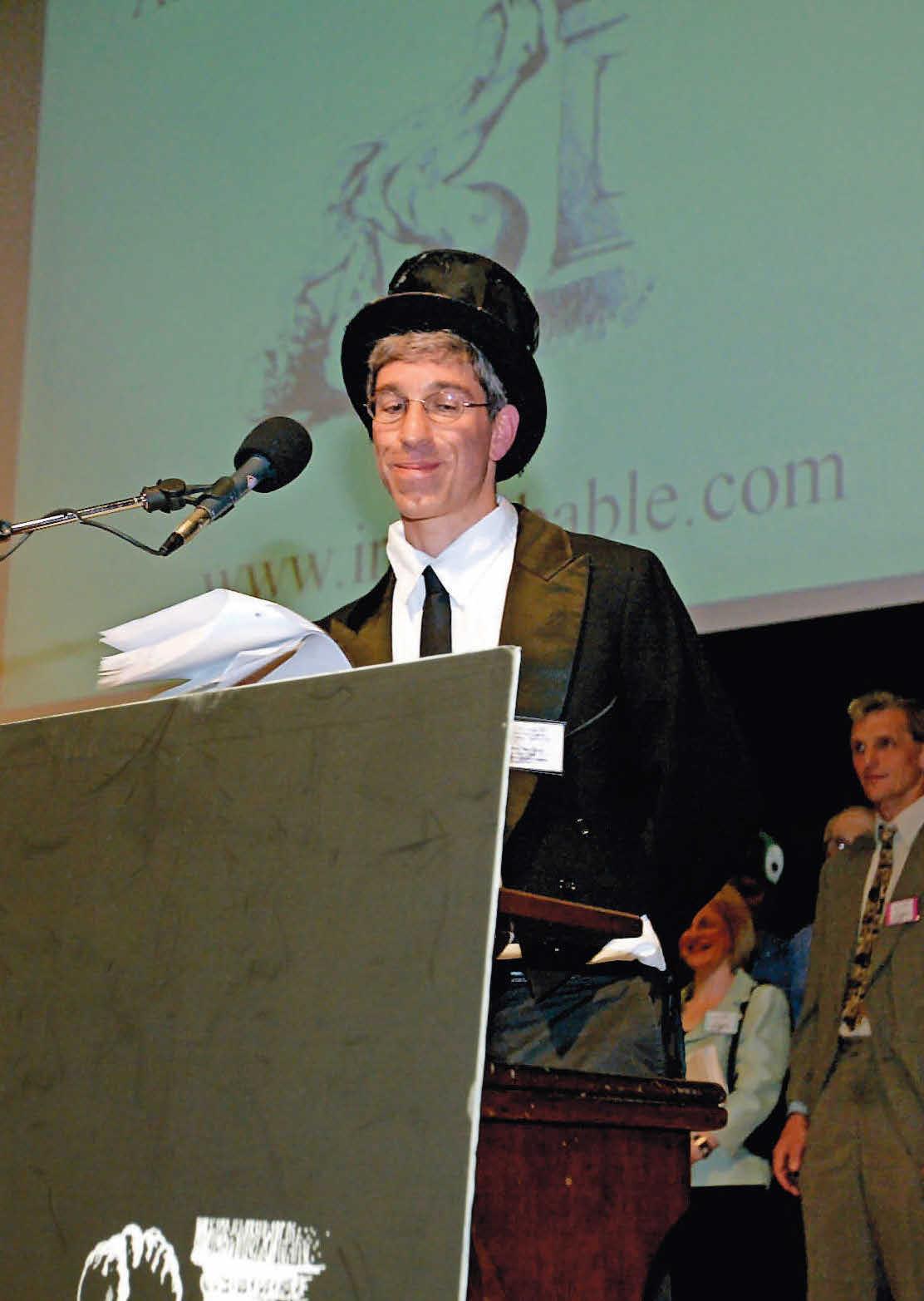
Have you ever wondered why woodpeckers smash their head into a tree 12,000 times a day and still don't get a headache?
We bet you haven't. But two scientists did. The research of Ivan R. Schwab and the late Philip R. May separately explored the superhuman strength of a woodpecker's head. In 1976, May, a psychiatrist and neuroanatomist, argued that understanding a woodpecker's head could give us clues into treating head injuries and designing crash helmets. Years later, Schwab—an ophthalmologist—built on May's research, focusing on the unharmed retinas of the woodpecker.
“Both May in 1976 and Schwab in 2002 suggested that the skull of the woodpecker is so beautifully designed that parts of it act like a shock absorber,” writes Upasana Sarraju in Unruly, her wonderfully absurd book on the Ig Nobel Prizes. “The impact from the beak striking a tree travels along the length of the beak into the skull where it dissipates, like steam from an idli cooker, into the shock absorbers. And because of this, woodpeckers do not develop headaches.”
Their research into the woodpecker skull won May and Schwab the 2006 Ig Nobel Prize in Ornithology. For the award ceremony at Harvard University's Sanders Theatre, Schwab wore a large black helmet adorned to look like the feathered red head of a pileated woodpecker, writes Sarraju. The prize was a wooden concoction of a sphere springing out of a block.
For those of you uninitiated into the world of the Ig Nobels, the awards—a bizarre cousin of the Nobels—were founded by Marc Abrahams in 1991, who as a boy “couldn't stop noticing peculiar things and then asking questions about them until adults became gently alarmed”. To pursue his passion for funny science, he mailed the Israeli duo who founded a strange little magazine called the Journal of Irreproducible Results, or

This story is from the April 19, 2026 edition of THE WEEK India.
Subscribe to Magzter GOLD to access thousands of curated premium stories, and 10,000+ magazines and newspapers.
Already a subscriber? Sign In
MORE STORIES FROM THE WEEK India

THE WEEK India
MASSIVE ADMISSION INTAKE MUST BE REWORKED
INTERVIEW: Professor Onkar Singh former governing board member, IIT Kanpur and IIT (BHU) Varanasi

2 mins
July 05, 2026

THE WEEK India
KNOWLEDGE WARRIORS
A simple mantra—what problem can I solve—is reshaping college education in India
5 mins
July 05, 2026

THE WEEK India
IN GREEN WE TRUST
Inside the Congress leadership's secretive green paper system that quietly drives crucial decisions
3 mins
July 05, 2026

THE WEEK India
Flower power
Thanks to government policy and scientific intervention, Bhaderwah’s lavender fields have become the epicentre of India’s Purple Revolution. The next step: going global
4 mins
July 05, 2026

THE WEEK India
The pineal gland
The first thing I noticed was that he never looked me in the eye.
3 mins
July 05, 2026
THE WEEK India
A centennial gift for the naked dancer
For a hundred years, she danced with naked abandon, and the world of antiquarians enjoyed watching her.
2 mins
July 05, 2026

THE WEEK India
BUILT DIFFERENT
India’s premier technology institutes are rethinking what an engineer should be Darling, can you buy a pint of milk,” asked the engineer's wife.
4 mins
July 05, 2026

THE WEEK India
The return of trust
A new, evolving framework for returning money to victims is reshaping the Enforcement Directorate’s response to financial fraud
7 mins
July 05, 2026

THE WEEK India
HOW YOU THINK MATTERS FAR MORE THAN WHAT YOU KNOW
Sunil Chemmankotil country manager, Adecco India
2 mins
July 05, 2026

THE WEEK India
THE LEGEND IN SLO-MO
His brace against Uzbekistan notwithstanding, Cristiano Ronaldo is searching for the speed and mobility that made him one of the greatest attackers of all time
7 mins
July 05, 2026
Listen
Translate
Change font size