Try GOLD - Free
Chornobyl: Forty years after
THE WEEK India
|May 17, 2026
Chornobyl proved not only the dangers of nuclear power, but also how concealing the truth from the people contributed to the collapse of the mighty Soviet state
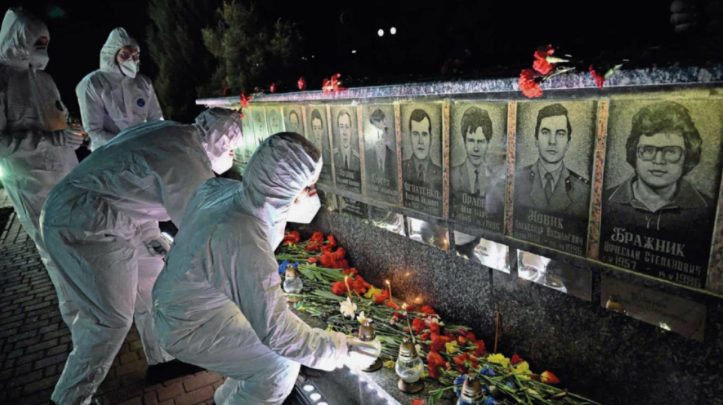
Forty years ago, on April 26, 1986, it was a weekend in Kyiv, sometimes sunny, sometimes rainy. An evening fest had been planned at the Kyiv Polytechnic Institute. We, the international students, rushed to attend, but for no clear reason it was cancelled. The first real shock came around 1am, when my friend from Bulgaria relayed what the BBC had reported: there had been a nuclear accident near Kyiv.
The Forsmark Nuclear Power Plant in Sweden had detected abnormally high levels of airborne radiation drifting from the direction of the USSR. At night, when signal jamming was weaker, foreign students would often listen to the BBC and VOA under the pretext of improving our English. We scarcely grasped the scale of the disaster.
Our thoughts drifted through the windows into the dark streets, where chestnut trees swayed quietly.
A KGB report noted that by 8am on April 28, radiation levels at units 3 and 4 were 1,000-2,600 microroentgen per second, while in parts of the city they ranged from 30 to 160. The then party chief of Ukraine, Volodymyr Shcherbytsky, scribbled his now-famous note: "What does this mean?" It was a telling sign that even senior officials did not fully understand the danger. From the next day, we saw bright yellow Hungarian-made Ikarus buses, filled with children, leaving the city under militia escort.
People spoke in whispers, fearful of saying too much. It took two full days for the Soviet authorities to acknowledge the accldent publicly. A brief statement was aired on the 9 o'clock evening news programme Vremya on April 28, assuring viewers there was no cause for panic. The first advice on protecting oneself from radiation exposure appeared only on May 9 in Pravda Ukrainy, urging people to avoid dust. The general secretary of the Communist Party of the Soviet Union, Mikhail Gorbachev, addressed the nation as late as May 14.

This story is from the May 17, 2026 edition of THE WEEK India.
Subscribe to Magzter GOLD to access thousands of curated premium stories, and 10,000+ magazines and newspapers.
Already a subscriber? Sign In
MORE STORIES FROM THE WEEK India

THE WEEK India
MASSIVE ADMISSION INTAKE MUST BE REWORKED
INTERVIEW: Professor Onkar Singh former governing board member, IIT Kanpur and IIT (BHU) Varanasi

2 mins
July 05, 2026

THE WEEK India
KNOWLEDGE WARRIORS
A simple mantra—what problem can I solve—is reshaping college education in India
5 mins
July 05, 2026

THE WEEK India
IN GREEN WE TRUST
Inside the Congress leadership's secretive green paper system that quietly drives crucial decisions
3 mins
July 05, 2026

THE WEEK India
Flower power
Thanks to government policy and scientific intervention, Bhaderwah’s lavender fields have become the epicentre of India’s Purple Revolution. The next step: going global
4 mins
July 05, 2026

THE WEEK India
The pineal gland
The first thing I noticed was that he never looked me in the eye.
3 mins
July 05, 2026
THE WEEK India
A centennial gift for the naked dancer
For a hundred years, she danced with naked abandon, and the world of antiquarians enjoyed watching her.
2 mins
July 05, 2026

THE WEEK India
BUILT DIFFERENT
India’s premier technology institutes are rethinking what an engineer should be Darling, can you buy a pint of milk,” asked the engineer's wife.
4 mins
July 05, 2026

THE WEEK India
The return of trust
A new, evolving framework for returning money to victims is reshaping the Enforcement Directorate’s response to financial fraud
7 mins
July 05, 2026

THE WEEK India
HOW YOU THINK MATTERS FAR MORE THAN WHAT YOU KNOW
Sunil Chemmankotil country manager, Adecco India
2 mins
July 05, 2026

THE WEEK India
THE LEGEND IN SLO-MO
His brace against Uzbekistan notwithstanding, Cristiano Ronaldo is searching for the speed and mobility that made him one of the greatest attackers of all time
7 mins
July 05, 2026
Listen
Translate
Change font size