
Go Unlimited with Magzter GOLD
Get unlimited access to 10,000+ magazines, newspapers and Premium stories for just
Try GOLD - Free
When We Walk By
Outlook
|October 11, 2025
The Beggary Law is one of the most draconian legislations and the severity increases manifold in the context of mental illness
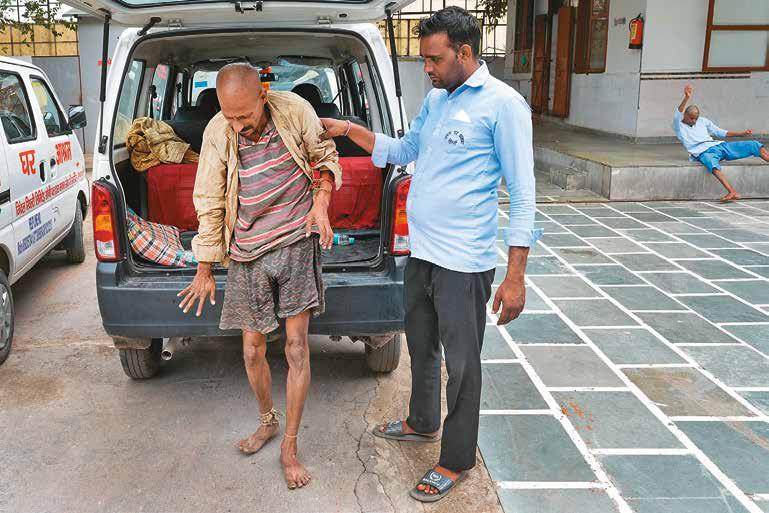
Life on the streets is full of hostility and abuse. Violence and humiliation are the norm. A large number of destitute people are compelled to live on the streets as homeless. Several of these people suffer from mental health issues. Many develop mental illness due to the abuse, trauma and neglect they experience regularly when living in destitution while many end up on the streets as the result of the abandonment they face after falling ill. Every homeless person lives with high vulnerability to exploitation, uncertainty and hurt.
If the homeless are vulnerable, even more vulnerable are those with mental illness. Still higher at risk are those mentally ill homeless persons who are caught under the Beggary Law. While the Beggary Law is amongst the most draconian legislations we have, the severity increases manifold in the context of mental illness.
At present, more than 20 states and two Union Territories have anti-beggary laws. The features of these anti-beggary laws in different states are more or less similar. Broadly speaking, all criminalise destitution (poverty), where people, irrespective of their physical, economic and psychological conditions are arrested and punished for begging. The conditions that are classified as 'beggary' are also almost identical.
Let us understand this by examining some of the key provisions of the Bombay Prevention of Begging Act, 1959 (BPBA), especially in the context of mental health and persons with mental illnesses.
Amongst the most draconian and outlived legislations, the Beggary Law does not recognise the conditions or circumstances that push people towards destitution. There are historical realities like the exclusion faced by certain communities such as de-notified tribes, transpersons, people affected with leprosy or those with mental health conditions that are not acknowledged by the law, while bringing these populations within the ambit of the law.

This story is from the October 11, 2025 edition of Outlook.
Subscribe to Magzter GOLD to access thousands of curated premium stories, and 10,000+ magazines and newspapers.
Already a subscriber? Sign In
MORE STORIES FROM Outlook

Outlook
'Why GDP Growth Doesn't Always Translate Into Votes'
The recent election results have once again shown that economic growth alone does not guarantee electoral victory.

3 mins
June 06, 2026

Outlook
Lights, Camera, Othering
The establishment of Israel has been accompanied by a national cinema devoted to negating and erasing the Palestinian Other
5 mins
June 06, 2026

Outlook
Goodbye to All That
Booker-winning British author Julian Barnes' Departure(s) is a unique hybrid work: playful, philosophical, whimsical
4 mins
June 06, 2026

Outlook
Collapse of Trust
As the NEET-UG 2026 paper leak forced the cancellation of India’s biggest medical entrance exam, more than 22 lakh aspirants find themselves trapped in uncertainty
11 mins
June 06, 2026

Outlook
NO LONGER A TWELFTH MAN
Bihar cricket, which has languished in the shadows for long, is all set to improve its strike rate, thanks to Vaibhav Sooryavanshi, the new Bihari kid on the block
5 mins
June 06, 2026

Outlook
BLAZE OF GLORY
The challenges of being a celebrity cricketer at a young age can be tough to handle
5 mins
June 06, 2026

Outlook
THE SWASHBUCKLERS
A new generation of fearless stars is emerging and finding its feet at the very top of an extremely competitive cricketing environment
5 mins
June 06, 2026

Outlook
THE TEEN TORNAD
At the age of 15, Vaibhav Sooryavanshi is already a cricketing legend
10 mins
June 06, 2026

Outlook
A Journey to Remember
The prerecorded message crackled over the din in the compartment: ‘Welcome to the Shatabdi Express.
4 mins
June 06, 2026

Outlook
Crossing Borders
Ruth Martin is the translator of German-Iranian author Shida Bazyar’s novel The Nights are Quiet in Tehran (originally written in German), which has been shortlisted for the 2026 International Booker Prize.
4 mins
June 06, 2026
Listen
Translate
Change font size