Try GOLD - Free
Boys Can Cry
Outlook
|April 21, 2025
We need to create safe spaces at schools and homes where frank conversations can happen without judgement

IN June 2021, as the pandemic forced the world into virtual mode, as WhatsApp, Snapchat, TikTok and Instagram became our interface not just for human interactions but also for knowledge and information sharing, I gave birth to a beautiful boy. When I held my baby in my arms, I whispered, “I have no idea, absolutely no idea about how to raise you. About how to be the parent you deserve.” You see, I come from a family of girls. We are two sisters, my mom also has only sisters, and my sister too has only daughters. As a girl born and raised in patriarchal India, and as a journalist turned gender-rights activist, I knew what to tell my daughter. I knew how to prepare her to take on a sexist and misogynistic world. But a son! Those three letters were unknown territory to me.
Fast forward to March 2025, and I found myself gripped with that same fear, rather exponentially, as I sat watching the Netflix series Adolescence. As Jamie sat shaking and crying in the police van, asking for his dad, I imagined my son there. When the polite and shy 13-year-old suddenly changed character and shouted at his therapist in a burst of rage, I tensed up. My son is only about three now. But on a daily basis, he interacts with a world that tells him he has privilege because he is a male. And this signals to him that his emotions should be suppressed because “strong boys don’t cry”, which creates a false sense of entitlement in him with the message—“you can grab what you want without consent”. I worried about my baby boy. When he chose a pink yoga mat at gymnastics, he was told, “Arrey yeh toh ladkiyan use karti hai...tu toh ladka hai” (Girls use this...You are a girl). When he wore a bindi, he was asked, “Arrey, ab chudiyan bhi pehnoge kya?” (Will you wear bangles too?)
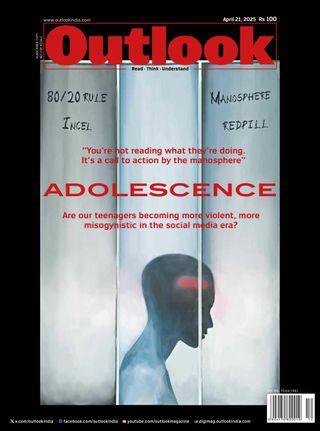

This story is from the April 21, 2025 edition of Outlook.
Subscribe to Magzter GOLD to access thousands of curated premium stories, and 10,000+ magazines and newspapers.
Already a subscriber? Sign In
MORE STORIES FROM Outlook

Outlook
Get the Right Partner
The broking industry is now in a price-war phase, but cost is no longer the key differentiator. The choice will depend on how you plan to use a broking platform

4 mins
July 06, 2026

Outlook
Balanced Fertilizer Push for India
As India faces fertilizer import shocks; Deepak Shah, Chairman of CCFI calls for shift to high NUE solutions for food security and growth.
2 mins
July 06, 2026

Outlook
India’s Anaemia Paradox
From disputed estimates to hidden causes, India’s anaemia story is entering a new phase, one that could reshape how the country understands and addresses a condition affecting millions
5 mins
July 06, 2026

Outlook
Record Placements Anchor PIMR Legacy
Prestige Institute of Management and Research, Indore (Deemed to be University): Anchoring Three Decades of Academic Vanguard and Frontier Leadership
3 mins
July 06, 2026

Outlook
Clinical Excellence in High precision Radiation Therapy
Driven by the conviction that healing begins with humanity, radiation oncologist Dr. Amit Jain has impacted countless lives
2 mins
July 06, 2026

Outlook
A Paradise Worth Protecting
Ancient rainforests, endemic and rare mammals, birds and reptiles, exotic species of trees, breathtaking corals and indigenous tribes... Great Nicobar is home to all this and a lot more
5 mins
July 06, 2026

Outlook
Your Future Starts Here
Adichunchanagiri University (ACU), nurturing visionary thinkers, global leaders, and bold entrepreneurs who are ready to drive impact in a fast-evolving digital economy
3 mins
July 06, 2026

Outlook
Building a Sustainable Airport Ecosystem in Bengaluru
At Kempegowda International Airport Bengaluru (BLR Airport), sustainability is a guiding philosophy shaping infrastructure, operations, growth, resilience and workplace culture.
4 mins
July 06, 2026

Outlook
Intelligent Imaging for Smarter Healthcare
Dilip Bhosale, shares with Outlook, how Agfa Radiology Solutions is leveraging advanced digital technologies, workflow automation and global expertise to shape the future of diagnostic imaging in India in conversation with Aditi Chakraborty
2 mins
July 06, 2026

Outlook
Advancing the Future of Oncology in Eastern India
A champion of accessible and patient-centred cancer care, Dr Soma Mukhopadhyay is leading NCRI Hospital towards new standards of excellence in oncology
2 mins
July 06, 2026
Listen
Translate
Change font size