
Go Unlimited with Magzter GOLD
Get unlimited access to 10,000+ magazines, newspapers and Premium stories for just
Try GOLD - Free
The Two-Step Process of COIN CERTIFICATION: Authentication & Grading are the Keys
COINage Magazine
|February - March 2023
For a coin to be certified, it has to be both authenticated and graded. Certification by a grading service is a two-step process.

First step: The coin has to be determined to be genuine and unaltered. Second step: The coin has to be graded or rated on a scale of one through 70, where one is the lowest and 70 is perfect.
Fake, altered or doctored coins were a major coin market danger in the late 1970s and early 1980s before the advent of third-party grading services. Grading services were designed to assist consumers in differentiating between high-quality coins where the difference in value between one coin with a small scratch and its counterpart without a scratch could have a multi-thousand-dollar value differential.
Since grading services guaranteed that the coins they graded were genuine, these services had the effect of basically ridding the coin hobby of fake coins. After all, not only does a grading service have to warrant that the coin it’s certifying is genuine, but it has to make that determination definitively before grading it. Grading a fake coin just isn’t an option.
COIN ALTERATIONS
An altered coin is a real coin that has been tampered with in some way. The uncertified coins for sale that have the greatest risk of being altered are coins with rare dates and mint marks that are in high demand.
The popular 1909-S V.D.B. Lincoln cent is one example of a rare-date coin occasionally found altered. The V.D.B. is the designer’s initials, Victor David Brenner, seen on the coin’s reverse. The “S” mint mark seen on the front or obverse under the date stands for San Francisco.
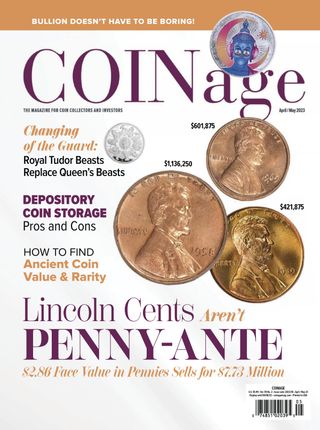

This story is from the February - March 2023 edition of COINage Magazine.
Subscribe to Magzter GOLD to access thousands of curated premium stories, and 10,000+ magazines and newspapers.
Already a subscriber? Sign In
MORE STORIES FROM COINage Magazine
COINage Magazine
TOP 6 TIPS FOR BIDDING IN COIN AUCTIONS
for coins.

8 mins
April / May 2026

COINage Magazine
Silver Rumors Addressed
No Proposal to Lower Reporting Threshold
1 mins
April / May 2026
COINage Magazine
MORGAN SILVER DOLLAR REFLECTIONS
Deep Mirror Prooflike Coins Dazzle
3 mins
April / May 2026

COINage Magazine
Sailing Into the Semiquincentennial
JOEL ISKOWITZ DESIGNED MEDAL FOR SAIL4TH 250
4 mins
April / May 2026
COINage Magazine
WHAT IF AN OUNCE OF SILVER HIT $5,000?
VOLATILITY OF THE WHITE METAL
8 mins
April / May 2026

COINage Magazine
Top 6 Tips for Bidding in AUCTIONS COIN
HOW YOU CAN BECOME A SAVVY AUCTION BUYER
14 mins
April / May 2026

COINage Magazine
SHANNON RAJKITKUL THE NEW PARADIGM
Shannon Rajkitkul is the founder and owner of Paradime Coins, a specialized rare-coin firm dedicated to the acquisition, curation and placement of premium certified United States coinage, with particular emphasis on CAC-approved material.
3 mins
April / May 2026
COINage Magazine
COINage Resource List of Rare-Coin Auctioneers*
1 min
April / May 2026
COINage Magazine
Stack's Bowers Galleries Saw Record-Shattering $325 Million Year of Auctions in 2025
Following a record-breaking 2024, legendary numismatic firm Stack's Bowers Galleries was pleased to announce that 2025 was another banner year for the company.
1 min
April / May 2026
COINage Magazine
Is Investing in Rare Coins the Right Move?
GOLD & SILVER BUYERS WANT RARITIES
5 mins
April / May 2026
Translate
Change font size