
Go Unlimited with Magzter GOLD
Get unlimited access to 10,000+ magazines, newspapers and Premium stories for just
Try GOLD - Free
beyond TRADITION
Hobby Farms
|July - August 2024
Raise these alternative animals on your hobby farm.

Climate and market changes mean hobby farmers need to proactively diversify their revenue streams. One way to do that is to add alternative livestock to your farming practices.
Before selecting any livestock addition, do your homework to learn more about the animals, their care requirements, shelter, fencing and veterinary needs. You may want to explore the investment it will take to become involved as well as whether you will need special licenses or permits.
If you’re alternative livestock curious, take a look at these options.
DONKEYS
Highly intelligent, generally gentle and sociable, versatile and easy to maintain. Donkeys offer benefits to hobby farms as guardians or companion animals for small herds or flocks. Trained, they can be ridden, handled for 4-H or put to work in therapeutic roles on behalf of complex human conditions such as autism and Asperger’s.
CARE & FEEDING: Donkeys thrive on a high fiber, low protein diets obtaining most of their nutrition from a variety of mixed woody shrubs and grasses. Efficient digestion means these animals only require 6 pounds of forage per day. Overall, they need 1⁄2 acre per animal is for grazing. (Caution: Lawn cuttings and unboiled linseed is toxic to donkeys in addition to moldy foodstuffs. It’s important to research your local plants prior to adding a donkey or donkeys to your operation.)
VETERINARY CARE: Donkeys typically follow the same vaccination schedule as other equine which varies depending upon locale. They are susceptible to the same illness that affect horses including equine herpes virus, strangles, rabies, tetanus and African horse sickness. They will need annual dental care as well as hoof trimming by a farrier.
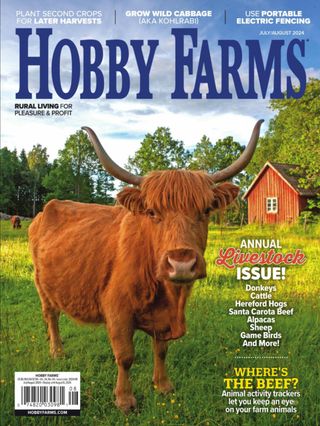

This story is from the July - August 2024 edition of Hobby Farms.
Subscribe to Magzter GOLD to access thousands of curated premium stories, and 10,000+ magazines and newspapers.
Already a subscriber? Sign In
MORE STORIES FROM Hobby Farms
Hobby Farms
AN HERB TO AVOID IN WINTER
While many culinary herbs are beneficial in winter, some members of the mint family are best to avoid when temperatures dip below 40 degrees Fahrenheit.

1 min
Healthy Hens 2026
Hobby Farms
Golden Girls
Discover some of the most overlooked health issues in aging hens.
6 mins
Healthy Hens 2026
Hobby Farms
Winter Tea Supplement
Several years ago, I noticed that while my healthy hens were robust during the growing season, their health declined a little during winter when they weren’t regularly consuming herbs or other greens.
2 mins
Healthy Hens 2026
Hobby Farms
Cool CHOOKS
Most chicken breeds are pretty hardy, but you can still make them more comfortable by offering them some escape from the summer heat.
7 mins
Healthy Hens 2026

Hobby Farms
Feeding Fowl
What you feed, how you supplement and when you treat will make all the difference for your chickens.
10 mins
Healthy Hens 2026
Hobby Farms
Egg-Eating Hens
Egg-eating hens can be a frustrating and costly problem for backyard chicken-keepers.
6 mins
Healthy Hens 2026

Hobby Farms
Potent PREDATORS
Take precautions, as these 15 marauders can wipe out an entire flock.
12 mins
Healthy Hens 2026
Hobby Farms
15 TOXIC PLANTS
Don't let your chickens eat these common plants.
6 mins
Healthy Hens 2026
Hobby Farms
BUG Off!
Bugs, who needs 'em? Certainly not chicken-keepers, who sometimes struggle to keep pesky flies and poultry parasites at bay.
7 mins
Healthy Hens 2026
Hobby Farms
ALPHA Hens
With or without a flock rooster, one lady always steps up to be the queen.
7 mins
Healthy Hens 2026
Listen
Translate
Change font size