Try GOLD - Free
MQTT in the Real World
Circuit Cellar
|October 2025
Migrating Legacy Protocols to MQTT

MQTT is an OASIS standard messaging protocol for the Internet of Things. This lightweight protocol can simplify and improve messages between IoT components that started out using different languages.
Many industrial systems still rely on Modbus, OPC-DA, Profibus, and other legacy fieldbus protocols. While these protocols have served industry well, they present limitations in flexibility, scalability, and cloud integration.
MQTT serves as a bridging solution, enabling seamless migration from legacy systems without requiring complete infrastructure overhauls. Gateways or protocol converters are deployed at the edge to translate legacy data formats into MQTT messages, which are then published to centralized brokers or cloud platforms.
A manufacturing plant uses SCADA with Modbus TCP, integrated with MQTT as a wrapper layer. By employing an edge gateway with Modbus-to-MQTT translation, they maintained existing PLCs while transmitting real-time data to a cloud analytics platform, as shown in Figure 1. This enabled the operations team to monitor key parameters remotely while gradually phasing out the legacy system.
The publish-subscribe nature of MQTT enables decoupling between devices and applications, paving the way for sustainable modernization. This transition approach reduces downtime and risks while allowing gradual integration of AI, ML, and advanced analytics.
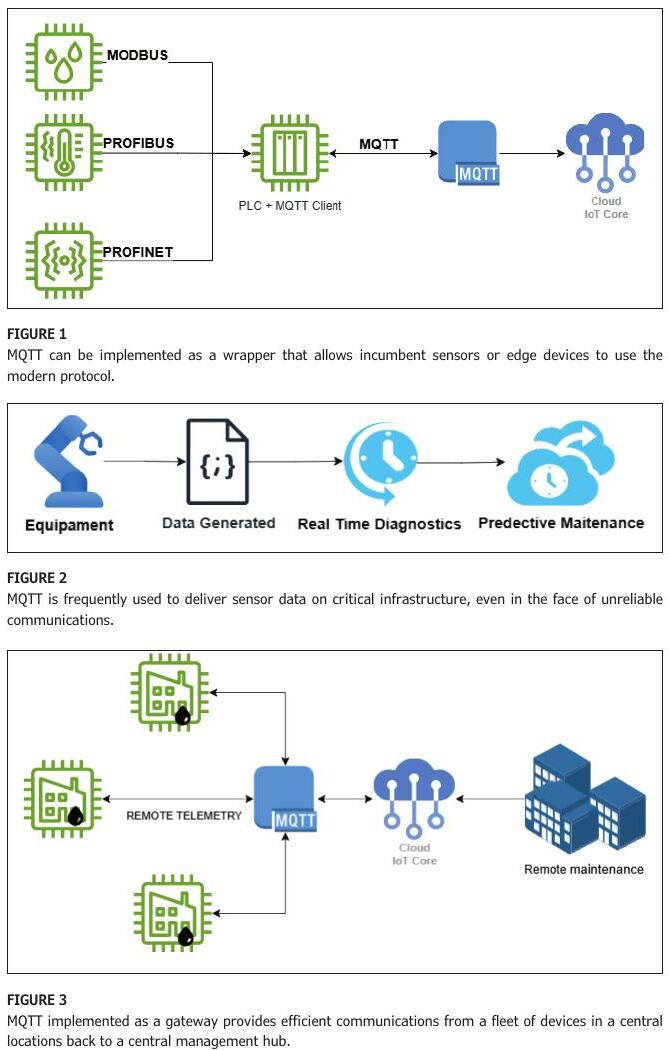 REAL-TIME DIAGNOSTICS
Traditional diagnostic methods in industrial settings often depend on periodic polling or manual inspection. These approaches are inefficient, particularly when uptime is critical. MQTT provides a lightweight, event-driven alternative that enables continuous data flow for real-time diagnostics.


This story is from the October 2025 edition of Circuit Cellar.
Subscribe to Magzter GOLD to access thousands of curated premium stories, and 10,000+ magazines and newspapers.
Already a subscriber? Sign In
MORE STORIES FROM Circuit Cellar
Circuit Cellar
Vishay Intertechnology Automotive-Grade Optocouplers Deliver High Isolation Voltage Ratings and Distance for EVs and Solar Inverters
Vishay Intertechnology, Inc. introduced two new Automotive-Grade optocouplers with phototransistor output in a widebody package featuring a comparative tracking index (CTI) of 600.

1 min
July 2026

Circuit Cellar
WWVB Timecode Generator A Tool for Testing Radio-Controlled Clocks
In this article, Robert describes how he built a timecode generator that provides simulated code from WWVB, a radio station operated by the National Institute of Standards and Technology, which is used to synchronize millions of radio-controlled clocks.
16 mins
July 2026

Circuit Cellar
MCUs at the Heart of the Edge Modern MCUs Go Beyond Simple Process Control
Microcontroller Units (MCUs) are the power at the heart of modern embedded systems.
2 mins
July 2026

Circuit Cellar
650V ICeGaN Device for Automotive Applications from CGD Helps Increase EV Range
Cambridge GaN Devices (CGD) has developed a 650V GaN IC for automotive applications that addresses automakers' desires to improve inverter efficiency.
1 min
July 2026

Circuit Cellar
Blues Latest IoT Modules Notecard for Skylo and Notecarrier CX
Satellite comms for IoT projects may seem the domain of enterprise customers, but new modules from Blues can bring satellites within reach even for small professional and research projects.
22 mins
July 2026

Circuit Cellar
Rust: An Embedded Lightning Rod Nothing Is Quite as It Seems
Linus Torvald’s release of Linux 7.0 announced the finalization of Rust-related projects in the kernel: From now on, the programming language is to be considered a first-class member of Linux.
10 mins
July 2026
Circuit Cellar
PLS' Debug and Trace Tool UDE Supports ST's Stellar P3E Automotive Microcontroller
The debug, trace, and test tool UDE Universal Debug Engine from PLS Programmierbare Logik & Systeme, has expanded its support to encompass the Stellar P3E.
2 mins
July 2026

Circuit Cellar
The Tireless Intern: LLM Coding Agents for Embedded Work Using AI Speeds Security Tooling
This article discusses a case study of using a large language model (LLM) to develop a tool for embedded security, that would have otherwise taken several weeks (or months) of effort in a few days.
10 mins
July 2026

Circuit Cellar
IoT Infrastructure: On-Premises Deployment or Cloud Solution?
Designing an IoT system is not only about sensors and dashboards.
5 mins
July 2026

Circuit Cellar
Signal-to-Noise Ratio for Voice Activity Detection Devices
Users needs to be able to give AI glasses voice commands and be sure the device is only picking up their speech, not other sounds.
4 mins
July 2026
Listen
Translate
Change font size