Try GOLD - Free
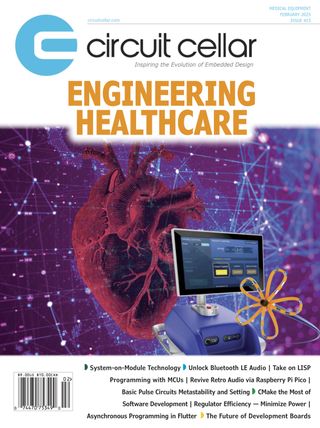
Engineering Healthcare - Cutting-Edge Technologies to Enhance Patient Care
Circuit Cellar
|February 2025
Explore the groundbreaking advancements in Pulsed Field Ablation technology, where engineering meets cardiac care to revolutionize atrial fibrillation treatment. This article delves into the intricate design and functionality of cutting-edge devices that enhance precision and safety in medical procedures, showcasing the vital role electronics play in shaping the future of healthcare.

Medicine has always depended on the best technology of its time. From the flint tools used for trepanation of human skulls 10,000 years ago to the modern advancements in 3D printing of organs and tissues through stem cell research, it is the progress in science and technology that has saved countless lives. Today, the integration of electronic systems is an essential part of medicine at all levels, from diagnosis to treatment both in and out of the hospital. The heart itself runs off of electrical conductive signals, and the monitoring of these via EKGs has long been a common practice in patient monitoring. While this monitoring may be easily achieved through the unobtrusive placement of conductive stickers, the treatment of disruptions to this conduction is a more complicated matter. New technology known as Pulsed Field Ablation, made possible through advancements in electrical engineering, seeks to treat one of these disruptions, and has shown remarkable promise. Through improvements in catheter ablation technology, and real-time mapping technology, Pulsed Field Ablation technology is overtaking traditional methods such as thermal ablation in the treatment of atrial fibrillation, with its improved safety and efficiency.
ATRIAL FIBRILATION
Atrial fibrillation is a dysrhythmia of the atriums of the heart caused by rapid or irregular electrical activity (

This story is from the February 2025 edition of Circuit Cellar.
Subscribe to Magzter GOLD to access thousands of curated premium stories, and 10,000+ magazines and newspapers.
Already a subscriber? Sign In
MORE STORIES FROM Circuit Cellar
Circuit Cellar
Vishay Intertechnology Automotive-Grade Optocouplers Deliver High Isolation Voltage Ratings and Distance for EVs and Solar Inverters
Vishay Intertechnology, Inc. introduced two new Automotive-Grade optocouplers with phototransistor output in a widebody package featuring a comparative tracking index (CTI) of 600.

1 min
July 2026

Circuit Cellar
WWVB Timecode Generator A Tool for Testing Radio-Controlled Clocks
In this article, Robert describes how he built a timecode generator that provides simulated code from WWVB, a radio station operated by the National Institute of Standards and Technology, which is used to synchronize millions of radio-controlled clocks.
16 mins
July 2026

Circuit Cellar
MCUs at the Heart of the Edge Modern MCUs Go Beyond Simple Process Control
Microcontroller Units (MCUs) are the power at the heart of modern embedded systems.
2 mins
July 2026

Circuit Cellar
650V ICeGaN Device for Automotive Applications from CGD Helps Increase EV Range
Cambridge GaN Devices (CGD) has developed a 650V GaN IC for automotive applications that addresses automakers' desires to improve inverter efficiency.
1 min
July 2026

Circuit Cellar
Blues Latest IoT Modules Notecard for Skylo and Notecarrier CX
Satellite comms for IoT projects may seem the domain of enterprise customers, but new modules from Blues can bring satellites within reach even for small professional and research projects.
22 mins
July 2026

Circuit Cellar
Rust: An Embedded Lightning Rod Nothing Is Quite as It Seems
Linus Torvald’s release of Linux 7.0 announced the finalization of Rust-related projects in the kernel: From now on, the programming language is to be considered a first-class member of Linux.
10 mins
July 2026
Circuit Cellar
PLS' Debug and Trace Tool UDE Supports ST's Stellar P3E Automotive Microcontroller
The debug, trace, and test tool UDE Universal Debug Engine from PLS Programmierbare Logik & Systeme, has expanded its support to encompass the Stellar P3E.
2 mins
July 2026

Circuit Cellar
The Tireless Intern: LLM Coding Agents for Embedded Work Using AI Speeds Security Tooling
This article discusses a case study of using a large language model (LLM) to develop a tool for embedded security, that would have otherwise taken several weeks (or months) of effort in a few days.
10 mins
July 2026

Circuit Cellar
IoT Infrastructure: On-Premises Deployment or Cloud Solution?
Designing an IoT system is not only about sensors and dashboards.
5 mins
July 2026

Circuit Cellar
Signal-to-Noise Ratio for Voice Activity Detection Devices
Users needs to be able to give AI glasses voice commands and be sure the device is only picking up their speech, not other sounds.
4 mins
July 2026
Listen
Translate
Change font size