Try GOLD - Free
THE MAGIC OF “MAFALDA”
The New Yorker
|July 07 - 14, 2025 (Double Issue)
How an Argentinean comic strip became an international phenomenon.
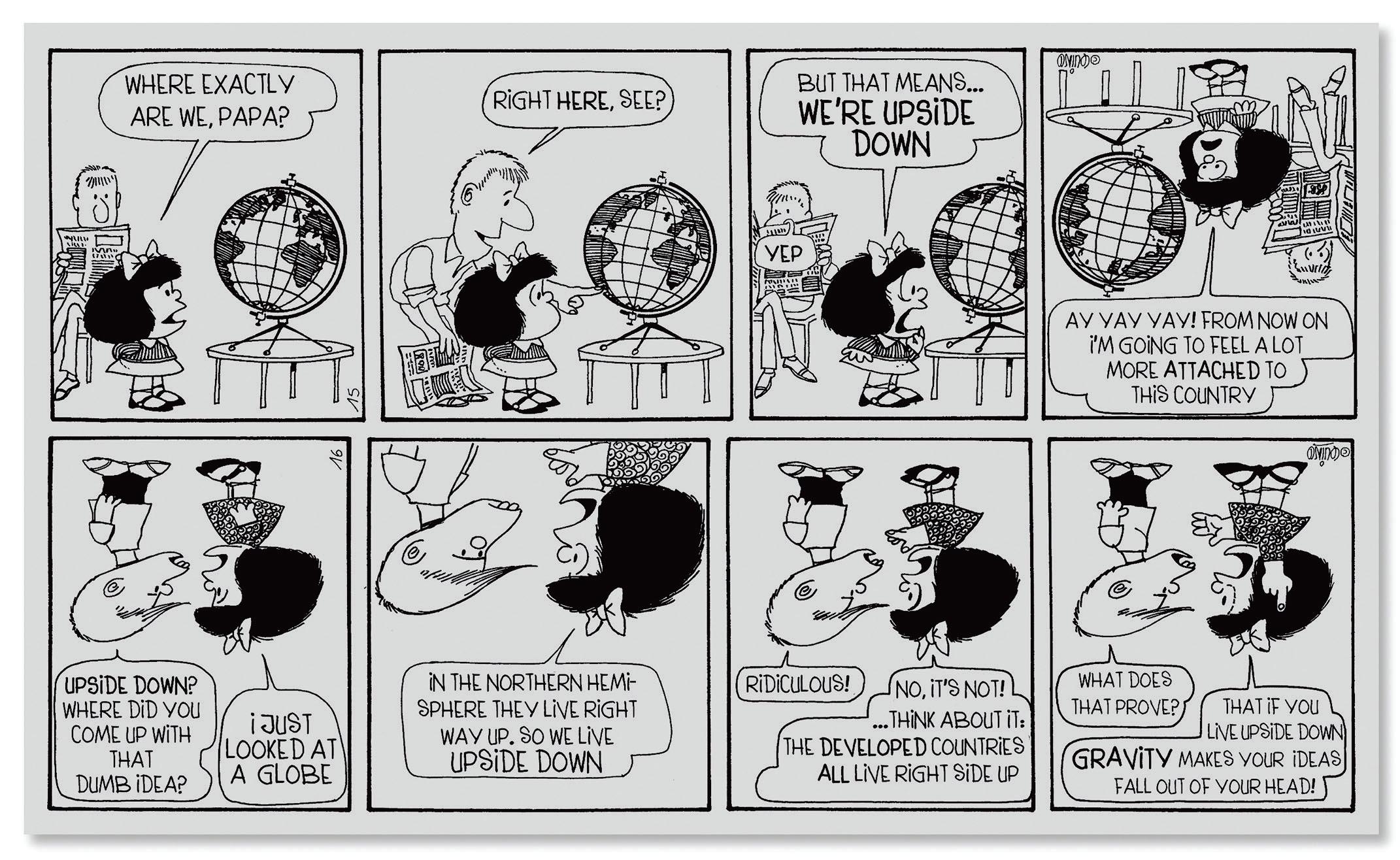
A uniformed police officer stands sideways, his head turned to face us. His eyes are unnaturally close together, rendered by the artist as two black dots floating in the very center of his face. He has a drooping nose, a thin mustache, and a glum look, staring as if he is aware of being watched. Behind him stands a little girl, less than half his size, wearing a red dress, a red bow poking from the thicket of her heavy black hair. Her eyes are big and sad, and her index finger touches the tip of the nightstick hanging from the policeman’s belt. “You see?” she says, with a worried expression. “This is the little stick for squashing ideologies.”
I probably first saw this image in the nineteen-eighties—taped to the wall of a cousin’s bedroom in Lima, perhaps, or hanging on the side of a newspaper kiosk—but I already knew who the little girl was. In fact, I can’t recall a time in my life when I didn't know her. “Mafalda,” the comic strip in which she appeared, was published in Argentina from 1964 to 1973, and remained a cultural touchstone for Latin Americans of every generation thereafter. At one point, Mafalda and Eva Perón were the two most recognizable Argentinean women worldwide. “Mafalda” has been translated into more than twenty-five languages, and tens of millions of books have been sold in Spanish alone, making it the best-selling Latin American comic of all time.
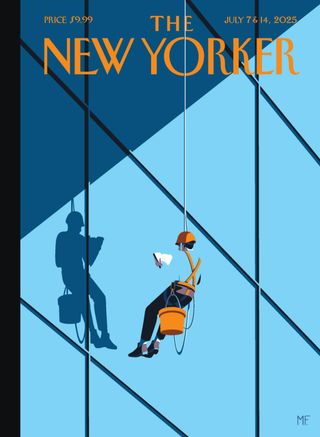

This story is from the July 07 - 14, 2025 (Double Issue) edition of The New Yorker.
Subscribe to Magzter GOLD to access thousands of curated premium stories, and 10,000+ magazines and newspapers.
Already a subscriber? Sign In
MORE STORIES FROM The New Yorker
The New Yorker
CONTRIBUTORS
Eliza Griswold (\"Young Americans,\" p. 12) is a contributing writer.

1 mins
June 29, 2026

The New Yorker
THE READERS
Early in my treatment, we decided that you wouldn't read my work.
24 mins
June 29, 2026

The New Yorker
URBAN LEGEND
Closing out a crime trilogy about a changing New York, Colson Whitehead excavates his own foundations.
33 mins
June 29, 2026
The New Yorker
ABOUT TOWN
POST-ROCK | Last year, the Chicago instrumental post-rock band Tortoise returned with \"Touch,\" its first album in nearly a decade, the further explorations of an inquisitive nature.
3 mins
June 29, 2026

The New Yorker
GOINGS ON JUNE 24-30, 2026
What we're watching, listening to, and doing this week.
1 min
June 29, 2026
The New Yorker
LONGING FOR ITHACA
There’s a reason Homer’s homecoming epic has long defeated the directors.
16 mins
June 29, 2026

The New Yorker
HOT PURSUIT
The repo man coming for your ride.
35 mins
June 29, 2026
The New Yorker
WILD THINGS
Why do animals have sex, anyway?
14 mins
June 29, 2026

The New Yorker
PRICKLY PAIRS - “The Invite.”
“The Invite” begins with an aphorism: “One should always be in love.
6 mins
June 29, 2026
The New Yorker
BRAVE NEW WORLD DEPT.INSTANCING
Wednesday evenings at Hex&Co., board-game café and bar in Morningside Heights, are dedicated to \"RPG Encounters,\" in which fans of role-playing games gather to create collaborative stories over espresso drinks.
3 mins
June 29, 2026
Listen
Translate
Change font size