
Go Unlimited with Magzter GOLD
Get unlimited access to 10,000+ magazines, newspapers and Premium stories for just
Try GOLD - Free
PROJECT
The New Yorker
|September 1- 8, 2025 (Double Issue)
A little while ago, I told the actor M that I was thinking of writing her autobiography. She liked the idea. She's a good sport. Would you just make it up? she said.
We had met in a bookstore. She was interested in books. In addition to being a film star, she was the model for a popular brand of face cream, and her image looked out everywhere, from shop windows and hoardings and the rain-streaked Perspex of bus shelters. In the photograph, she appeared very young and happy. Her smile had a sweetness that almost seemed to reproach those who looked at it for their dim and suspicious view of life.
She lived in a large house on the other side of the river. In person, she was very small, and the house was like a big doll's house, with her as the doll inside it.
We knew a couple of people in common. One of them told me a funny story about a dinner they'd attended at a restaurant, where M's bodyguard had insisted that she change places with another film star, who was older and less famous, because he was worried that M's position at the table exposed her to danger.
It was hard not to feel ugly next to M. Part of it was the ugliness of experience. I had never learned how to make experience easier for myself. For M it was the reverse. Her difficulty lay in her distance from the random violence of insignificance. Personally, I felt saturated with that violence. All my life it had been made clear to me how unimportant I was. M and I both secretly felt that it was the ways in which we had been damaged that had given us our power.
It was autumn, and the city became inexorably colder and wetter and grayer. In the face-cream advertisement, M remained wreathed in the pink flowers of spring.
On sunny mornings, people ran beside the river, men and women running past like gods in the sun, tall with dazzled eyes and windswept hair. Other men and women lived in tents beneath the stone bridges and brushed their teeth in the water fountains. Sometimes their shoes could be seen, placed neatly side by side outside the tent's zipped entrance.
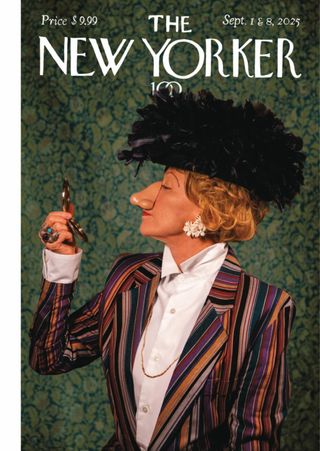

This story is from the September 1- 8, 2025 (Double Issue) edition of The New Yorker.
Subscribe to Magzter GOLD to access thousands of curated premium stories, and 10,000+ magazines and newspapers.
Already a subscriber? Sign In
MORE STORIES FROM The New Yorker

The New Yorker
A WEB OF ABUSE
Andrew Tate became a global celebrity—and a political force—by systematically exploiting women.

79 mins
June 15, 2026
The New Yorker
BLOOD FROM A STONE
How Edmonia Lewis changed nineteenth-century sculpture.
11 mins
June 15, 2026

The New Yorker
TICKS TO FEAR THIS SUMMER
Gray-Legged Tick - Physically resembling a crossbreed of a gremlin and Stephen Miller’s soul, the Gray-Legged Tick can be found wherever it is even moderately interesting to vacation in the Northeast.
2 mins
June 15, 2026

The New Yorker
HAPPY CAMPERS
“Can I Be Frank?” and “Heated Rivalry: The Unauthorized Musical.”
6 mins
June 15, 2026

The New Yorker
SILENCE, PLEASE
For people with misophonia, everyday sounds can be agony.
18 mins
June 15, 2026
The New Yorker
NO VACANCY
Could Switzerland be the first country to cap its population?
21 mins
June 15, 2026
The New Yorker
SURF AND TURF
World-class sushi in Omaha, Nebraska.
7 mins
June 15, 2026

The New Yorker
Constellation
When I think of the free time my mother spent with my father, in our small town outside Turin, this is the scene I usually picture: she’s on the couch, working through La Settimana Enigmistica, a weekly word-puzzle magazine, while he reads a book.
17 mins
June 15, 2026

The New Yorker
THE ANTAGONIST
It took me a few tries to find my mother on Google in 2017.
3 mins
June 08, 2026
The New Yorker
CARTE BLANCHE
Maggie O'Farrell and the art of inventing the past.
6 mins
June 08, 2026
Listen
Translate
Change font size